
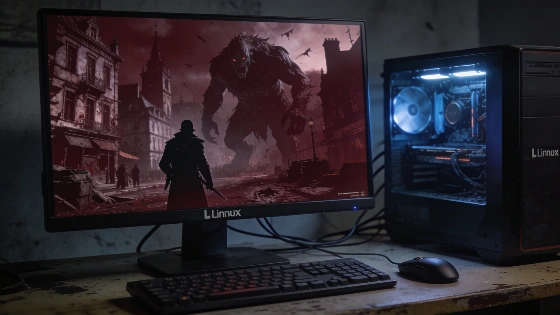
An unofficial Linux port now runs Bloodborne without a general emulator and adds graphics controls and modern upscaling options. bbport 0.3 supports Linux and Steam Deck, but it is not an official or finished PC release.
Bloodborne has reached PC in the form fans have wanted, but not through an official release. An unofficial native port now runs the original PlayStation 4 executable directly on an x86-64 Linux PC. Players do not need a general emulator, and the port adds graphics controls that the console version never had. The project released bbport 0.3 on October 6, 2026, according to its GitHub release information. Users must still provide their own Bloodborne files.
A native Linux build
The project is called bbport. It needs the original game files.
Instead of emulating the entire PlayStation 4, bbport provides a compact runtime that replaces the system libraries Bloodborne calls. The game's own x86-64 code runs directly on the computer. Its graphics workload is translated to Vulkan through technology derived from shadPS4.
That difference matters. shadPS4 is a broad PlayStation 4 emulator designed to support many games. bbport has a much narrower target. It supports Bloodborne version 1.09 and the CUSA03173 release. It implements only the operating-system functions this game needs, including memory, threads, synchronisation, files, audio, controller input, saves and application content. The project's GitHub README describes it as a custom runtime, not a universal PlayStation 4 emulator.
The port is therefore not a general PlayStation 4 compatibility layer. It is built around one title and one executable. The original decrypted game files are still required. The available project material does not confirm official participation by Sony Interactive Entertainment or FromSoftware.
What the port adds
The biggest change is not only the move from emulation to native execution. bbport includes an in-game settings menu. Players can change upscalers, output resolution and graphics presets without editing configuration files by hand. The menu also includes controls for depth of field, motion blur and screen-space ambient occlusion.
The graphics stack still uses the shadPS4 renderer and shader recompiler. bbport adds substantial game-specific work around them. Its renderer separates draw preparation into stages, caches render states and texture sets, supports render-scale proxies and records motion vectors for temporal upscaling.
The bbport 0.3 release description lists AMD FSR 3.1, FSR 4 and FSR 4.1.1 as available temporal upscaling options. These features belong to the port's graphics stack. They are not features of the original PlayStation 4 version of Bloodborne.
The project also targets a known bottleneck in Bloodborne's emulation path. In shadPS4, one thread processes the complete command stream. bbport separates command decoding from draw recording, allowing the workload to use more of the host machine's hardware threads, including on Steam Deck.
That is an architectural difference, not a promise of a specific frame rate. The supplied material does not include independent performance measurements.
The evidence and limits
The technical description names the exact target: CUSA03173 running game version 1.09. It says the custom loader and runtime total roughly 5,000 lines of code. The graphics core includes about 200 marked changes, along with new rendering modules.
Community patches for render resolution, effects and frame rate are compiled when the launcher starts. They are not applied as external emulator patch files.
HobbyConsolas reports that the fan project runs on Linux and Steam Deck. It provides 30, 60 and 90 FPS modes, along with its own resolution, scaling and image settings. Those are project modes, not independently verified performance results across different hardware. They also do not make bbport an official PC release.
The figures describe the project's implementation, not finished coverage. The port is not complete across the whole game. Later sections may still contain unresolved problems. The available information does not establish stable frame-rate results, universal hardware compatibility or parity with every feature of the PlayStation 4 release.
That unfinished status is the main qualification. Native execution can reduce the CPU overhead linked to emulation. The added controls are useful. Neither point turns an in-progress community project into a polished commercial PC version.
Players must supply the original game data. The port is currently described specifically for x86-64 Linux, not Windows.
Why it matters
Bloodborne has long been one of the most requested games for PC. Emulation has already made it one of the better-known PlayStation 4 titles to run outside its original hardware.
bbport does not replace that broader emulator. It shows what developers can do when they give up general compatibility and build a runtime around the exact behaviour of one game.
The result is unusually practical for an unofficial project. Players who avoid emulation can access the game through a native Linux executable. Experienced users also get direct control over image quality and post-processing that would otherwise require manual configuration.
The Vulkan renderer, temporal upscaling options and multithreaded command path give the project a technical identity beyond packaging an existing emulator.
Bloodborne now has an unofficial native PC route. It does not have an official PC release or a finished port. Bloodborne officially remains a PlayStation 4 game. The fan project does not change that platform status or represent an announced commercial Windows version from Sony or FromSoftware.
Its strongest achievement is showing that the long-standing platform barrier can be tackled with a purpose-built runtime instead of a complete recreation of the PlayStation 4. Players willing to handle the Linux setup and the remaining risks may find that meaningful. The incomplete coverage is why bbport should still be treated as an evolving technical project, not a definitive version.
Native execution and emulation are different approaches. An emulator recreates a wider system in real time. A native port can replace only the services one game uses.
That narrower route may reduce overhead and allow deeper game-specific features. It also makes the software less flexible and ties its success to the targeted executable. bbport's value lies in that trade-off: more control and potentially leaner execution in exchange for limited scope and unfinished coverage.