
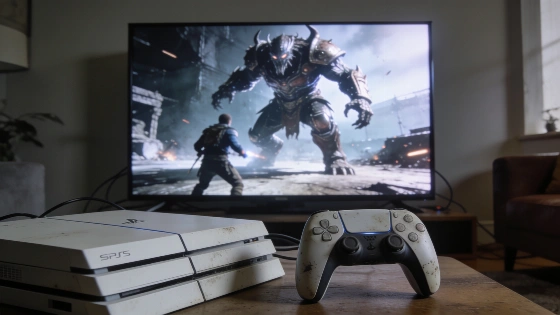
Sony Interactive Entertainment has outlined a machine-learning system that could change NPC behaviour during play by using data from the player. The patent does not confirm a finished feature, working prototype or planned PlayStation release.
A PlayStation patent could give future action-game enemies something fixed movesets are designed to prevent: the ability to change strategy after studying the player. Sony Interactive Entertainment has outlined a machine-learning system that would use encounter data to create new NPC behaviour during a game. That could move enemies beyond one predictable sequence. Sony has not confirmed that it has launched the technology, built it into PlayStation hardware or used it in a released game.
What the patent describes
Sony Interactive Entertainment filed the patent. It was published on October 1 after Patentlyze identified it. The proposal covers a system that collects player data and game data from an encounter between a player and an NPC. That material then goes into a machine-learning model.
According to the patent description, the collected information is used to prepare the model's input and obtain new NPC content. The available reporting describes a proposed system, not a working prototype.
The model could create NPC content that changes behaviour, dialogue, appearance or other parts of a game. The patent does not name one model architecture, a generative AI service or an exclusive Sony technology. As Wccftech reports, its wording does not show that the system depends on a particular machine-learning model. It also does not say that the technology must come from PlayStation's own studios.
At its simplest, the process has four stages. The system records the interaction. It prepares input data for the model. The model generates NPC content. The game applies the resulting changes.
That describes a technical pipeline. It does not show that a released PlayStation game already uses it. The Sony Interactive Entertainment patent description is the relevant primary source for the proposed pipeline, but it does not establish a product roadmap.
Why Soulslikes fit
Soulslikes would be an obvious test case because their combat is built around recognition. Players learn an enemy's attacks, find safe openings, manage distance and repeat the process until a boss's pattern becomes readable. That structure creates the genre's tension. It also means a powerful enemy can become manageable once the player has mapped its behaviour.
A system that reacts to player habits could change an opponent's approach when the player attacks aggressively, defends from one range or relies on the same punish window. A boss might respond differently to familiar tactics instead of repeating the same scripted sequence every time. These are possible uses of the patent, not behaviours demonstrated by a completed game.
The patent also describes changes to dialogue, appearance and wider game content. In a multi-phase encounter, the idea could let a boss reach a stronger phase sooner when the player applies heavy pressure. That resembles the comeback logic found in fighting games such as Street Fighter V and Street Fighter 6. The patent does not say that either series is involved.
Challenge without cheap numbers
Dynamic behaviour could deal with a familiar difficulty problem more intelligently than simply raising enemy health or damage. A player who has mastered one pattern could face a new tactical problem. A less aggressive player might trigger a different response. The system's appeal would depend on whether those changes stayed clear and fair.
That matters most in a single-player game. If an enemy changes too often or counters every successful tactic at once, the encounter may stop rewarding learning. It could start to feel arbitrary instead. Developers would need firm limits on what the model can change. They would also need safeguards that preserve clear attack tells and reliable chances to respond.
The available information contains no difficulty settings, performance requirements or examples of a completed boss encounter using the system. It does not confirm whether changes would happen locally during play or be produced at another stage of a game's content pipeline.
No verified figures are available for adaptation latency, the volume of collected data, model accuracy, computing requirements, impact on frame rate or a possible implementation date.
A patent is not a product
The October 1 publication shows that Sony Interactive Entertainment documented the concept in a patent. It does not show that the system is in production. It does not show that it will appear in a FromSoftware game. No PlayStation title has been announced around it.
SiliconSnark likewise notes that a patent should not be treated as confirmation of a finished product or guaranteed implementation.
That limits the most dramatic reading of the proposal. Patents describe possible technical approaches. Some ideas never become features that players can use. The narrower signal is that Sony has outlined a way to connect recorded player behaviour with machine-generated NPC content at a time when AI use in games is moving beyond development tools and asset creation.
The publication is part of a wider group of Sony patent applications involving AI and gaming devices. A separate Sony application describes AI-assisted input signals meant to improve accessibility by analysing the timing, duration and character of a player's movements. That parallel accessibility filing does not confirm a connection with the adaptive-NPC system discussed here.
For action games, the idea is more promising than another routine claim about smarter enemies because it targets the link between player habits and encounter design. The patent is still only a blueprint.
Until a playable implementation shows predictable rules, fair counterplay and stable performance, this remains an intriguing possibility rather than a revolution in boss design.
Machine learning differs from a conventional scripted pattern because it can use collected examples to generate a response instead of choosing only from a fixed sequence. That does not automatically make an enemy intelligent or enjoyable. Designers still need to set boundaries for the model.
The patent points to a potentially useful tool for adaptive combat. It does not prove that future bosses will become impossible to learn, or that the proposed system has already changed behaviour in practice.