
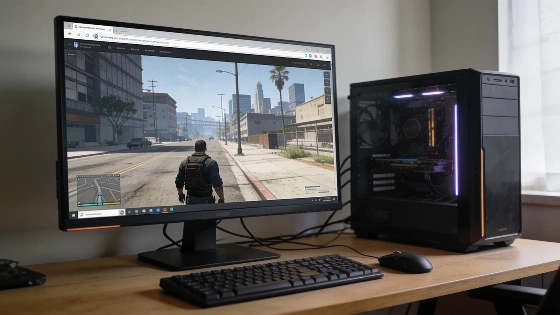
PlayGTA5.com briefly let users launch GTA V through a browser after downloading roughly 700 MB. Reports described it as an unofficial browser port with story-mode exploration, but the project vanished within hours and was never an official Rockstar feature.
For a few hours, PlayGTA5.com let some users launch GTA V in a web browser. They did not need to install the usual full PC version locally. The site turned one of gaming's biggest browser experiments into a short-lived technical demo. Independent reports described it as an unofficial port, not an official Rockstar Games feature.
The browser experiment
The project was available for only a few hours. Several users tested it. The clearest public demonstration came from @4k_isn, who showed GTA V running in Google Chrome on an Apple machine with an M3 Pro chip.
The initial download was reportedly about 700 MB. That is far smaller than a normal full PC installation. The project could still download more assets during play. The evidence points to a browser-delivered build, not a video playing inside a webpage or a standard launcher shortcut.
VideoCardz and TweakTown reported that PlayGTA5.com had stopped working by the time the story spread widely. Some users could not reach the site before it disappeared. Users suggested that Rockstar may have taken action. Heavy traffic was another possible explanation. Neither claim was confirmed by an official statement from Rockstar Games or Take-Two.
Local execution or streaming
The main technical question is how much of GTA V actually ran on the user's machine. A cloud-gaming service would run the game on a remote computer and send an interactive video stream to the browser. Here, the small initial download and the reported behaviour suggested that at least part of the game was running locally inside the browser.
That difference matters. Local browser execution would mean the project adapted a demanding game to the limits of a web runtime. Cloud streaming would mainly show that the game could be delivered and controlled through a browser. The available reporting does not show whether the original executable was recompiled, translated through a compatibility layer or changed specifically for browser use.
Videocardz reported that WebAssembly might have been involved. That remains a possibility, not a confirmed detail. WebAssembly can run compiled code in modern browsers, but its use alone does not explain the conversion process, graphics pipeline, asset loading or compatibility level. The creator has not released public technical documentation explaining how the build was made.
What the browser build apparently included
Reports from Spaziogames and Beebom said the browser project included the story mode and free movement through Los Santos. GTA Online was not supported. The same reports mentioned keyboard, mouse, controller and touch input. These details describe what independent publications said users encountered. They do not prove that the project had a supported feature set as a released browser version.
Some coverage also mentioned a RAM requirement of 3 to 16 GB and the use of multithreading. Unlike the roughly 700 MB initial download, those figures were not confirmed by a primary source from the project or by official documentation. They should be treated as unverified technical reporting, not firm system requirements.
Why the evidence matters
GTA: Vice City has already appeared as a browser demo, showing how older or less demanding games can be repackaged for the web. GTA V is a tougher test. Its open-world structure, streamed assets and larger feature set put more pressure on memory, graphics processing and browser limits.
The demonstration also fits into a broader discussion about running software on hardware without a traditional installation. NGB's earlier DLSS breakdown looked at a different way to expand access to rendering technology. This project appeared to focus on placing an entire game environment inside a browser runtime.
That comparison does not show that browser gaming is ready to replace native PC releases. The project was available only briefly. Its technical method was not documented in the available evidence. No controlled testing established its frame rate, image quality, input latency or stability. Screenshots and user demonstrations can show that something worked for some people, but they cannot define the experience on every browser or machine.
A demonstration, not a release
The clearest confirmed point is that users reported launching GTA V through PlayGTA5.com without downloading a complete local PC installation. Independent publications described it as an unofficial browser port, not an official Rockstar Games function. The less certain claims concern how it worked and why it disappeared. Neither the source material nor the demonstrations establish that it was a supported product, an authorised distribution method or a dependable way to access the game now.
The site's disappearance leaves the project as a technical proof of possibility, not a new platform for GTA V. There is no confirmed return date, verified source-code release or evidence that the browser build will become available again. A message reportedly seen on the site asked who wanted the source code. That may show the creator considered sharing it, but it does not confirm that any code was published.
Claims that the port used leaked GTA V source code or artificial-intelligence tools have not received independent confirmation. The same caution applies to claims that the game was almost directly compiled for WebAssembly. The available reporting does not provide enough evidence to establish either point.
The story deserves attention without being presented as a launch announcement. The experiment showed that a browser can host something much closer to a full modern game than the usual lightweight web demo. The missing technical details and short lifespan limit what can be concluded. For players, the practical result is simple: GTA V briefly ran in a browser for some users, but it has not been shown to be an accessible or supported browser version.
WebAssembly is best understood here as a browser runtime for compiled code, not a promise of native performance. It can help software run inside Chrome and other browsers. The final experience still depends on how the game handles graphics, memory, files and input. A small initial download can also hide later asset transfers. It does not prove by itself that the entire game was installed or rendered locally. Those details separate a convincing technical experiment from a dependable player-facing release.