
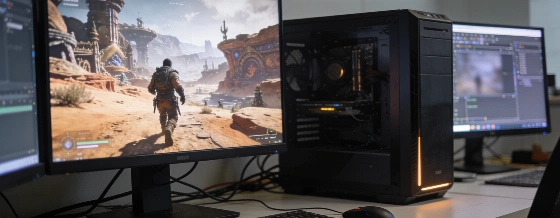
Pearl Abyss kept Crimson Desert on its in-house Blackspace Engine instead of moving to Unreal Engine 5. The studio says that choice gave it more control over updates, platform support and future games outside its MMO roots.
Pearl Abyss made control the main technical choice behind Crimson Desert. The Korean developer kept its proprietary Blackspace Engine instead of moving the project to Unreal Engine 5. Relying on an outside technology provider, the studio said, could have slowed feature work and disrupted the planned release schedule.
Control over convenience
The decision was not a rejection of commercial engines altogether. Jin-hwan Kim, Lead Engineer, and Jin-ho Yoon, Senior Leader of the Game Engine Graphics Division at Pearl Abyss, spoke to MeinMMO during gamescom 2026. They said commercial engines offer strong practical tools.
In the report, Pearl Abyss described those technologies as "excellent and offer many practical features." The studio still did not want to depend on an outside platform for capabilities tied closely to its own development work.
The developers said Crimson Desert's production needs might not have matched a commercial engine's update cycle. If the team had needed to wait for an external update before getting a required feature, it would have had less control over the path to release. The in-house engine gave the team a direct link between its priorities and the tools used to build the game.
The timeline available here is limited but useful. The comments came at gamescom 2026. Crimson Desert launched on March 19, 2026. Pearl Abyss has continued supporting it with substantial post-launch work.
The official Pearl Abyss patch note for update 2.03.00, released by September 18, 2026, records an upgrade to NVIDIA Streamline SDK 2.14.1. The change allows DLSS Ray Reconstruction to use the latest transformer model. It is a clear example of continuing technical work. The available material does not give a benchmark, a platform-specific performance target or an independently measured result.
Built for more than one genre
Blackspace was also meant to avoid a problem Pearl Abyss encountered with Black Desert. That game's earlier engine became so specialised around the MMO that using it for other genres grew difficult. Its flexibility declined over time.
According to the developers, Pearl Abyss considered wider platform support and the ability to build different game worlds when Blackspace development began. In their gamescom 2026 interview with MeinMMO, Kim and Yoon said the engine was designed from the outset to support multiplayer and different types of games, rather than only MMOs.
They acknowledged that the engine is not perfect. They also argued that its structure does not need to be rebuilt from scratch for new projects.
That matters more than the familiar engine name attached to a game. An engine is not just a graphics package. It shapes how teams build, test, update and adapt their software.
Blackspace was built to support different platforms and a wider range of game types. The developers specifically mentioned possible future first-person shooter and third-person shooter projects.
The multi-platform plan is not only a future goal. Pearl Abyss's current official Crimson Desert promotion lists PC, PlayStation 5, Xbox Series X/S and macOS as supported platforms. That list helps explain why the studio treats flexibility as an engine-level priority rather than a feature tied to one release.
The update advantage
Pearl Abyss linked Blackspace directly to Crimson Desert's post-launch pace. The engine supported more than patch deployment, the developer said. It helped the team deliver new features quickly, including a major story overhaul that changed the experience across the game.
The official 2.03.00 patch note gives that account a specific technical detail. The update included NVIDIA Streamline SDK 2.14.1, intended to bring the latest transformer model to DLSS Ray Reconstruction.
The patch came after the March 19 launch and was available by September 18, 2026. It confirms at least one major post-launch update and continuing technical support for the game running on Pearl Abyss's proprietary engine.
These claims should still be treated as a developer explanation, not as independent technical testing. The supplied material contains no benchmark data, frame-rate measurements, loading comparisons or breakdown of the engine's architecture.
It does establish why Pearl Abyss preferred owning the technology. The team could set priorities and make changes without waiting for a commercial engine's roadmap.
That puts Crimson Desert in a notable position among modern AAA projects, where Unreal Engine 5 is used by a large proportion of major productions. The point is not that a proprietary engine automatically creates better visuals or performance. Pearl Abyss believes its own tools gave the studio more freedom to change the game after launch.
What comes next
The same flexibility is now being presented as the base for Charting the Unknown. Pearl Abyss says the expansion will contain a significant number of new features. The supplied information does not confirm its release date, platforms, price, content list or technical specifications.
The cautious reading is the most useful one for players. In Pearl Abyss's account, Blackspace has proved useful as a production and update tool. The 2.03.00 patch also shows that the project continues to receive technical work.
That does not prove every future genre or project will benefit equally from the engine. Choosing an in-house engine does not guarantee a smooth launch or consistent performance without independent testing.
Commercial engines offer mature tools and regular updates. Proprietary engines give studios closer control over decisions that shape a specific game. Pearl Abyss chose the second trade-off for Crimson Desert, and the speed of its early updates gives that decision more substance than a branding exercise.
For players, the strongest conclusion is simple. Blackspace matters because it appears to have shortened the distance between Pearl Abyss identifying a change and delivering it. An in-house engine is not automatically superior.
In technical terms, engine control concerns the development pipeline, not a guarantee of visual quality. A commercial engine can provide features quickly, but a studio may still need to adjust its production methods to that engine's schedule and structure.
A proprietary engine puts more responsibility on the developer. It also lets teams shape their tools around their own projects. That trade-off is why Blackspace is central to Pearl Abyss's plans for Crimson Desert and for games beyond the MMO format.