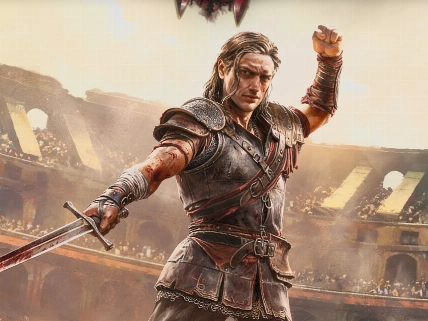

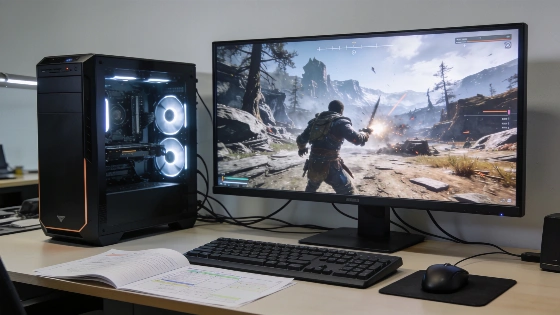
Pearl Abyss says its proprietary Blackspace Engine gave Crimson Desert more control over release timing and updates. The studio also sees it as a way to move beyond the limits of the Black Desert MMO engine.
Crimson Desert's biggest technical decision came before launch. Pearl Abyss chose not to use Unreal Engine 5 and continued with its proprietary Blackspace Engine instead. The studio says that gave it direct control over development priorities and release timing. It also let the technology support more than one type of game.
Control over convenience
Pearl Abyss did not present the decision as an attack on commercial engines. Developers Jin-hwan Kim and Jin-ho Yoon told MeinMMO at gamescom 2026 that commercial technology offered useful features, but did not fit the studio's preferred way of handling core development work.
The main issue was control. Relying on an outside engine could mean waiting for updates before adding required features. It could also force the team to adjust its schedule around another company's priorities.
That trade-off matters most after launch. Pearl Abyss says Blackspace helped the team release Crimson Desert updates quickly because developers did not have to wait for an outside engine provider to build or release the tools they needed. The engine became part of the studio's production plan, not just the technical base beneath the game.
Crimson Desert launched on 19 March 2026. Pearl Abyss discussed the engine at gamescom 2026 after the game had already received several updates.
Reports cited in the coverage claim that the game sold more than 3 million copies in its launch week. That figure has not been backed here by a primary corporate filing or a wire-service report, so it should be treated cautiously. The same source describes a major story overhaul delivered within a few weeks of launch.
Those details do not provide independent performance measurements. They do show why Pearl Abyss connects its engine choice with the ability to keep changing the game after release.
Pearl Abyss's official Crimson Desert site now lists Crimson Desert Enhanced as a free update for current owners. That confirms the game remains in an active post-launch support phase. Independent coverage identifies version 2.03.00, also called Crimson Desert Enhanced, as the latest update. It reportedly went live on 18 September 2026 for PC, PlayStation 5, Xbox Series X/S, and macOS.
Blackspace breaks free
Pearl Abyss learned a lesson from the technology behind Black Desert. That engine became so specialised around the MMO that using it for another genre was difficult. Its flexibility also declined.
Blackspace was designed with a wider purpose from the start. It was meant to support multiple platforms and different kinds of game worlds.
The developers do not claim the engine is perfect. They also say rebuilding it from scratch would not make sense. Their goal was to avoid repeating the earlier engine's narrow specialisation.
Pearl Abyss built Blackspace to support different games. The studio believes it could eventually handle first-person or third-person projects as well as the action-focused structure of Crimson Desert.
That sets an in-house engine apart from a commercial licence. A commercial engine can save a studio from building common tools itself. An in-house system gives the studio control over the features that shape its production pipeline. Pearl Abyss is choosing that control even though it must keep maintaining the technology on its own.
The September 2026 update offers a clear example of that work. According to independent coverage, version 2.03.00 added NVIDIA Streamline SDK support and DLSS-related rendering improvements.
The changes show that Pearl Abyss is still extending Blackspace's graphics features rather than switching engines after launch. They do not prove that the proprietary technology is technically better than Unreal Engine 5. They do show the kind of engine-level work the studio wants to control directly.
A rare AAA alternative
Most modern AAA projects use Unreal Engine 5 or another widely adopted commercial engine. Crimson Desert is unusual because Pearl Abyss has tied its engine choice directly to the game's update model.
The company says Blackspace made it easier to reshape the product after release. Launch was not treated as the end of meaningful development.
An alleged former Pearl Abyss developer previously described Crimson Desert as different from the typical modern AAA game built around Unreal Engine 5. That claim should remain separate from the developers' later explanation. The former employee offered an unverified perspective. The current developers gave the studio's own stated reason for keeping Blackspace.
The contrast with other major engine decisions is useful. CD Projekt Red has described a different path for The Witcher 4 by moving away from its proprietary technology toward Epic's engine, as outlined in this engine switch report.
Neither choice is always right. The question is whether the technology fits the studio's production needs and the post-launch support it plans to provide.
What players gain
For Crimson Desert players, the immediate benefit is not a feature called Blackspace. It is the possibility of faster, larger changes when Pearl Abyss decides the game needs them.
The source credits the engine with enabling frequent updates. It also describes a story overhaul that changed the overall experience soon after release. That is a more direct benefit for players than the usual claim that proprietary technology creates better graphics.
The longer-term promise is wider. If Blackspace can support different platforms and genres as intended, Pearl Abyss will not be locked into the MMO-specific limits that affected the Black Desert engine.
The developers named first-person and third-person games as possible future uses. They did not announce a specific project or confirm that either type is currently in development.
That distinction keeps the claim grounded. Blackspace has shown value in Pearl Abyss's account of Crimson Desert's production and updates. The source does not provide independent engine testing, a detailed technical breakdown, or proof that every future genre would be equally easy to build.
The strongest confirmed point is narrower. Pearl Abyss preferred ownership and control over the convenience of adopting Unreal Engine 5.
That is a sensible bet for a studio that wants to control its release schedule and keep reshaping games after launch. It also creates a clear responsibility. An in-house engine only earns its cost when the team can maintain it and turn that control into delivered features.
For Crimson Desert, the reported speed of post-launch changes, the free Crimson Desert Enhanced update for current owners, and the continued rendering work in version 2.03.00 give Pearl Abyss a stronger case than engine branding alone.
Blackspace is not automatically better than Unreal Engine 5. It appears to fit better with the way Pearl Abyss wants to build and support its games.
An in-house engine gives the developer ownership of the core technology. The team can change it without waiting for a commercial engine's update schedule. That can shorten the path from a design decision to a patch, although the studio remains responsible for maintaining its tools and platform support.
A commercial engine spreads that maintenance across many customers. It may also fail to prioritise a feature needed by one project. Pearl Abyss's explanation makes the trade-off clear: Blackspace matters because it gives the studio direct control over development and delivery.