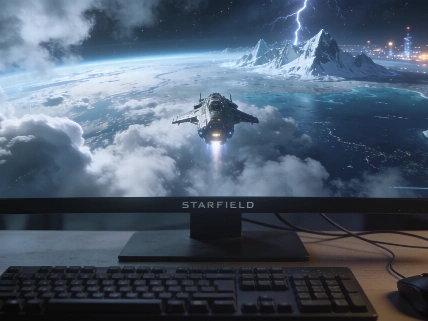

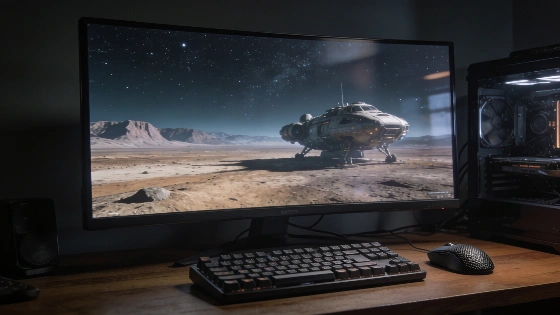
A former Bethesda developer has outlined how he would have structured Starfield's planetary exploration, arguing that the game's focus on quantity over handcrafted content limited its impact compared to The Elder Scrolls and Fallout
Starfield's ambitious promise of 1,000 explorable planets was a major talking point ahead of its 2023 release, but a former Bethesda Game Studios developer has now explained why he believes this approach ultimately held the game back. Nate Purkeypile, who worked at Bethesda for 14 years on titles including Skyrim, Fallout 3, Fallout 4 and Fallout 76, has shared his perspective on how Starfield's design could have been more effective if it had prioritised bespoke content over sheer scale.
Concerns Over Procedural Content
Purkeypile, who served as lead lighting artist and senior world artist on Starfield before leaving the studio in 2021, recently discussed his reservations about the game's direction in an interview. He revealed that he had warned internally about the risks of targeting such a vast number of planets, suggesting that the studio's resources would inevitably be stretched thin, resulting in repeated locations and less meaningful exploration. According to Purkeypile, the procedural generation used in Starfield did not create truly unique worlds, but instead rearranged pre-built content in different combinations, a method he described as "space quilts".
He argued that, rather than attempting to fill a galaxy with a thousand planets, a smaller number of carefully crafted worlds would have delivered a more coherent and memorable experience. Drawing comparisons to Mass Effect 1's procedural planets, Purkeypile suggested that Starfield's approach led to content repetition even within the main quest, undermining the sense of discovery that defined earlier Bethesda RPGs.
Alternative Visions and Internal Debate
Purkeypile's comments are not the only example of former Bethesda staff questioning the scale of Starfield's universe. Bruce Nesmith, who was lead designer on Skyrim and senior designer on Starfield before departing in 2021, previously stated that he had initially proposed a much smaller number of star systems-around two dozen-rather than the 120 that shipped. Nesmith noted that once the assets and systems for one solar system were built, expanding to many more did not require proportionally more work, but the variety and depth of content remained limited by development resources.
This internal debate highlights a fundamental tension in open-world and space exploration games: the trade-off between scale and handcrafted detail. While Starfield's marketing emphasised the freedom to visit countless planets, only around 10% of them were confirmed to contain life or significant settlements, with the remainder serving primarily as resource-gathering locations or barren landscapes.
Player Response and Ongoing Support
Upon release, Starfield received a mixed response from players and critics, with many praising its core systems but expressing disappointment at the lack of variety and depth across its vast universe. Despite this, Bethesda has reported that over 17 million players have logged nearly a billion hours in the game since launch. The studio has reiterated its commitment to ongoing support, confirming that Starfield remains a key part of its future plans and teasing new Starborn downloadable content for 2027.
Recent updates have not fundamentally changed the structure of planetary exploration, but Bethesda has promised further expansions, gameplay improvements and continued investment in modding tools. The studio's focus has now shifted to The Elder Scrolls 6, though it insists that Starfield will continue to receive attention. For those interested in how modders are attempting to address some of Starfield's immersion issues, a recent feature on seamless spaceship take-offs explores ongoing community efforts to enhance the experience.
What the Numbers Reveal
Starfield launched in September 2023 for PC and Xbox Series X|S, with its 1,000-planet claim forming a central part of pre-release marketing. Bethesda confirmed that only about 10% of these planets feature life, while the rest are largely barren or resource-focused. Since launch, the game has attracted over 17 million players, who have collectively spent nearly a billion hours exploring its universe. Despite this impressive engagement, the game's critical reception has remained mixed, and subsequent updates have yet to address the core concerns raised by both former developers and the player community.
Procedural generation is a technique used in game development to algorithmically create content such as worlds, levels or environments, rather than building each element by hand. While this allows for vast scale and replayability, it often results in less distinctive or memorable locations compared to handcrafted design. In Starfield's case, procedural generation was used to assemble planets from pre-made components, leading to repeated structures and environments. The balance between procedural and bespoke content remains a central challenge for open-world and exploration games, influencing both player experience and development resources.