
Frederik Wessberg's Starfield mod replaces distant planet textures with detailed 3D worlds. Its work in progress system aims to carry ships from orbit through the atmosphere and onto any planet without a loading screen.
Creation Engine 2 normally separates Starfield's orbit view from its planetary surface with a loading transition. Frederik Wessberg is spending roughly six months trying to remove that break.
Wessberg is a Danish singer-songwriter and audio engineer rather than a professional coder. His project reaches beyond a visual tweak. According to OpenCritic's latest report, the system is intended to let players enter and leave the atmosphere of any planet without loading screens, although it remains in development.
Rendering a Planet From Orbit
Starfield's standard space view uses limited layers. A planet may show a surface texture. Moving clouds or an atmosphere can appear as well. Approach too closely and the illusion breaks down.
Wessberg's solution rebuilds that view in 3D. The planet stays detailed during descent instead of flattening into an image. A custom three-dimensional transition now connects orbit with the surface.
The mod starts with Starfield's existing biome information and surface maps. It also uses climate data. Atmospheric composition, orbital phase and distance from the sun feed the system separately. The influence of orbiting moons is included too.
Those game systems are adjusted through physical modelling. In practice, the space view is being treated as part of a continuous environment rather than a decorative backdrop.
Seamless landings require more than moving a ship closer to a texture. Orbital flight has to connect with atmospheric rendering. Surface cartography must remain aligned with the planet's environmental systems during the transition.
Bethesda has previously associated the game's loading transitions with Creation Engine 2 stability limits. The company has also linked them to the need to preserve world objects correctly when moving between spatial zones. That background explains the size of Wessberg's technical challenge.
Weather During Descent
The demonstration shows manual flight and autopilot during landing. Under autopilot, the player can move around inside the ship instead of being locked into a conventional cutscene.
Water landings are included. A ship can touch down directly on an ocean surface rather than only at predetermined landing locations.
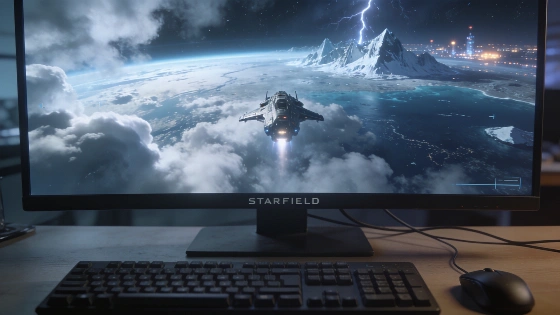
During descent, the planned system uses volumetric clouds shaped by climate data. Dynamic weather is part of the same sequence. Thunderstorms and lightning appear in the presentation.
Polar auroras and night-side airglow are shown as well. Atmospheric scattering is calculated from the planet's composition. The surface can display city lights at points of interest and broad terrain. Cloud shadows cross the oceans. Ice-covered peaks and native biomes remain visible.
The mod also models effects around the ship. Re-entry heat produces fumes against the hull and can leave an ash layer. The demonstration includes heat-shield heating. It also shows ablation traces and atmospheric scattering based on the planet's composition.
These effects remain part of a work in progress. Shazoo describes the result as a custom three-dimensional orbit-to-surface system, rather than a simple change to Starfield's existing planet textures.
Six Months of Development
Wessberg has worked on the project for roughly six months. He has spent that time rebuilding planetary-rendering technology in Creation Engine 2 to remove loading-screen transitions.
The mod has no release estimate. It will be available only on PC and will require SFSE, the Script Extender used by many of Starfield's largest mods. Those conditions limit its audience, while giving Wessberg access to systems that ordinary in-game settings do not expose.
The latest published update says seamless atmospheric entry and departure are intended to work for any planet. Access has been confirmed only for the PC version through SFSE. The feature has not been confirmed for consoles.
Bethesda's stated long-term roadmap reaches into 2027. That roadmap follows the March release of the Free Lanes update. It also includes Terran Armada DLC. The PlayStation 5 version was mentioned in the source material.
The technical work places the project in experimental modding rather than near-term feature delivery. Starfield's underlying data must remain visible and coherent during a journey the vanilla game normally prevents.
No Release Date Yet
There is no announced launch date. The footage does not establish final performance. It also cannot confirm stability or compatibility with future Starfield updates.
The project is not an official Bethesda addition. As of the independent update published on October 10, 2026, the mod is still in development.
Bethesda has separately said that Starfield development is not finished. New stories are planned for 2027. Gameplay improvements and Starborn content are also planned, along with further updates. That official support does not confirm any connection between Bethesda's roadmap and Wessberg's mod.
Seamless rendering keeps the same world in view while the camera moves between different levels of detail. A separate surface scene does not load at the point of arrival.
A successful implementation must stream terrain and atmosphere without obvious breaks. Clouds and lighting must also remain stable, with no severe performance problems. The demonstration shows the direction of the work, while the mod remains in development as of October 10, 2026.