
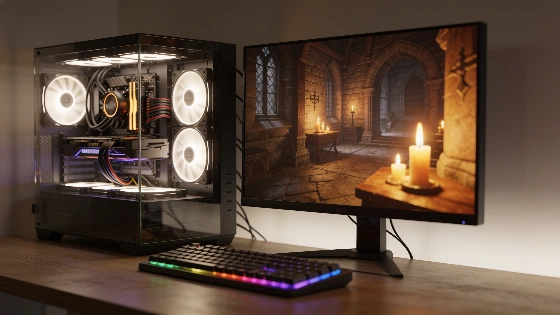
A free Nexus Mods release targets The Witcher 3 Remastered's most expensive lighting features, with measured gains of up to 30% indoors on one RTX 5070 system.
The Witcher 3 Remastered's path tracing can still punish modern graphics cards. A free mod cuts much of that cost. Hourlines' Path Tracing and Ray Tracing Optimization mod reports gains of about 30% indoors while keeping the image largely intact.
Where the mod helps
The mod changes how the game handles its most demanding lighting calculations. It does not remove path tracing. Indoor path tracing uses one light bounce instead of two, while ray tracing gets a lighter RTXGI treatment. That targets the scenes with the heaviest performance load. Outdoor path tracing sees a smaller improvement.
On the modder's system, an RTX 5070 ran the game at 1440p with DLSS Q. The recorded results were about 10% faster outdoors with path tracing, about 30% faster indoors with path tracing, and roughly 5% to 8% faster with ray tracing. These figures come from one setup. They are not a universal benchmark for every PC.
The numbers matter because the mod targets the setting most likely to make the remaster difficult to run smoothly. A 30% gain indoors can make a bigger practical difference than a small outdoor improvement when enclosed areas create the heaviest lighting workload.
The wider performance picture explains why this focused change is useful. CD PROJEKT RED's official release materials list Path Tracing as a PC feature of the remastered update. They also list NVIDIA DLSS 4.5 with Ray Reconstruction. Independent testing by DSOGaming found that the setting could still cause large frame-rate drops on powerful hardware. In one 4K Ultra+ test on an RTX 5080 with DLSS 4.5 Performance Mode, the game averaged about 46 FPS, with a minimum near 42 FPS. Frame Generation raised the reported result to roughly 77% to 84% FPS.
Small visual costs
The trade-off is concentrated in dark indoor spaces. The modder reports that the deepest corners become about 10% darker because less bounced light reaches them. Lit areas, candles, and windows appear unchanged. No brightness difference was measured outdoors.
Ray tracing also reacts a little more slowly when lighting changes. The in-game RTGI preset option has no effect while the mod is installed. Users lose that control even though the optimisation remains active.
This is a practical compromise, not a free image-quality upgrade. Players who want the full two-bounce lighting behavior in shadowed corners may prefer the original settings. Those struggling with path tracing have a clear visual cost to weigh against the performance gain.
NVIDIA separately explains that enabling Path Tracing in The Witcher 3 Remastered on GeForce RTX hardware automatically activates DLSS Ray Reconstruction. The feature is intended to improve image quality and performance. Those official reconstruction and upscaling features are separate from this mod. The mod changes the game's rendering workload and remains a third-party, unofficial optimisation.
What remains untouched
Ray-traced shadows are the main exception. The optimisation produced only a 1% performance improvement for that option, so the mod leaves the choice to the player. Anyone chasing higher frame rates may still need to disable ray-traced shadows separately after installing it.
That keeps the release from being a complete answer to every ray-tracing bottleneck. It improves path tracing and lighter ray-tracing workloads. The most expensive shadow setting remains almost unchanged.
The timing will be familiar to PC players who have watched modders refine demanding rendering features after a major update. This is a narrower change than the sequel-level work discussed in NGB's earlier report on Stellar Blade. The basic idea is similar: players get more control over how a demanding game runs without waiting for a full official overhaul.
Remaster context
The Witcher 3 Remastered followed a surprise announcement at this year's gamescom Opening Night Live. It is available on PC, PlayStation 5, Xbox Series X|S, and Nintendo Switch 2. The visual upgrade is the main reason PC players are likely to enable path tracing. That feature also shows how much hardware higher-fidelity lighting can require.
CD PROJEKT RED's official update description covers new graphical improvements and a console update. On PlayStation 5 and Xbox Series X, the official Witcher update notes say that console Ray Tracing Mode targets 30 FPS with dynamic resolution scaling. That console target is separate from the PC-focused Path Tracing workload addressed by Hourlines' mod.
The mod is hosted on Nexus Mods and targets both ray tracing and path tracing. Players using NVIDIA DLSS 5 can also try settings supplied by Nexus Mods user Nesumi. Those settings were paired with the Light Rewrite mod using the Realistic and Centre Overlaps options. The goal was to address the effect of PTDirectLightImpact on candle lighting.
The evidence supports a limited conclusion. Hourlines' measurements show a potentially useful indoor improvement with limited reported visual damage. They do not establish identical results across graphics cards or scenes. The mod is best understood as a targeted performance trade-off, not a universal fix for The Witcher 3 Remastered's most demanding settings.
Path tracing calculates how light behaves through multiple bounced interactions. That is why enclosed scenes can become especially expensive. Reducing one bounce lowers the number of lighting calculations and can recover performance. It also explains the darker indoor corners. The mechanism makes the mod's compromise technically consistent and gives PC players enough information to decide whether smoother performance is worth a modest loss of indirect light.