
Kakao Games has revealed ArcheAge S: Strait of Freedom, an MMORPG with classless progression, personal housing and a rebuilt economy. The changes aim to avoid the scarcity and pay-to-win problems that damaged the original ArcheAge.
Kakao Games is rebuilding ArcheAge around the problems that made some of its best-known systems hard to sustain. ArcheAge S: Strait of Freedom will use an isometric camera, no fixed classes and account-linked housing. Gear and resources will come through several competing routes instead of crafting alone.
A sequel with a different view
On September 29, 2026, Kakao Games showed the first real gameplay footage in a 17-minute developer documentary. The project is being presented as a PC MMORPG and a separate new branch of the ArcheAge franchise. It still aims to keep the original game's social and economic identity.
The isometric view should make small encounters easier to read without making larger battles confusing. DigitalToday also cited that reason in its coverage.
Kim Kyung-tae leads the project. He worked on the original ArcheAge from its early development and is now the executive producer and lead producer. The official developer documentary also shows the soundtrack and wider creative direction. That points to an active, publicly presented production rather than an early announcement.
The game is targeting a global release in the second quarter of 2027. Overseas service is planned through Steam.
ArcheAge S comes after the previously announced ArcheAge 2 changed direction and became Chronicles. That project focuses more on action-adventure gameplay and smaller-scale online elements. Strait of Freedom has a different job. It is trying to keep the social economy and player conflict that fans connected with the original instead of continuing the abandoned sequel plan.
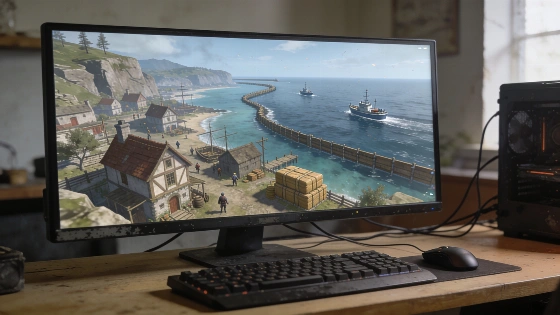
The "S" refers to a strait, a narrow waterway that connects larger bodies of land and concentrates trade and military movement. The sea is therefore the game's main pressure point. Commercial routes and naval conflict will meet there.
Reports from GNN Gamer and other regional outlets describe the project as a rethink of the original's main ideas, including social economics, competition for resources, life in the world and maritime trade. The developer diary describes a connected loop that moves from progression and combat into competition and open warfare. Each feature is not being treated as a separate system.
Classes built from equipment
Players will not choose a permanent class. Weapons provide four combat skills, while armour adds more abilities. Those combinations will shape a character's role and playstyle.
The system should let players change direction without locking them into one class identity. Inven Global's report on the presentation identifies the weapon and armour system as one of the project's stated breaks from fixed-class design.
The bigger change is how players earn equipment. In the original ArcheAge, crafting was the only route to gear progression, and crafted items could be sold through the Auction House. That pushed players toward repeating whichever activity produced the most currency.
The developers acknowledge that this pressure combined with the monetisation model and contributed to pay-to-win problems.
ArcheAge S will spread progression across field hunting, dungeons, gathering and production-based trade. Different activities will provide different gear and skill combinations.
Some materials will require players to complete the relevant content themselves. That will limit how far the Auction House can replace actual play.
Scarcity moves into production
Housing is getting a more direct fix. The original game's finite land supply created a race for building plots and made it harder for new players to enter. Strait of Freedom will give every player a personal housing space tied to their account.
That removes competition for the plot itself. Players will still be able to furnish and arrange their homes as they choose. GNN Gamer's coverage also describes individual homes as a way to ease the pressure created by the fight for land.
The new economy will not have unlimited resources. Production opportunities will be restricted so resources keep their value. Competition will shift away from land ownership and toward decisions about what each player produces.
One player might focus on quiet home production. Another might travel to find missing materials. Surplus resources can move through the trade system and the Auction House, although special resources will only come from direct gameplay.
This makes the social design more than a set of crafting conveniences. Goods in transit give other players targets and turn trade routes into possible conflict zones.
The system could give peaceful production a reason to exist without removing the danger that makes transport valuable. Whether those restrictions create meaningful scarcity instead of another forced grind will not be clear until the economy is running.
The studio's diagnosis of the original economy fits with earlier coverage that judged modern game systems by what players actually do with them, not just by their feature lists.
Combat and conflict
Combat will use familiar controls, including QWER abilities and point-and-click or WASD movement. The developers say the original's broad skill selection made fights difficult to manage.
Strait of Freedom will focus on quick response. Abilities will activate as soon as a button is pressed toward the intended direction.
Visual effects will also carry information during a fight. Combo effects will show an enemy's status in the action instead of making players check a separate buff bar.
That is an interface change, not a promise of better technical performance. The available material does not establish frame-rate targets or independent performance results.
Player conflict will take place at several scales. Parties and guilds can fight within individual servers. Server-versus-server competition will rotate match-ups so one side cannot stay permanently dominant.
The developer diary also said that global PvP across a shared sea is being considered. That feature is not confirmed for launch.
The intended progression is clear. Overland trade can create a desire for a base, then lead to larger farming operations and eventually guild-scale warfare over strongholds.
That gives the game a cause-and-effect structure in which economic choices create military stakes. It is more ambitious than simply adding a PvP mode. It also makes balance and resource availability major risks at launch.
ArcheAge S: Strait of Freedom is targeting a global Q2 2027 launch on PC. The overseas version is planned through Steam.
The project is still in development. The official developer documentary shows systems and intentions, not a finished product, final monetisation model or measured technical profile.
Its strongest promise is not that it can recreate the original unchanged. It is that the developers are willing to redesign the systems behind the original's scarcity and economic failures.
Dynamic scarcity means limiting supply so resources keep their value instead of letting every player produce everything forever. In an online economy, that limit works only when demand and access routes stay balanced. Otherwise, it creates another compulsory grind.
ArcheAge S will succeed or fail less on its classless label than on whether trade, gear and conflict stay connected without letting payment or the most efficient farming method decide every outcome.