
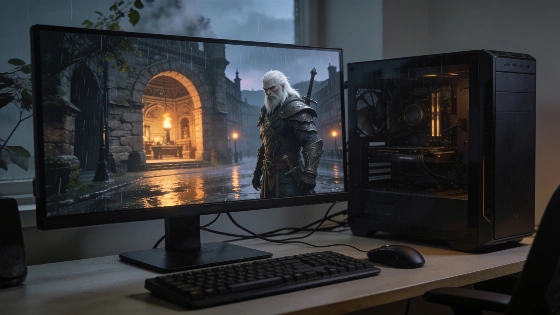
The Witcher 3: Wild Hunt - Remastered is now available as a free upgrade with path tracing, revised systems and cross-platform mods. The lighting looks better, but dated character models and soft combat are still easy to spot.
Path tracing gives The Witcher 3: Wild Hunt - Remastered its biggest visual upgrade yet. Sharper lighting cannot hide every part of an eleven-year-old game. CD Projekt RED's free update adds a rebuilt skill system, revised Witcher Senses, new animations, transmog, an expanded Photo Mode and cross-platform mod support. It also includes Hearts of Stone and Blood and Wine alongside the base game. This is the full package, not an upgrade limited to the main campaign.
According to CD Projekt RED's official release announcement, the remaster is available to existing owners. It includes PC path tracing, PS5 Pro support and a version for Nintendo Switch 2. The company calls the PC release its "most visually stunning version" of the game. The full original content remains included.
Lighting leads the upgrade
The visual overhaul works best when light does the work. On PC, path tracing replaces the earlier generation update's separate ray-traced systems for global illumination, ambient occlusion, shadows and reflections. It uses a more unified approach.
Interiors gain the most. Fire, windows and enclosed spaces now produce more convincing bounced light. Outdoor scenes get subtler changes across the medieval landscape.
DLSS 4.5 with Ray Reconstruction is available for players who cannot afford the full cost of path tracing. CD Projekt RED lists the technology among the PC improvements. It improves both path-traced and ray-traced output, which makes the less demanding option more appealing on compatible hardware.
Foliage has also received meaningful attention. The refreshed Sign effects are clearer and hit harder visually. Igni makes particularly good use of the new lighting.
The upgrade does not rebuild the characters from the ground up. Models still look dated at close range, especially when examining a body. The new Path Traced Hair option also does little to bring hairstyles up to modern standards.
Water is another weak point. It now stands out as one of the least convincing parts of the presentation, even with the wider visual work.
Combat still feels old
CD Projekt RED has adjusted the camera and added new movement, traversal and finishing animations. The main problem is still impact. Geralt's attacks lack the physical punch found in stronger modern action systems. The remaster improves how combat looks more than how it feels.
The reworked skill tree goes further than the animation changes. Skills now reach Rank 3 instead of Rank 5 in most cases, so players can complete more abilities. The number of available slots also rises from twelve to as many as sixteen.
Those extra slots require enough unlocked mutations. At level 54, only two of the four additional spaces were available in testing. The system is cleaner, but it remains restrictive when a developed build offers more useful options than the player can equip.
Witcher Senses are a stronger improvement. Clues no longer appear across the scene right away. The player must focus on the relevant object or trace.
That change turns a familiar detective mechanic into a more deliberate search without removing its purpose. It can also slow down simple investigations when environmental details blend together.
The other additions are practical. Transmog separates equipment appearance from statistics. Photo Mode gains new poses and camera controls. Bard's Ballad adds selected adjustments for players dealing with cognitive fatigue or attention limitations. These features make the game easier to tailor, but they do not pretend the underlying systems were rebuilt from scratch.
Measured PC performance
The tested build was version 5.00 on a GeForce RTX 5090 paired with a Ryzen 7 9800X3D. At 4K with maximum settings, DLSS Super Resolution on Quality and Dynamic DLSS Multi Frame Generation, a Novigrad route from the docks to the far end of the city averaged 161.7 frames per second.
The run recorded a 131 FPS 1% low, a 117 FPS 0.1% low, a 135 FPS minimum and a 199 FPS maximum. Average frame time was 6.185 milliseconds. Average PC latency was 66.326 milliseconds.
Those figures describe a very high-end setup, not a universal performance guarantee. They do show that REDengine can handle an expensive lighting workload impressively in a dense city packed with non-player characters.
The result is especially notable because Novigrad is one of the game's most demanding locations. Frame generation changes how the numbers should be read, though. The headline frame rate is not a direct measure of input responsiveness.
Console owners are included too. PS5 Pro support uses PSSR to enable 60 frames per second with ray tracing active. The PC version gets the exclusive path-tracing option.
The broader update also adds new Sign effects, improved enemy behaviour for creatures such as wolves and drowners, cleaner quest notifications and an updated main menu. The Nintendo Switch 2 version expands the remaster's platform reach.
A definitive edition with limits
The timing is simple. The remaster is available as a free upgrade and gives returning players a way to revisit the main campaign and both major expansions before The Witcher 3: Wild Hunt - Song of the Past DLC launches next year.
The surprise announcement came just over a month ago at gamescom 2026 Opening Night Live. That happened even though the game had already received a major next-generation update in December 2022.
That history matters. The 2022 update had already improved textures and added ray tracing, so this release is not rescuing an abandoned technical version. It is a second layer of refinement for a familiar game arriving ahead of new content.
The official next-generation update notes from The Witcher gave a release window of 14 December at 1:00 CET for PC and Xbox Series X|S, and midnight local time for PS5. They also described that update as free and listed visual, performance and technical improvements alongside additional content.
The same official materials noted higher-quality textures, greater detail, improved shadows, longer draw distances and denser crowds on new-generation consoles. Those changes put the remaster in context. Its visual progress builds on a substantial earlier update rather than replacing an untouched last-generation presentation.
Players who have followed how sequels reshape originals will recognise the wider pattern. Established games can gain useful systems and presentation upgrades without becoming wholly new productions.
Mod.io integration may be the most durable addition for PC players. It expands access to custom quests, weapons, equipment and balance changes across platforms. It also gives the remaster a cleaner route for community content than relying entirely on separate installation methods.
That benefit will depend on what creators build. The feature itself extends the game's lifespan without adding a new paid layer.
The Witcher 3: Wild Hunt - Remastered is the strongest version of CD Projekt RED's open-world RPG. It is not a remake in everything except name.
It makes the world much more attractive. It adds sensible accessibility and customisation tools and delivers a generous free upgrade. Dated models, weak water and underpowered combat are still visible.
Remasters improve an existing foundation rather than erase its history. This one earns a definitive-edition label because it polishes the masterpiece without pretending that The Witcher IV will not be the real generational leap in 2028.
Path tracing calculates lighting interactions across a scene instead of handling each effect as an isolated approximation. That is why interiors gain so much from the update.
DLSS can reconstruct a sharper image from a lower internal resolution. Frame generation inserts additional frames that improve visible smoothness, but it does not create the same input response as traditionally rendered frames.
Those distinctions matter when reading performance figures. A fast counter can confirm strong rendering throughput without proving that every action feels equally responsive.