
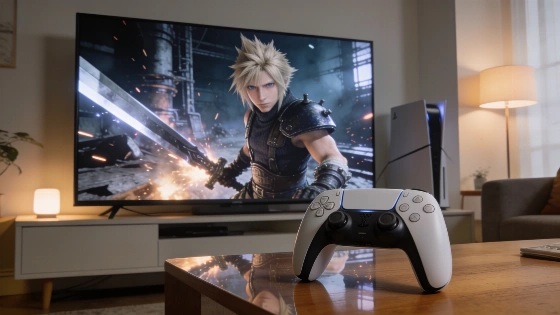
Square Enix has confirmed that the Final Fantasy 7 Remake trilogy is being built to match the visual standard of the 2005 film Advent Children, aiming to deliver the film's character fidelity and atmosphere in playable form
Square Enix has set a clear visual ambition for the Final Fantasy 7 Remake trilogy: to bring the graphical fidelity of the 2005 film Advent Children into the realm of interactive play. This decision, revealed during a PAX West panel, signals a deliberate move to align the remake's look and feel with what many fans consider the definitive visual interpretation of the original JRPG's world and characters.
Advent Children as the Visual Blueprint
Rather than simply updating the 1997 classic, Square Enix has chosen to use Advent Children as its graphical north star. The film, released in 2005, was widely recognised for its detailed character models and expressive animation-qualities that set a new bar for how Cloud, Sephiroth and the rest of the cast could be realised. According to director Naoki Hamaguchi, the team believes Advent Children represents the "ideal vision" of Final Fantasy 7 for a significant portion of the fanbase, making it the logical reference point for the remake's visual direction.
This approach is not just about nostalgia. By targeting the film's standard, Square Enix aims to "gamify" the cinematic experience, allowing players to inhabit a world that previously existed only in pre-rendered cutscenes. The focus extends to character movement, facial expression and environmental atmosphere, all of which were hallmarks of Advent Children's presentation.
Technical Feasibility and Franchise Evolution
It's worth noting that the leap from 2005 film visuals to real-time gameplay is only now practical due to advances in hardware and rendering technology. When Advent Children debuted, its visuals were far beyond what any console could deliver in real time. Two decades later, the PlayStation 5 and modern PCs provide the horsepower needed to approach that level of detail during actual play, not just in cutscenes.
Cloud and his companions have appeared in multiple spin-offs and crossovers since the original game, but none have matched the visual ambition of Advent Children until now. The remake trilogy's development reflects a broader trend in the industry, where cinematic fidelity is no longer reserved for non-interactive sequences. This mirrors the approach seen in other major franchises, as highlighted in our reported earlier on Gran Turismo 7's evolving content and presentation standards.
Release Timing and What Remains Unclear
Square Enix has confirmed that the next entry in the trilogy, Final Fantasy 7 Revelation, is scheduled for release on 8 April 2027. While the studio has been transparent about its visual targets, it has not yet detailed how closely the in-game experience will match the film's most complex scenes, especially during high-action sequences or densely populated environments. No independent gameplay footage has been released that demonstrates the final build's performance or visual consistency across platforms.
Players should also be aware that while the graphical goal is ambitious, the actual delivery will depend on optimisation, platform-specific constraints and the realities of large-scale game development. Square Enix has not announced any special editions, early-access plans or platform-specific features for Final Fantasy 7 Revelation at this stage.
Editorial Perspective
Square Enix's decision to anchor the remake trilogy's visuals to Advent Children is a calculated move that acknowledges both fan expectation and the technical realities of modern hardware. It's a bold promise, but one that will only be meaningful if the final product delivers not just in static fidelity but in real-time playability and consistency. The studio's willingness to set such a public benchmark is commendable, but it also raises the stakes for the eventual release. Players should remain attentive to future gameplay demonstrations and technical breakdowns before assuming that cinematic ambition will translate seamlessly into the hands-on experience. For now, the promise is clear-whether the execution matches remains to be seen when Final Fantasy 7 Revelation arrives in 2027.
To understand why this graphical leap matters, it's important to distinguish between pre-rendered cinematics and real-time gameplay. Pre-rendered scenes, like those in Advent Children, are created in advance and can include far more detail than what consoles could render live. Real-time gameplay, by contrast, must balance visual fidelity with performance, ensuring smooth frame rates and responsive controls. Achieving film-like visuals in a playable environment requires significant optimisation and often involves compromises in resolution, effects or animation complexity. The move to target Advent Children's standard is therefore not just a matter of art direction, but a technical challenge that will test the limits of current hardware and development pipelines.