
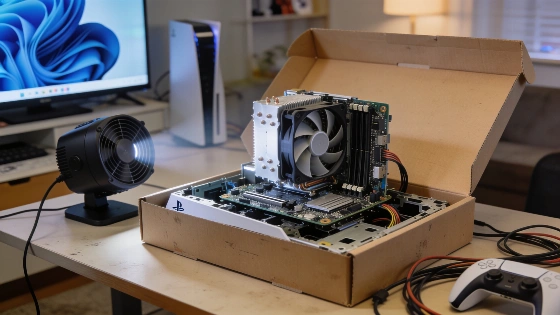
A pawn shop owner's deshelled PlayStation 5 Pro has kept working inside a cardboard box for a year. An external fan keeps the exposed hardware cool during demanding PlayStation VR2 sessions.
A deshelled PlayStation 5 Pro has spent a full year inside a cardboard box and is still used every day with PlayStation VR2. Reddit users expected it to fail because of overheating or dust. It has kept working, but only with one key change: an external fan that stays on during demanding games.
A console without its shell
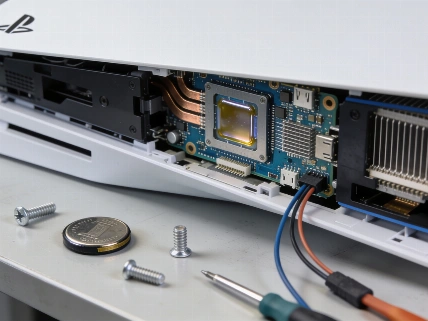
The system came from a customer who removed the vital electronics from a PlayStation 5 Pro. The customer then returned the empty outer shell to Walmart for a full refund. A pawn shop owner bought the exposed hardware for $100, not to resell it, but to use it as a personal experiment.
This is less a normal console modification than a cooling problem. The internal parts now sit in a cardboard box instead of the original enclosure. That leaves the system without the shell's built-in fan arrangement, so the owner has to supply airflow from outside.
The owner says the console runs PlayStation VR2 every day. He describes that as the most demanding use in the setup. The system has also run software such as Crimson Desert. That makes the reported survival more notable than it would be if the console were used only now and then for light workloads.
Heat still sets the limit
The cardboard box has not removed the hardware's need for cooling. Without the external fan, the PlayStation 5 Pro reportedly overheats after about 30 minutes when running PSVR2 games or demanding titles such as Crimson Desert.
That matters more than the novelty of the box. The console still needs proper cooling. It is working with a replacement airflow setup that must remain on. The arrangement functions, but it is not convenient. It gives ordinary users no reason to remove a working console shell.
The owner estimates that the improvised system saved $800. That figure comes from the user's account. It describes the reported purchase arrangement, not a retail price comparison supplied by Sony.
The need for active airflow matches the design of the retail PS5 Pro. The console uses dedicated cooling hardware and supports horizontal or vertical placement, rather than passive operation. Third-party PS5 Pro cooling fan listings also treat the console as an actively cooled system under load. A troubleshooting guide from Phone Studio says a console without enough ventilation can overheat or shut down. It also says louder fan noise during demanding use is generally normal and does not by itself show a fault.
Power use helps explain why the improvised setup reaches its limit so quickly. Push Square has cited hardware analysis that puts the PS5 Pro's power draw at up to about 240W, substantially more than the base PS5. That number does not prove the cardboard setup is unsafe by itself. It does explain why an external fan can become essential in an unofficial enclosure during long, demanding sessions.
Dust theory faces a reality check
Dust was the main concern when the setup was first shared. Reddit users argued that the exposed system would fail quickly as dust gathered around its components. After a year of use, the owner rejects that explanation. He argues that the original shell becomes a ventilation problem when it gets heavily coated with dust.
That is not the same as a controlled test. One exposed PlayStation 5 Pro in one environment cannot show that removing a console shell is safe. It also cannot show that dust poses no risk to other systems. It does show that the expected failure did not happen during this reported year of daily use.
The experiment says nothing conclusive about long-term component health. The available account includes no independent temperature readings, dust measurements or performance tests. The narrower claim is clear: the hardware still works, and it can run PSVR2 when the external fan is active.
The PS5 family's thermal design involves more than moving air across a circuit board. Sony has historically used liquid metal as the thermal interface for the CPU and GPU. Recent hardware revisions have reportedly changed the cooling area to improve liquid metal containment. Frandroid described the newest base PS5 Slim revision as using a PS5 Pro-like approach to liquid metal retention and heatsink construction. VGC has reported that Sony continues to revise cooling and related protections across its models.
That makes the exposed-console experiment hard to apply to other systems. The PS5 Pro's original enclosure, heatsink and airflow path work together as one thermal system. A fan pointed at exposed hardware is not automatically equivalent to that design. Sony's continued changes to cooling parts also show that thermal management remains an active engineering concern, rather than a problem solved once with a single fan.
The missing replacement option
The useful lesson is not that cardboard makes a sensible console enclosure. The case shows how few simple repair options owners may have when an outer shell is damaged. Parts and accessories exist for modern consoles, but complete replacement shells are much harder to find than the individual components used for custom builds.
That gap matters when a console is damaged during transport or its casing becomes unusable while the internal hardware still works. As our earlier hardware report showed, PlayStation hardware remains a major part of Sony's platform identity. Repairability gets far less attention than new hardware plans.
A proper replacement shell would not need to encourage extreme modifications. It would give owners a safer way to restore a damaged machine without using improvised boxes, exposed electronics or permanent external cooling. This cardboard-box PlayStation 5 Pro is ingenious because it works. It also shows how awkward console repair becomes when the casing is treated as disposable instead of replaceable.
Anyone considering a similar project should treat the report as a reason for caution, not imitation. The system's one-year survival is an intriguing user account. It does not prove that deshelling improves cooling, prevents dust damage or preserves reliability. The experiment makes the repair-access problem more convincing than it makes cardboard look like a sound console design.
Airflow is only one part of cooling. A fan can move heat away from exposed components, but safe operation also depends on how air reaches the relevant heatsinks and how steadily the system sheds heat under load. That is why the external fan is necessary in this setup. Its presence does not show that the original cooling design was unnecessary.
Push Square's report on the latest base PS5 revision describes an optimized motherboard layout, a different heatsink and revised cooling designed to bring the machine closer to the PS5 Pro's approach. Those changes support the main lesson from this unusual repair. The shell is only one visible part of a larger thermal system. A cardboard box does not recreate Sony's engineered airflow and heat-transfer path.