
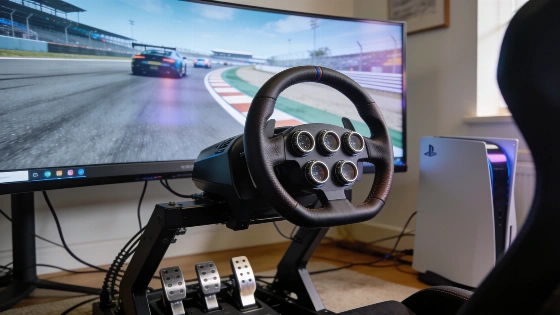
Thrustmaster is now an Official Partner of the Gran Turismo World Series. The company has also revealed the T-GT III, a new wheel with Direct Axial Drive and a load-cell pedal set.
Thrustmaster is taking its Gran Turismo partnership into a more expensive and ambitious phase with the T-GT III. Confirmed on 3 October 2026, the new wheel is the fifth officially licensed Gran Turismo 7 wheel and the first Direct Axial Drive bundle made for Gran Turismo. It is also the first model in the line to include a load-cell pedal set as standard.
A new Gran Turismo wheel
The T-GT III is officially licensed for Gran Turismo 7 on PlayStation 4 and PlayStation 5. The complete bundle will launch on 3 December 2026 at €699.99, $749.99, £649.99 or ¥119,000. Worldwide availability is expected before Christmas. Retail prices may vary by market. TechRadar reports the same launch date and lists the price as $749.99 in the US, €699.99 in Europe and £649.99 in the UK.
Thrustmaster is also returning as an Official Partner of the Gran Turismo World Series. The official Gran Turismo announcement describes the move as an extension of the company's long relationship with the series. Kazunori Yamauchi said Thrustmaster has stayed loyal to Gran Turismo for a long time and presented the new role as a continuation of that cooperation.
The expanded partnership does not replace every existing arrangement in the competition. According to the official Gran Turismo announcement, Fanatec remains the official steering-wheel partner of the series, while Thrustmaster joins as a World Series partner. The new agreement gives Thrustmaster a larger role in the Gran Turismo ecosystem. It does not transfer the current wheel-partner position.
Thrustmaster previously held the Official Hardware Partner of Gran Turismo World Series role from 2018 to 2020. It also took part as a partner of the Olympic Esports Series in Singapore in 2023. The announcement brings the company back to a partnership status it has held before and introduces a new generation of hardware.
This is more than a new wheel rim or a cosmetic update. The T-GT III uses a new drive design and a pedal system that measures braking pressure through load instead of relying only on pedal travel. It is the first officially licensed Gran Turismo bundle to pair Direct Axial Drive with load-cell pedals as part of the standard package.
What the hardware claims
Thrustmaster says the Direct Axial Drive motor delivers constant torque of 5 Nm and can reach up to 10 Nm through overshoot capacity. The stated goal is to preserve detail without saturating the motor. In practical terms, the company says the wheel should stay responsive during strong force-feedback effects instead of flattening out at its limit. These are manufacturer specifications, not independent test results.
The bundle adds two game-specific effects through Thrustmaster's Harmony technology and high-frequency torque. GEAR JOLT is meant to reproduce the impact of gear changes. ENGINE ROAR is designed to make the chassis resonate in time with engine revolutions. These claims describe the intended sensation in Gran Turismo 7. They are not independent measurements of latency or force-feedback accuracy.
The package keeps the familiar T-GT steering wheel design, including a leather finish and four rotary encoders mapped directly to Gran Turismo. The controls are meant for adjustments during a race. The included pedal set also gives the bundle a fuller out-of-the-box specification than earlier officially licensed models.
Sixteen years of development
The T500RS GT Edition set the direction for the partnership's hardware in 2011. It used a dual-belt-and-pulley drive system, a Quick Release mechanism and a reversible all-metal pedal set for PlayStation 3. The design followed an earlier brief focused on reducing latency and reproducing the feel of Gran Turismo 5 with greater precision.
The T300RS GT Edition arrived in 2016 as Thrustmaster's first wheel with a brushless Force Feedback motor. The T-GT Series followed in 2017. It introduced T-DFB technology to reproduce road detail and vibration effects in Gran Turismo Sport. The wheel also added four rotary encoders and more than 13 buttons for PlayStation 4.
That history gives the T-GT III a clear place in the range. Thrustmaster is not presenting it as a separate accessory for casual console racing. The company is pitching it as its latest attempt to turn Gran Turismo's software-specific feedback into a premium bundle. Its return to the World Series partnership puts that hardware work back into the context of its long relationship with the franchise.
Price and support
Thrustmaster says the T-GT III will continue to receive software and firmware updates in line with Gran Turismo's SPEC updates. That matters for a licensed peripheral because compatibility and game-specific effects may depend on support after the hardware reaches stores.
The timing is linked to Gran Turismo 7 Spec IV. The source says the free update will arrive in two parts. The first is scheduled for October 2026, and the second for December 2026. Thrustmaster is offering the T-GT III as the new hardware option for players who want the features associated with that update. The announcement does not include independent testing of the wheel or explain every software change in Spec IV.
There is also no evidence here of measured input latency, frame-rate behaviour, durability testing or a comparison with competing Direct Drive systems. The torque figures come from the manufacturer, and the sensory effects are product claims. Buyers can assess the price and feature list now. Real-world testing will require the retail hardware and supported Gran Turismo 7 software to be tested together.
The T-GT III is a major step up in Thrustmaster's Gran Turismo strategy, not a routine licensed accessory. Its 5 Nm constant torque, up to 10 Nm overshoot capacity, load-cell pedals and promised firmware support give it a clear premium pitch. The €699.99 starting price also makes independent testing important. For PlayStation sim racers, the announcement confirms a substantial new option. It does not yet prove that the wheel offers a decisive advantage on the track.
Direct Axial Drive differs from a belt-driven wheel because the motor sends force through the steering axis without the same belt system between the motor and rim. That may produce a sharper force-feedback response. The published torque figure alone cannot show how smooth or accurate the wheel will feel in every corner. A load-cell brake measures applied pressure, which can make braking more repeatable after calibration. The result still depends on setup, software tuning and the driver's preferred pedal force.