
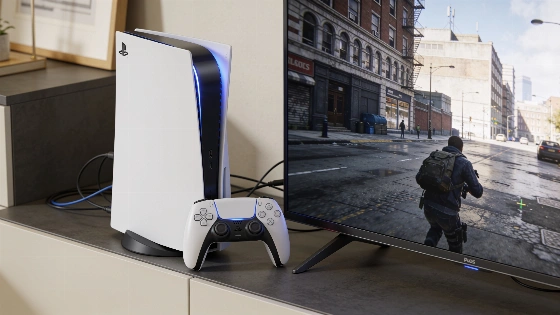
Sony has brought QSSR to the base PS5 through patches for Marvel's Wolverine and Ghost of Yōtei. The feature aims to deliver clearer, steadier images without the £899.99 PS5 Pro.
Sony has brought one of the PS5 Pro's clearest visual advantages to the standard console. Quick Spectral Super Resolution, or QSSR, is now available on PlayStation 5 through patches for Marvel's Wolverine and Ghost of Yōtei. It uses AI to rebuild images while staying within the base PS5's performance limits.
QSSR reaches PS5
QSSR is a performance-focused version of PlayStation Spectral Super Resolution, or PSSR. PSSR remains exclusive to PS5 Pro. Sony's official PlayStation Blog announcement still calls it the company's gold standard for image reconstruction on that console.
QSSR was built to run efficiently on the standard PS5. It improves image detail and stability without requiring the newer hardware.
Sony says the technology grew out of Project Amethyst, its collaboration with AMD. It uses a streamlined neural network architecture and a hand-tuned implementation. The goal was to fit machine-learning upscaling to the standard PS5's available performance rather than move the PS5 Pro solution across unchanged.
That difference matters. QSSR is not a software switch that turns the base PS5 into a PS5 Pro. It is a separate system designed to improve image clarity and temporal stability on the original console. The source material provides no independent measurements for changes to resolution or frame rate.
Two launch titles
Marvel's Wolverine and Ghost of Yōtei are the first named games to use QSSR. Both received patches on the day Sony announced the technology. They are the first released games with the feature, rather than technical demonstrations.
Sony also says QSSR is meant to become broadly available to PlayStation developers. That means it is not expected to remain limited to these two games. Video Games Chronicle reported the same plan, saying Sony intends to make the upscaler broadly available across the PlayStation development ecosystem.
Mike Fitzgerald of Insomniac Games said QSSR adds pixel-level clarity and stability to environments in Marvel's Wolverine. He pointed to the busy streets of Madripoor and the alleyways of Shinjuku. Dense scenes such as these can reveal weaknesses in image reconstruction more easily than simpler areas.
Jasmin Patry of Sucker Punch Productions said QSSR is particularly good at resolving fine detail on characters and in environments in Ghost of Yōtei. She also pointed to temporal stability that had not previously been possible on PS5. Patry presented the feature as a step toward giving more players image quality associated with PSSR on PS5 Pro.
The price gap
QSSR arrives as the gap between the two consoles becomes more expensive. The PS5 Pro now costs $899.99 after the latest price increase. QSSR, by contrast, is arriving through game patches for people who already own a PS5.
That does not remove the Pro's hardware advantages. It does give standard-console owners a direct visual upgrade without requiring another purchase.
Sony's wider work on machine-learning reconstruction also reaches beyond its own hardware. Readers interested in another attempt to bring advanced image reconstruction to more GPUs can read this earlier breakdown.
There is no confirmation that every PS5 game will receive QSSR. There is also no confirmation that the feature will appear in Grand Theft Auto VI. Rockstar's game is worth watching, but its use of QSSR has not been announced.
Sony has confirmed the two patched games named in its announcement. Its wider plans for developer access do not confirm support for any particular future title.
What players receive
For owners of Marvel's Wolverine and Ghost of Yōtei, the practical gain is better image reconstruction in supported versions of those games. QSSR is a rendering feature, not a new performance mode. It also does not guarantee a specific output resolution.
Sony's announcement focuses on clarity and stability. It gives no measured frame-rate figures and makes no claims about native rendering.
Ghost of Yōtei is also getting the Echoes of Sekigahara expansion and the Most Wanted survival mode on the same day. Those additions are separate from QSSR, but they make the patch more significant for players returning to Sucker Punch's game.
Letting the base PS5 use technology that was previously linked to the premium console is a sensible move for Sony. QSSR will not erase the PS5 Pro's hardware lead. Sony still calls PSSR the gold standard on that system. But the new feature makes that lead less decisive in two major first-party releases and gives existing owners a reason to update their games.
Upscaling rebuilds an image from a lower internal render instead of producing every final pixel natively. A neural upscaler studies information across frames to restore fine detail and reduce flicker or instability. Temporal stability describes how consistently that detail holds as the camera moves.
QSSR therefore promises a cleaner image. It does not prove native resolution or a fixed frame rate. Its value will depend on how each game uses it.
For now, the clearest evidence comes from Sony's two launch implementations and the developers' descriptions. The PlayStation Blog points to Madripoor, Shinjuku, character detail and environmental detail as practical tests for the technology. The planned wider rollout will show how consistently QSSR performs across other PS5 games.