
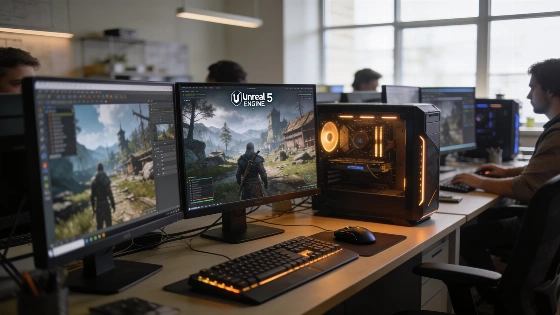
CD Projekt Red has confirmed The Witcher 4 will use Unreal Engine 5, not due to technical limits of REDengine but to prioritise storytelling and streamline development. The move marks a major shift in the studio's identity and future output
CD Projekt Red's decision to abandon its proprietary REDengine for Unreal Engine 5 on The Witcher 4 is not a story of technical defeat. Instead, it marks a deliberate pivot away from building in-house technology towards a renewed focus on narrative craft and production scale. The studio's leadership has made clear that the move is about identity, not engine shortcomings. According to joint CEO Michał Nowakowski, the transition was driven by the company's goal to make "convincing and immersive" games, emphasizing that CD Projekt Red does not aim to become a technology company but rather to focus on storytelling and player experience, as stated in a recent YouTube interview.
Why CD Projekt Red is leaving REDengine
For years, REDengine powered the studio's flagship titles, including The Witcher 3: Wild Hunt and Cyberpunk 2077. While Cyberpunk 2077's launch was marred by technical issues, CD Projekt Red's joint CEO Michał Nowakowski has clarified that the engine itself was not the root cause of those problems. The studio's original ambition was never to become a technology company, but to deliver technically advanced games with a primary emphasis on immersive storytelling. The shift to Unreal Engine 5 was triggered not by Cyberpunk's troubled release, but by the studio's early exposure to Epic's The Matrix demo. Nowakowski explained that this demo prompted CD Projekt Red to question whether Unreal Engine 5 could support the scale and complexity of their RPGs. Initial assessments indicated that UE5 was not ready for such ambitions out of the box, but a deeper partnership with Epic Games was seen as the solution. This background was detailed in Nowakowski's interview and is supported by reporting from PSU.com and WindowsForum.
Initial assessments suggested Unreal Engine 5 was not ready for the studio's ambitions out of the box. However, by forming a close partnership with Epic Games, CD Projekt Red gained unique access to the engine's core, allowing them to tailor it for their needs. This collaboration means the studio is now one of the few teams outside Epic itself working directly with the engine's internal systems. According to a 2022 announcement cited by WindowsForum, this strategic collaboration is focused on improving Unreal Engine 5 specifically for large open-world games, rather than simply licensing the engine as-is.
What the Unreal Engine 5 partnership changes
By moving to Unreal Engine 5, CD Projekt Red is no longer responsible for building foundational technology from scratch. Instead, the studio can focus on developing bespoke features and systems that matter for its specific style of open-world RPGs. This approach is intended to accelerate production and enable the team to deliver more games and richer stories without the overhead of maintaining a proprietary engine. Notably, both The Witcher 4 and Cyberpunk 2 are being developed on Unreal Engine 5, as confirmed by CD Projekt Red and reported by PSU.com.
The partnership with Epic Games is not a standard licensing arrangement. CD Projekt Red is actively involved in shaping the engine's capabilities, working alongside Epic's own developers. This level of collaboration is rare and positions the studio to influence the technical direction of Unreal Engine 5 in ways that benefit large-scale narrative games. The hope is that this will also address persistent technical issues, such as the stuttering problems that have affected some Unreal Engine 5 titles in recent years. According to WindowsForum, the collaboration is designed to ensure that Unreal Engine 5 can meet the demands of massive, open-world RPGs.
Release timing and what's next for The Witcher
The Witcher 4 is not expected to launch before 2028, with CD Projekt Red indicating that this remains the planned window for release, as reported by PSU.com. This means players will have to wait several years to see the results of this engine transition. In the meantime, The Witcher 3: Wild Hunt is set to receive the Songs of the Past expansion in 2027, which will provide new content for fans of Geralt of Rivia. The studio's move echoes a broader industry trend of studios reassessing their technology stacks, as seen when Blizzard chose to retain its legacy engine for World of Warcraft Forever, as reported earlier.
CD Projekt Red's approach stands out for its willingness to relinquish control over core technology in favour of creative flexibility and production efficiency. The studio's leadership believes this will allow them to focus on what they value most: delivering convincing, immersive stories at scale. As highlighted by Nowakowski in his YouTube interview, the move is fundamentally about enabling the studio to create more ambitious and engaging experiences for players.
Technical context and future implications
While the switch to Unreal Engine 5 is significant, it does not guarantee a flawless technical outcome. The engine's flexibility and visual power are well established, but its performance on large, complex open worlds remains a work in progress. CD Projekt Red's direct involvement in engine development may help resolve some of these challenges, but the true impact will only become clear when The Witcher 4 is finally released. Until then, the studio's decision signals a clear intent to prioritise narrative and player experience over proprietary technical achievement. According to WindowsForum and PSU.com, the collaboration with Epic Games is expected to yield improvements that will benefit not only CD Projekt Red but potentially other developers working on similarly ambitious projects.
Game engines are the software frameworks that underpin every modern video game, handling everything from graphics rendering and physics to scripting and asset management. Proprietary engines like REDengine offer studios full control but require significant resources to maintain and update. Third-party engines such as Unreal Engine 5 provide advanced features and regular updates, but can introduce compatibility and performance challenges, especially for large-scale open-world games. The choice of engine shapes not only how a game looks and runs, but also how quickly and efficiently it can be developed and supported over time.