
Transport Fever 3 launched on 29 September 2026 for PC, Mac, Linux, PlayStation®5 and XBOX Series X|S. It includes three editions, more than 275 realistic vehicles and a new Subarctic climate.
Transport Fever 3 launched on 29 September 2026 for PC, Mac, Linux, PlayStation®5 and XBOX Series X|S. It is Urban Games' broadest launch so far. The game comes in Standard, Deluxe and Collector's Edition formats. Its larger simulation covers railways, roads, shipping, air travel and helicopters. Paradox Interactive's launch announcement names Urban Games as the developer and places the game after Train Fever and Transport Fever 2.
A wider transport sandbox
The new game is available on PC, Mac and Linux through Steam, the Epic Games Store and GOG. Console players can get it on PlayStation®5 and XBOX Series X|S. The PlayStation Store lists 29 September 2026 as the PS5 release date, matching the PC launch. A separate PlayStation Store listing confirms a Deluxe Edition for PS5.
The basic idea has not changed. Players build transport networks and manage how cities, industries and routes react to those choices. The simulation spans four climate zones: Temperate, Dry, Tropical and the new Subarctic region.
Each zone is meant to bring different building problems and opportunities. Urban Games has also changed terrain generation, giving the landscape a bigger effect on network planning. The source provides no independent performance tests or technical specifications, though. The claimed technology cannot yet be judged through frame-rate or image-quality testing.
More vehicles and routes
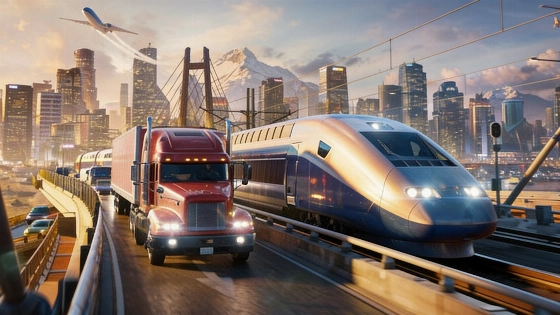
Transport Fever 3's Steam store description lists "275+ realistic vehicles" from more than a century of transport history. The lineup includes trains, buses, trams, trucks, ships and aircraft. Helicopters appear in the series for the first time. That gives players more tools, but the vehicle count alone does not show how well the game balances each type of transport.
The game fully simulates its worlds. Cities and industries grow in response to what players do. Network design is therefore tied to the surrounding environment. Long-term planning matters too. A route is not just a link between two points. It becomes part of an economic system that changes as the player expands.
Urban Games founder and CEO Basil Weber has described the studio's work as a long-running commitment to simulation games and detailed craftsmanship. That helps explain the sequel's design priorities. It is still the developer's view, not independent proof that every new system works as advertised.
Launch editions and pricing
The Standard Edition has an RRP of $49.99 / €49.99 on PC and $59.99 / €59.99 on consoles. The Deluxe Edition costs $64.99 / €64.99 on PC and $74.99 / €74.99 on consoles. The Collector's Edition is listed at $119.99 / €119.99. The release announcement does not spell out the regional contents of every package.
The official press kit gives a full breakdown of the Deluxe Edition and Collector's Edition. It also includes the release-date-announcement trailer, cover artwork, high-resolution screenshots and additional video. Players comparing the packages should check the contents of each one instead of assuming the higher price covers only early access or cosmetic items.
Before release, Transport Fever 3 reached number one on Steam's global bestseller list. That is a storefront position, not a sales figure. It does not show review quality, player retention or performance across platforms. For more transport-simulation context, the logistics-focused earlier logistics report shows how different the genre's player-facing systems can be.
What players can assess now
The main changes at launch are the new climate zone, improved terrain generation and a larger vehicle catalogue within the series' existing management framework. Players can build an empire across rail, road, sea and air instead of focusing on one transport type. Helicopters add another option, but the announcement does not explain their operating costs, capacity or place in the wider economy.
Transport Fever 3 is a large expansion of the advertised simulation toolkit, not a complete rewrite of the basic structure. The confirmed facts are straightforward. It launched on 29 September 2026 for the listed platforms. Three editions are available. The game adds Subarctic environments and helicopters, and Steam lists more than 275 realistic vehicles. What remains unclear is how well the new technology performs and whether the deeper simulation leads to meaningful strategic choices during extended play.
For PC players, Steam lists support for Windows 10 and 11, macOS and SteamOS/Linux. Its published requirements include 8 GB of RAM, an AVX2-capable CPU, a GTX 1060, RX 480 or Arc A380-class GPU, and 90 GB of storage. These are platform requirements, not independent performance tests. They do not by themselves show how the game will run on different systems.
Those unanswered questions matter because management games depend on how their systems hold up over time. A larger map or vehicle list may draw attention at launch, but it does not prove that the economy, terrain or city development will create better decisions. Based on the available evidence, Transport Fever 3 is the series' most ambitious release yet. Its strongest test will be how those systems work together, not the size of the marketing claims.
Dynamic terrain in a simulation game means the landscape can change the cost and practicality of building routes. It is not the same as dynamic resolution, which changes a game's internal image resolution to manage rendering performance. The Transport Fever 3 announcement describes improved terrain generation but gives no measured comparison with earlier entries. For now, it should be treated as a confirmed design focus, not a verified technical result.