
Hingston Digital will release MOLTYN's free PC demo on Steam on 6 October 2026. It will include five missions and two sandbox worlds ahead of the US$9.99 Early Access launch.
A city might survive a superhero with badly aimed laser vision. Gravity, lava, floods and a nuclear blast are harder to handle when they behave like real forces inside MOLTYN's simulated world.
Demo launch details
Hingston Digital will release the free PC demo on Steam on Tuesday, 6 October 2026. It will go live at 6am Pacific, 2pm BST and 3pm CEST. Japanese coverage lists the release time as 22:00 JST.
The demo will stay available during Steam Next Fest from 19 to 26 October. That gives players time to try it before the game enters Early Access on 12 November for US$9.99. GNN Gamer reported the release dates and launch price. Famitsu also lists MOLTYN among the games planned for the October festival.
The game is aimed at players who want to experiment instead of simply following a scripted power fantasy. MOLTYN runs on Steam Deck. Its interface and subtitles support English, Japanese, Simplified Chinese, Korean, Russian, Brazilian Portuguese, Latin American Spanish, German and French.
The schedule is straightforward. The free demo comes first. Steam Next Fest follows later in October. The paid Early Access build arrives in November.
Hingston Digital is an Australian indie studio and the game's developer. It separately confirmed the demo date, Steam Next Fest appearance and Early Access timing in an announcement for the Japanese market carried by Jiji Press. The announcement also names studio representative Andrew Hingston.
Physics as the power set
MOLTYN gives players laser, gravity, water, lava, storm, freeze and nuke abilities. These are more than attack animations. The game simulates how materials and structures respond.
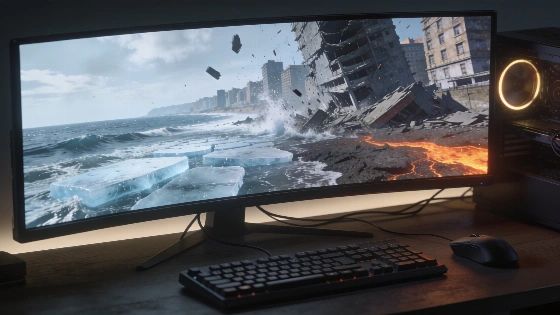
Players can melt the ground, flood a city, freeze the sea and throw the ice that forms. Buildings can collapse when their supports disappear. Evaporated water can form storm clouds and later return as rain.
According to the description reported by GNN Gamer, these forces can reshape terrain, destroy buildings and set off chain reactions across the world.
Movement also affects the simulation. Flying fast enough can turn the ground into lava. Traversal follows the same physical rules as destruction.
That gives the demo a more useful test than a standard combat showcase. The question is not only whether the powers look impressive. It is whether the world produces consequences the player did not directly script.
For readers following smaller Steam launches, NGB's earlier Steam coverage offers a useful contrast. MOLTYN is not built around a conventional adventure structure. Its hook is the freedom to create situations and then react to them.
What the demo contains
The demo includes five story missions. They cover a harbour rescue, a city-sized kaiju encounter, a fight against a copy of the player, a meteor storm and a mission on the Moon.
Each mission ends with a report card. It measures how much of the city remains standing, turning destruction into both a tool and a score.
Two sandbox worlds are also included: The Island and Blank Canvas. Their editor lets players spawn NPCs, objects, vehicles and materials. Players can then switch straight back into superhero mode.
This is the clearest way to judge MOLTYN's long-term appeal. It shows whether the simulation can support repeatable experiments beyond the authored missions.
Early Access is planned to add the first 10 of 18 intended story missions. It is also planned to include six sandbox worlds, with every level unlocked in the editor, plus local player-versus-player support through VS and Sandbox modes.
Those are planned additions, not delivered features. The November build should be treated as an unfinished stage of development rather than a final release.
Evidence behind the launch
Hingston Digital Pty Ltd is making and publishing MOLTYN. It is a one-developer studio led by Andrew Hingston in Griffith, New South Wales.
After Indie Game Joe shared the first trailer, the game passed 10,000 Steam wishlists. It has since reached about 21,000. A September Steam playtest attracted about 3,500 players. Most survey respondents rated its fun factor at 8 or more out of 10.
Those figures show that the project has found an audience before launch. They do not establish its final quality or prove that every planned system will arrive as intended.
The stronger evidence is the playable package now on offer: five missions, two editable worlds and a simulation built around material reactions rather than fixed destruction sequences.
The developer's account of the playtest describes unscripted moments such as freezing sections of the ocean and throwing them at a city. Players could also dig beneath the city until it collapsed.
That is a clear description of the design goal. The free demo will show whether the physics stay coherent when players push them beyond the examples used in promotion.
Early Access fits this project because its appeal depends on systems that will be tested through player behaviour as much as through a conventional mission count.
MOLTYN already has a sharper identity than many small sandbox launches. Its free demo gives players a way to judge that identity before paying US$9.99.
The main promise is not superhero spectacle alone. It is a world that reacts when the player stops following the obvious plan.
Early Access means players receive a work in progress rather than a finished game. The planned 18-mission campaign and future sandbox content should not be treated as guaranteed launch-day material.
That distinction matters because MOLTYN's value rests on simulation depth. The demo can show how its rules work. Continued development will determine how much variety those rules can sustain.