

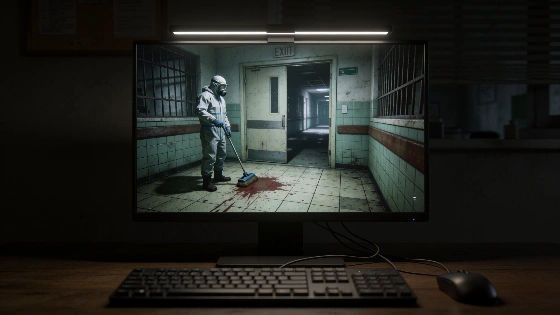
Blood Covenant sends up to four hazmat workers into an abandoned psychiatric hospital for a paid night shift. A solo demo is available now, while the co-op trial is headed to Steam and Next Fest.
Blood Covenant turns hospital cleaning into a timed escape from an active nightmare. The 1-4-player survival horror job sim was announced for Steam by Alberta-based independent studio DelaJea Press, Inc. A solo demo is available now on itch.io, and a co-op demo is planned for Steam. A developer post on Reddit dated October 2, 2026 describes Blood Covenant as the work of a solo developer and confirms the same 1-4-player co-op format. The game already has a public Steam page.
Night shift rules
The premise is more work than heroics. Players enter the abandoned Hargrove Psychiatric Institute as hazmat cleaners. They collect instructions from a tablet in the work van, scrub blood from walls, seal contaminated rooms and recover biological samples. The threat inside the building is part of the job. Noise from every tool can attract whatever is still moving through the hospital.
That creates pressure for a co-op crew. Players can split up the cleaning work, stay quiet and move quickly. The trade-off is simple: faster progress creates more noise and leaves the team more exposed.
Blood Covenant is built around completing paid instructions, not finding weapons first. Its feature list does confirm that melee combat eventually includes drills, cleavers, axes, saws and other improvised or purchased tools.
The shift ends when the timer runs out and the hospital doors lock. The crew must survive until the work van returns. Only then can extraction begin. Any unfinished job becomes a direct liability.
Demo and festival dates
The itch.io demo currently available is solo-only. The co-op version is coming to Steam on 8 October 2026, according to the announcement details. Blood Covenant is then scheduled to appear in Steam Next Fest from 19 to 26 October 2026. Steam's public festival calendar lists the October 2026 Next Fest window as 19-26 October, matching the dates reported for the game. The full game has been announced for Steam, but no final release date or launch window has been supplied.
The confirmed player count is one to four online participants, with solo play supported. Built-in voice chat is meant to help with coordination from the lobby through extraction. It also creates a gameplay risk because monsters can hear the microphone.
Full controller support is listed for Xbox and PlayStation controllers. The game is planned to support English, French, German, Italian, Spanish (Latin America), Japanese, Korean, Portuguese (Brazil), Simplified Chinese, Traditional Chinese and Russian.
Steam's festival schedule also includes a separate press preview period beginning around 8 October. Press and content creators will get access before the public event from 19 to 26 October. That puts the planned Steam demo close to the early visibility window. The itch.io build gives players an earlier way to examine the project.
Players have two ways to assess the game. The solo itch.io build can show the basic job loop immediately. The Steam demo should answer the more useful question for groups: can cleaning, noise management and emergency combat remain clear when four players are making decisions at once?
NGB's earlier release coverage also shows why access details matter more than a broad announcement when players are deciding how and when to try a new game.
The main numbers are clear. Blood Covenant supports 1-4 online players, offers a solo demo now, targets a Steam co-op demo for 8 October 2026 and is scheduled for Steam Next Fest from 19-26 October 2026. No price, full launch date, system requirements or final edition details have been announced.
Work pays until it does not
Progression is tied to the job rather than a standard campaign menu. Completed directives provide base pay. Extra blood vials can earn a commission that is multiplied by the shift number.
Between shifts, players can spend that money on promotions and black-market equipment. Successful crews therefore have a reason to take more risks before moving deeper into the hospital.
Later shifts expand the setting beyond the interior and into the exterior grounds. The announcement says the work becomes harder and the threats get worse as the crew advances. Enemy waves also grow in size, speed and aggression the longer a shift lasts.
Those details point to a progression system built around rising exposure, not a simple run of separate cleaning missions.
The game's central contradiction is clear. Players are hired to work, but their work tools may become weapons. The available information does not describe a conventional action game with cleaning added as decoration.
The directives, timer, pay and equipment purchases form the operating framework. Combat is the emergency measure that keeps the shift alive.
Blood Covenant has a clearer mechanical identity than a generic co-op horror pitch. Its strongest idea is the clash between workplace routine and survival pressure. Every completed task improves the payday. Every noisy shortcut may shorten the route back to the van.
The announcement establishes that hook. The demos will need to show whether the loop stays tense beyond its first few shifts.
For now, the evidence supports a focused Steam announcement rather than a release story. Players can try the solo demo on itch.io. The forthcoming Steam build should provide the first meaningful test of the four-player design.
Until the studio supplies a full release date, price and technical requirements, Blood Covenant is best treated as a playable introduction to a co-op horror concept, not a finished product with a confirmed launch plan. Its unusual strength is that the threat is tied directly to the work. Whether that makes the long-term game compelling will depend on how much variety those night shifts deliver.
Voice chat adds another risk. In ordinary online co-op, a microphone is mostly a communication tool. Blood Covenant makes it part of the stealth system because monsters can hear players.
A stable network connection may keep conversation clear. Careful teams will still need to control when they speak because communication itself can change the danger around them.