
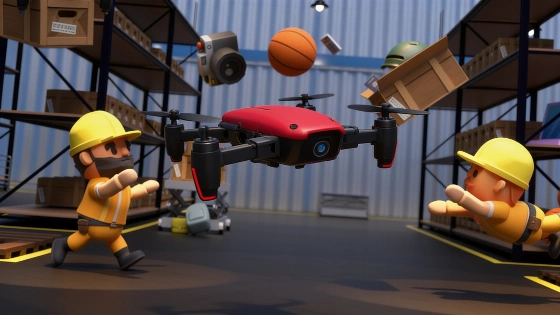
Found it!: Lost & Found Co. is coming to Steam in Q1 2027. The game combines solo and online co-op play with lost belongings, messy storage and impatient customers.
A lost and found warehouse may seem like an odd setting for a management game. Then every shelf becomes a choice and every misplaced item becomes a customer complaint. Found it!: Lost & Found Co. is coming to Steam in Q1 2027 as a first-person simulation for solo play and online co-op.
Pressure in the warehouse
Developer The Crow Studio and publisher GrabTheGames announced the project on October 1, 2026. The idea is simple. Players receive shipments of lost belongings, unpack them, sort the contents and find the right item when its owner arrives to claim it.
The challenge comes from handling objects instead of managing a basic menu inventory. Items can be grabbed, carried, thrown and stacked. Accidents can also wreck whatever system the player has built.
Players decide how that system works. Shelves, baskets, containers and labels can be arranged to suit personal preferences. An orderly warehouse should make searches faster, but building a huge pile remains possible. That choice sits at the heart of the game. Organisation is not just decoration. It is a practical response to incoming deliveries and customers who are growing impatient.
The announcement details should be treated as information from the project's supplied launch materials, not as independently confirmed reporting. A check of the Steam Store and available search results found no Tier-1 coverage or separate official press release confirming the Q1 2027 window or the listed studio and publisher.
Automation arrives
As the warehouse expands, Found it!: Lost & Found Co. adds equipment to cut down on repetitive work. Conveyors can move items through the facility. Box openers can speed up incoming shipments. Sorters can help separate belongings before they vanish into storage.
The announcement gives no technical specifications or performance targets. These systems should therefore be treated as confirmed gameplay features, not proof of how large or complex the final warehouse will be.
The workload is built for co-operation too. Online teams can split up the work. One player might unpack shipments while another organises storage or deals with customers. The same operation can also be managed alone.
Deliveries, physics-based mishaps and customer demands may pile up at the same time. A tidy plan can become a recovery job within seconds.
Steam Store search results surfaced broad genre tags linked to simulation, automation, incremental mechanics and physics. Those tags fit the described design, but they do not confirm a specific listing, feature set or final classification for Found it!: Lost & Found Co.
Clues in the clutter
Finding an item is not just about recognising its shape. Customers may be matched with belongings using details such as item type, colour, source, owner and value.
That adds an investigative layer to the search. The supplied announcement does not explain how clues will appear or whether requests will become procedurally harder over time.
The warehouse will contain hundreds of physical items, including ordinary belongings such as bags, wallets and passports. Shipments may also hold stranger objects, breaking up the routine of sorting everyday property.
Progression and reputation are part of the design. Customers are expected to become more demanding, testing whether the player's storage method can keep working as the warehouse grows.
Found it!: Lost & Found Co. belongs to the broad family of tactile management games where the physical arrangement of objects matters as much as the business loop. NGB's earlier coverage of another independent PC project also showed why a clear central system can matter more than a long feature list. The two games use very different structures.
What Steam players know
The confirmed launch window is Q1 2027. The confirmed platform is PC through Steam. The announced modes are single-player and online co-op.
No price, system requirements, release date within the quarter, console version, trailer link or technical performance information has been supplied. There is no basis yet for judging how demanding the simulation will be or whether co-op includes any extra progression systems.
A Steam wishlist page is available for players who want to follow the project before launch. The press material describes the game's core loop and intended features. It does not establish a finished product, a playable build or an independently tested performance profile.
That distinction matters for a simulation built around responsive physics, readable object clues and an interface that can handle a crowded warehouse without getting in the way.
Available search checks also found no fresh report from Reuters, the Associated Press, Bloomberg, the Financial Times or The Wall Street Journal confirming the announcement. They found no separate official developer or publisher page carrying a verifiable press release either.
This does not change the announcement described above. It does mean the project's current status and details are supported mainly by the supplied announcement materials. They should be treated that way until more primary documentation appears.
Found it!: Lost & Found Co. has a stronger hook than its messy premise might suggest. It makes organisation the main source of both progress and failure.
The Crow Studio and GrabTheGames have confirmed a focused PC simulation with solo and online co-op support. The announcement does not promise a limitless business empire. For players who like tactile management and controlled chaos, that is enough to watch the project. The Q1 2027 launch window will need to be followed by evidence of how its physical systems and customer demands work in practice.
Physical simulation means the game treats objects as things that occupy space and can affect one another. They are not just static inventory icons.
That approach could make throwing, stacking and conveyor movement feel immediate. It also makes collision behaviour and object readability important. In a warehouse filled with hundreds of items, small problems with physics or visual clarity could turn deliberate disorder into frustration.
Until the game is shown in a playable build, the concept is convincing. Its execution remains untested.