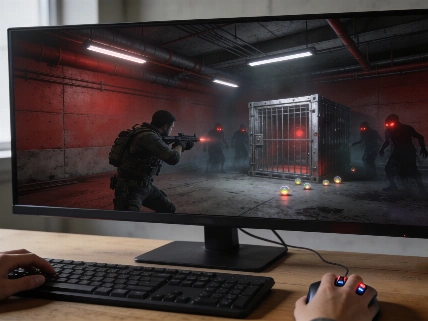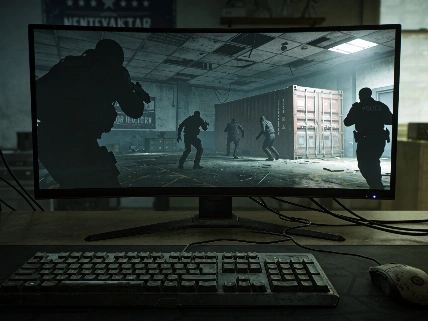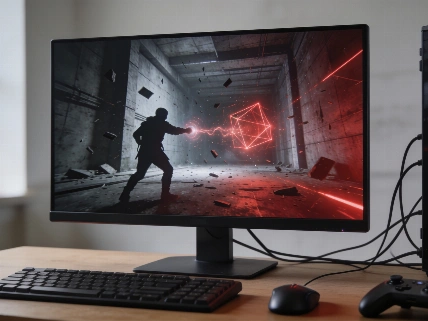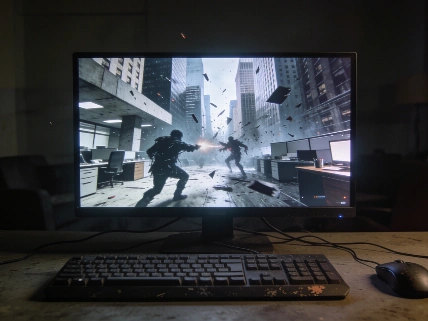

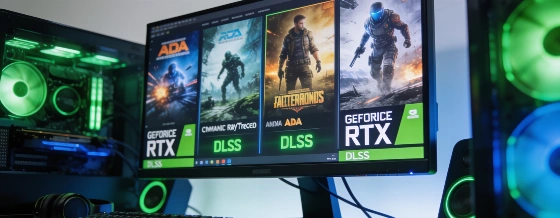
NVIDIA's GeForce Game Ready driver 617.14 prepares four major PC launches with DLSS 4.5 and RTX support, including path tracing, frame generation and AI development tools.
NVIDIA has released GeForce Game Ready driver 617.14 WHQL for Windows 10 and Windows 11 ahead of four major PC launches. The biggest technical push is for CONTROL Resonant. The driver adds game-specific optimisations for CONTROL Resonant, The Witcher 3: Wild Hunt - Remastered, AION 2 and Gears of War: E-Day. It also expands support for NVIDIA's latest DLSS 4.5 and RTX features.
Four launches in focus
The schedule starts with CONTROL Resonant on September 24. The Witcher 3: Wild Hunt - Remastered follows on September 29. AION 2 opens advanced access on September 30 and regular access on October 5. Gears of War: E-Day offers advanced access from October 1 before its regular access date on October 6.
That makes driver 617.14 a launch update, not a routine compatibility release. NVIDIA has matched the package to four games arriving close together. GeForce owners get one driver that covers several immediate PC releases instead of a separate update for each game.
The timing matters for Gears of War: E-Day. Xboxygen reported that the game had reached gold status. Preloading was scheduled for September 29, with release set for October 6. The driver arrives during the launch preparation window, not after the game is out.
The release notes, as reported by Comss, also list fixes outside the four featured games. They cover launch problems in Judgement, Lost Judgement and Virtua Fighter 5 R.E.V.O. Another fix addresses a black screen or missing image on some HDMI and DisplayPort monitors in the R615 driver branch.
CONTROL Resonant has the longest feature list. NVIDIA says the game supports the full DLSS 4.5 and RTX suite. That includes Super Resolution, Dynamic Multi Frame Generation, Ray Reconstruction, path-traced direct and indirect illumination, ray-traced reflections and outdoor shadows.
CONTROL puts the hardware to work
Dynamic Multi Frame Generation is listed as supporting up to 6X frame rates in CONTROL Resonant. NVIDIA's official benchmarks put the GeForce RTX 5090 at up to 320 FPS in 4K and up to 480 FPS at 1080p.
Those are manufacturer benchmarks, not independent tests. They show the performance NVIDIA is presenting for the feature set. They do not establish a universal result for every PC.
Frame generation creates extra frames through GPU-assisted processing. It can raise the displayed frame rate, but that is not the same as a native rendering workload. It also does not prove identical input response. The supplied driver information does not include test settings, processor details, game versions or independent frame-time measurements.
Readers comparing reconstruction technologies will find a different focus in the image-quality discussion around PlayStation hardware in earlier PSSR coverage. The confirmed information here concerns NVIDIA's software stack and its use across several PC games. It does not concern a console performance mode.
Remasters and online access
The Witcher 3: Wild Hunt - Remastered is set to receive an update with an overhauled skill system. The update also brings refined animations and combat mechanics, cross-platform mod compatibility, meditation features and an enhanced photo mode.
For RTX users, the update adds path tracing and DLSS 4.5 features. The remaster's technical changes arrive alongside its gameplay and quality-of-life updates.
AION 2 launches with DLSS 4.5 Super Resolution and Multi-Frame Generation support for GeForce RTX graphics cards. Its access dates are split between advanced access and regular access. The supplied information does not say what conditions apply to either period or whether additional editions are required.
Gears of War: E-Day is listed with DLSS Super Resolution, Dynamic Multi Frame Generation and NVIDIA Reflex. Its rendering technology includes ray-traced Lumen global illumination, MegaLights shadows and NVIDIA RTX Mega Geometry support. That gives the game a broad mix of lighting, latency and geometry features in this driver update.
The final PC requirements put those features in context. For the Ultra target of up to 4K at 60 or more frames per second, the published specifications name a GeForce RTX 5070 Ti or Radeon RX 7900 XT, 16 GB of RAM and a processor such as the Core i7-14700K or Ryzen 7 7800X3D. TweakTown reported these requirements as part of the game's final PC specification set.
An SSD is mandatory. The game also requires a graphics card with hardware ray-tracing support. GPUs without that capability are not supported.
That requirement fits the game's advertised ray-traced Lumen lighting and other RTX-related rendering features. It does not guarantee a particular frame rate on every supported configuration.
Tools behind the games
NVIDIA has also released developer updates for AI integration in games. The package includes NVIDIA ACE for AI-driven in-game characters, Nemotron Speech 3.5 Streaming for speech recognition and Qwen3 TTS for text-to-speech.
These are development tools. Their inclusion does not confirm that every technology will appear as a player-facing feature in the four launches.
The RTX Mega Geometry SDK has reached version 2.0 with updates for advanced mesh handling. Geometry processing affects how detailed environments and objects can be. The announcement does not provide a direct performance comparison between SDK versions. It also does not identify a specific improvement that players will see in every supported title.
Driver 617.14 is most useful as launch-day preparation for GeForce owners. It is not a promise of identical performance across all four games.
NVIDIA has confirmed broad feature support and published headline RTX 5090 benchmark figures. Independent testing will still be needed to assess frame pacing, latency and image quality across different settings and hardware.
DLSS Super Resolution reconstructs a higher-resolution image from a lower internal render. Frame generation creates additional displayed frames between traditionally rendered ones. Path tracing changes how lighting is calculated and can put a heavier load on the graphics card.
The technologies can work together. A higher frame-rate counter alone does not establish native resolution, stable frame delivery or lower input latency.