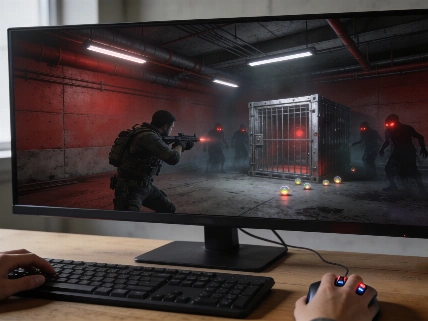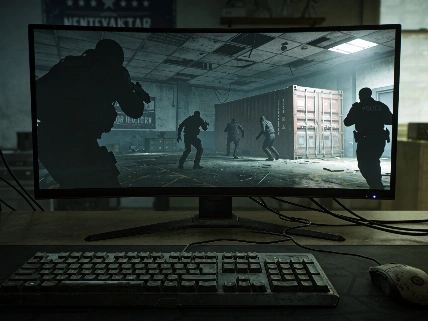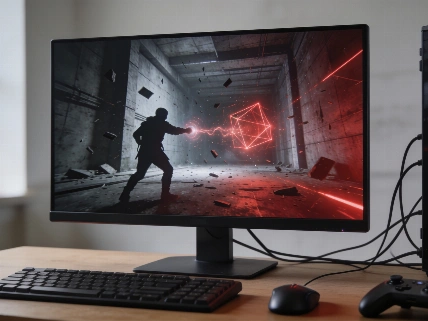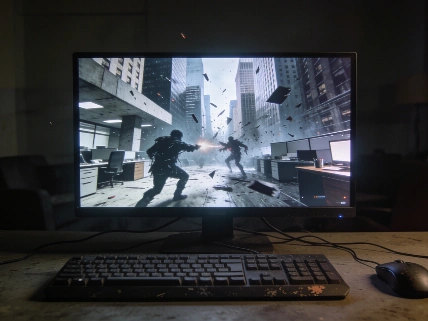

NVIDIA's GeForce Game Ready Driver 617.14 is now available with launch support for CONTROL Resonant, The Witcher 3: Wild Hunt - Remastered, Aion 2 and Gears of War: E-Day.
NVIDIA's GeForce Game Ready Driver 617.14 is now available with support for four major PC launches scheduled between 24 September and 6 October. The update covers CONTROL Resonant, The Witcher 3: Wild Hunt - Remastered, Aion 2 and Gears of War: E-Day. It also expands the developer tools behind NVIDIA's AI and geometry technologies.
The driver is WHQL-certified for 64-bit versions of Windows 10 and Windows 11. According to Comss, the 617.14 files are already on NVIDIA's servers. The company website and automatic updates may take more time to distribute them.
Four launch windows
CONTROL Resonant arrives on 24 September. The Witcher 3: Wild Hunt - Remastered follows on 29 September. Aion 2 starts advanced access on 30 September, ahead of its regular access date on 5 October. Gears of War: E-Day offers early access from 1 October at 15:00 UTC, before its worldwide launch on 6 October at 15:00 UTC. An independent TechWiser profile confirms that 24 September is the release date for CONTROL Resonant, not an early-access window.
That schedule makes the driver a release-week update rather than a broad graphics refresh. NVIDIA has grouped game-specific support around a tight launch period. GeForce owners get one driver for several demanding releases instead of waiting for separate post-launch tuning.
The timing also helps explain how platform and access dates can shape a launch story. NGB's release-date report on Phantom Blade Zero looks at that issue from another angle. Here, the focus is NVIDIA's software support for four separate games.
CONTROL pushes RTX
CONTROL Resonant gets the broadest technical treatment in the announcement. NVIDIA says the game supports the full DLSS 4.5 and RTX suite. That includes Super Resolution, Dynamic Multi Frame Generation with up to 6X frame generation, Ray Reconstruction, path-traced direct and indirect illumination, reflections and outdoor shadows.
NVIDIA's own figures put the GeForce RTX 5090 at up to 320 frames per second at 4K and up to 480 frames per second at 1080p in its CONTROL Resonant benchmarks. These are manufacturer figures, not independent measurements. The phrase "up to" describes a peak result under NVIDIA's stated test conditions. It does not guarantee the same frame rate in every scene or setup.
DLSS 4.5 combines reconstruction and frame-generation features to produce a higher displayed frame rate than the GPU would render on its own. That can help in a ray-traced game. The headline number does not, by itself, show frame pacing, input latency or image quality during a long play session.
Remaster and MMO support
The Witcher 3: Wild Hunt - Remastered is scheduled for 29 September. It brings an overhauled skill system, refined animations and combat mechanics, cross-platform mod compatibility, meditation features and an enhanced photo mode. The update also adds path tracing and DLSS 4.5 features for RTX users. Those technical changes arrive alongside broader gameplay and quality-of-life updates.
Aion 2 launches with DLSS 4.5 Super Resolution and Multi-Frame Generation support for GeForce RTX graphics cards. The announcement confirms the graphics features and the two access dates. It does not provide independent performance testing, a frame-rate target or a resolution target for the MMO.
That distinction matters for buyers comparing PC hardware. Driver support confirms that the stated rendering technologies are integrated or enabled for the games. It does not confirm identical performance across RTX models, graphics settings or game areas.
Gears and developer tools
Gears of War: E-Day brings a wider set of RTX features to its launch. NVIDIA lists DLSS Super Resolution, Dynamic Multi Frame Generation and NVIDIA Reflex. The game will also use ray-traced Lumen global illumination, MegaLights shadows and NVIDIA RTX Mega Geometry.
Microsoft's Xbox News announcement says Gears of War: E-Day officially went gold on 17 September 2026. That means development of the release build has finished and lowers the risk of a delay. The game will launch on Xbox Series X|S, Xbox on PC and Steam. It will also be available on day one through Game Pass Ultimate and PC Game Pass.
Xbox will start preloading on 29 September 2026 at 15:00 UTC. The same announcement gives 8:00 AM Pacific Time as the shared release time for early access and the full launch. Microsoft also confirmed that day-one Game Pass access and early installation are meant to prepare players for both access phases.
NVIDIA Reflex is meant to improve responsiveness. The lighting and geometry features target visual detail and scene complexity. The announcement includes no measured latency results or independent testing. The real-world effect will depend on the final game build, the selected settings and the hardware in use.
The driver announcement also includes developer updates beyond the four games. NVIDIA has highlighted NVIDIA ACE for AI-driven in-game characters, Nemotron Speech 3.5 Streaming for speech recognition, Qwen3 TTS for text-to-speech and version 2.0 of the RTX Mega Geometry SDK for advanced mesh handling. These are development tools. Their inclusion does not confirm that every technology will appear as a player-facing feature in the four launches.
For PC players, the immediate value is clear but narrower than the marketing language suggests. Driver 617.14 provides the planned launch support for a technically ambitious group of games. CONTROL Resonant gets the fullest RTX feature set, while Gears of War: E-Day combines rendering tools with Reflex. NVIDIA's benchmark peaks show what its own test setup achieved. They do not replace independent checks of stability, latency and image quality. The update is worth installing for owners of the affected games, but the final performance verdict will have to wait for testing on released builds.
Dynamic Multi Frame Generation creates extra displayed frames between conventionally rendered frames. A higher counter reading does not automatically mean lower input latency. DLSS Super Resolution reconstructs a higher-resolution output from a lower internal render. Path tracing adds a heavier lighting workload. These differences matter because driver support and an advertised peak frame rate show technical capability, not uniform performance.