
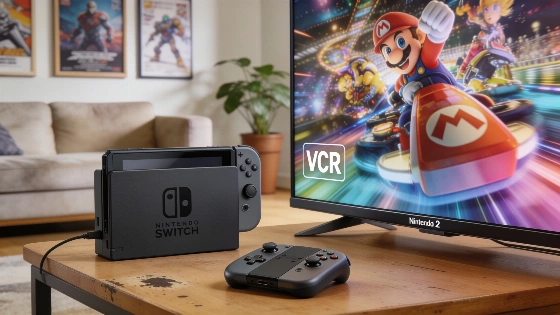
Nintendo Switch 2 now delivers docked VRR support that surpasses PlayStation 5's implementation, but only patched games can benefit and a persistent system quirk complicates display settings for some players
Nintendo Switch 2's docked Variable Refresh Rate (VRR) support has leapfrogged PlayStation 5's offering, but the real-world benefit depends entirely on developer action and player awareness of a persistent system quirk. The technical edge is clear, yet the practical impact remains limited for now.
Measured VRR Advantage
Independent technical analysis has confirmed that Nintendo Switch 2's docked VRR implementation delivers a broader effective range than PlayStation 5. When connected to a 120Hz display, the Switch 2 supports full Low Framerate Compensation (LFC), while in 60Hz mode, it covers 40-60Hz-matching Xbox Series X|S and outclassing PlayStation 5's narrower 48-60Hz window. This means developers can target 40 frames per second modes or even unlocked framerates with less risk of visible stutter or tearing, provided the game is patched to support VRR.
Despite the hardware's capabilities, only a single title-Welcome Tour-currently supports VRR in docked mode. All other games require explicit updates to take advantage of the feature. The system's own screen also supports VRR, raising expectations that future releases will integrate the technology as standard, especially for fast-paced or visually demanding titles.
Developer and Player Limitations
The catch is that VRR support is not automatic. Developers must patch their games to enable VRR compatibility, and at present, the overwhelming majority of Switch 2's library remains unchanged. This means that, for now, most players will see no benefit unless they are playing Welcome Tour or a future patched release. The situation mirrors the early days of VRR on other platforms, where technical potential outpaced actual implementation.
There is also a system-level quirk: when VRR is enabled in the Switch 2's display settings, it remains active at all times, regardless of whether the running software supports it. For players who rely on features like black frame insertion for improved motion clarity, this can force repeated trips into the settings menu to toggle VRR on or off depending on the game. While this is unlikely to affect the majority, it is a notable inconvenience for those who demand precise control over their display experience.
Technical Context and Platform Comparison
Switch 2's VRR support now stands on par with Xbox Series X|S in terms of refresh-rate range, and ahead of PlayStation 5's more restrictive implementation. The difference is not just theoretical: a wider VRR window allows for smoother gameplay in modes that target non-standard frame rates, such as 40fps, which has become increasingly popular for balancing visual quality and responsiveness. However, the lack of widespread game support means the advantage is, for now, mostly potential rather than realised benefit.
With major releases like Metroid Ravenous on the horizon, the expectation is that more developers will patch in VRR support to take advantage of the hardware. Yet, as seen with other platform features, adoption can be slow and inconsistent. The technical leap is real, but the player experience will only improve as studios commit to supporting the feature in both new and existing titles. For context, the challenge of aligning technical capability with developer uptake is not unique to Nintendo; similar patterns have played out across the industry, as seen in reported earlier for PC platform launches.
What Players Should Expect
For now, Switch 2 owners should not expect immediate transformation in game performance simply by enabling VRR in system settings. Only patched games will benefit, and the system's all-or-nothing approach to VRR activation may frustrate those who frequently switch between titles with and without support. The hardware is ready, but the software ecosystem must catch up before the full advantage is felt across the platform's catalogue.
Switch 2's VRR leap is a technical win, but it is not a player win until developers deliver the necessary updates. Nintendo has set the stage for smoother, more flexible performance modes, but the onus is now on studios to make that promise real. Until then, the Switch 2's VRR advantage is a headline feature waiting for its moment in the spotlight.
Variable Refresh Rate (VRR) is a display technology that allows a monitor or television to synchronise its refresh rate with the output of a console or PC. This reduces screen tearing and stutter, especially when frame rates fluctuate below the display's maximum. The effective VRR window-the range of frame rates over which the technology works-determines how often these benefits are delivered. Wider VRR windows, like those now supported by Switch 2 and Xbox Series X|S, allow for smoother gameplay at a broader range of frame rates, but only if the game and system are configured to take advantage of the feature.