
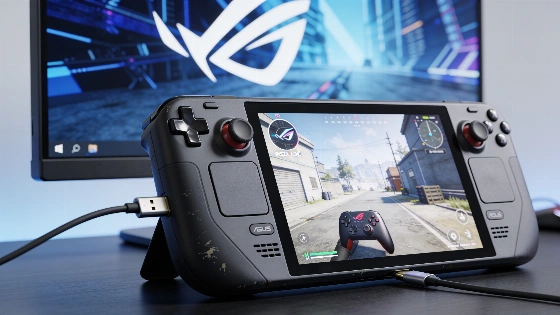
HelixSR runs NVIDIA's DLSS 3.7 Preset E through DirectX 12 shaders on Steam Deck and AMD handhelds. Early tests show lower processing costs than FSR 4, but independent verification remains limited.
The first public build appeared on GitHub two days before the report, giving Steam Deck users an experimental way to run NVIDIA's DLSS 3.7 Preset E on AMD graphics hardware.
HelixSR is a new mod that replaces AMD's FSR 3.1 upscaler in Direct3D 12 games. The game still believes it is using FSR 3.1. HelixSR routes the reconstruction through DLSS's neural network instead. The relevant public discussion sits on Reddit rather than an authoritative technical publication, so broad compatibility remains unproven. Stability and continued development also need confirmation.
DLSS Without NVIDIA Hardware
Developer lonewolf0622 released HelixSR through GitHub. The Reddit discussion points to public releases in the developer's repository, but the available search material does not provide independently verifiable information about the version, release date, license or exact file contents.
The implementation avoids the usual NVIDIA dependencies. Its network runs as ordinary DirectX 12 compute shaders and does not require an NVIDIA driver. CUDA is not required either, and the mod does not depend on ROCm.
That design lets HelixSR work on Linux through Proton and vkd3d-proton, a key detail for Steam Deck users. The handheld uses AMD graphics, so conventional NVIDIA DLSS support is unavailable. A DirectX or Proton-level replacement could bypass that hardware barrier, though the available evidence does not establish compatibility with every game or SteamOS version.
HelixSR uses Preset E, also known as Model E, from DLSS 3.7. NVIDIA moved from this last CNN-based DLSS model to Transformer models with DLSS 4. Its lighter workload makes Preset E a more credible fit for low-power handheld GPUs.
NVIDIA's public developer documentation remains the primary reference for DLSS model terminology. The specific claim that HelixSR ports this model to AMD hardware comes from community reporting, not an NVIDIA statement.
A Reddit participant claims that HelixSR relies on FP16 calculations. The same discussion suggests that older AMD hardware, including RDNA 1 and Vega, may work with the mod. That is an estimate from the discussion rather than a developer-confirmed specification. It does not guarantee that every GPU in those families will run HelixSR correctly.
Early Tests Favour HelixSR
The available figures look promising, but they come from early community measurements rather than a controlled review.
One ResetEra user recorded roughly 3.5 milliseconds per frame for HelixSR at 800p, compared with 4.5 milliseconds for FSR 4. At 1080p, the comparison was 7 milliseconds versus 11 milliseconds on a Steam Deck GPU running at 1400 MHz.
On the BC-250, testing in Hitman: World of Assassination at 4K produced 35 frames per second with DLSS Quality and 17 frames per second with FSR 4. The result does not establish a universal advantage across every game or setting. It does explain why the mod drew attention so quickly.
The broader source material mentions video tests on RDNA 2 and BC-250 GPUs. It does not disclose complete settings, driver versions or measurement methodology, so the results cannot currently be reproduced independently from the available information.
Image quality remains unsettled. The original tester rated HelixSR below FSR 4 while placing it clearly ahead of FSR 3.
YouTuber BlackHeart909 reached 34 to 40 frames per second in Pragmata on Steam Deck in Performance mode. In CONTROL Resonant on the ROG Ally X at 1080p, the result was 35 to 40 frames per second. Reducing the Ally X output to 720p allowed a locked 60 frames per second and addressed heavy ghosting previously seen in that game.
Rapid Updates and Hard Limits
According to the report, HelixSR received five updates in the few days after launch.
The developer added a single-file installer. Quality Super-Sampled Mode was introduced to render above the display resolution for cleaner edges. A separate fix addressed a blurry-image problem reported on RDNA 3 hardware under Windows.
That last change relates directly to the issue seen in BlackHeart909's ROG Ally X testing. The update and stability claims have not been independently confirmed by an authoritative source. The available search result is an unofficial Reddit discussion, so the chronology and current status should be checked against the developer's repository.
The mod supports Direct3D 12 games only. It has no Vulkan support. Games that do not use FSR 3.1 require OptiScaler as an additional route, adding another compatibility requirement before the technique can be used.
AMD's FSR 4 is officially restricted to RDNA 4 GPUs. Steam Deck uses RDNA 2. Handhelds such as the ASUS ROG Ally and ROG Ally X use older AMD architectures.
Community methods can bring FSR 4 to those devices, but the reported performance cost is too high for demanding games. That leaves HelixSR as a more attractive compromise for this hardware class.
A Useful Handheld Stopgap
HelixSR gives developers and players a way to run a lighter CNN reconstruction model through existing DirectX 12 shader infrastructure. It does so without waiting for official hardware support or a new generation of handhelds.
For Steam Deck owners, the mod could extend the useful life of a machine increasingly separated from newer upscaling features.
Valve is reportedly targeting 2028 for Steam Deck 2, according to AMD leaker Kepler_L2. The component crisis could delay that plan. HelixSR does not remove the Deck's hardware limits, but it may reduce the penalty of choosing a lower internal resolution in games that already support FSR 3.1.
The wider Steam Deck software ecosystem shows that DLSS-like replacements have not become a standard scaling path. A separate GitHub project for another game continues to recommend FSR 3 at 1280×720 on Steam Deck. That is not a direct HelixSR test, but it provides useful context: established FSR configurations remain the documented fallback while experimental alternatives are evaluated on a game-by-game basis.
The strongest evidence is the measured processing advantage rather than a settled image-quality victory. Early results support further attention, while the Direct3D 12 restriction and OptiScaler dependency keep HelixSR experimental. Visual assessments also vary between tests.
Upscaling reconstructs a higher-resolution image from a lower-resolution render, so output resolution alone does not describe the workload. HelixSR's reported millisecond figures measure the reconstruction step rather than complete frame time. A lower cost can leave more GPU capacity for lighting and geometry, but it does not guarantee identical image quality or stable performance in every game.