
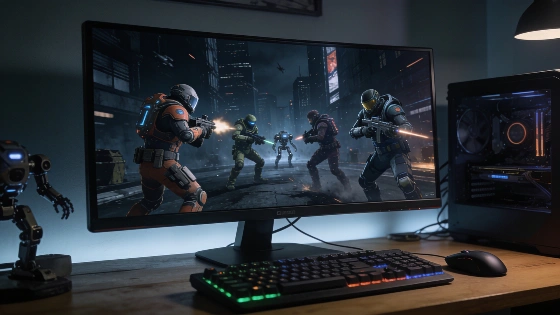
NC has locked in a premium price and PC-first launch for Cinder City, with the first public alpha scheduled for Q4 2026 and a new demo revealing four-player co-op dungeons and hundreds of concurrent players
NC has drawn a clear line in the sand for Cinder City: the MMO shooter will launch first on PC as a buy-to-play title, with the earliest public alpha now scheduled for the final quarter of 2026. This decision ends speculation about free-to-play ambitions and signals a deliberate move to court players seeking a more traditional, up-front purchase model in a market saturated with microtransaction-driven shooters.
Business Model and Platform Plan
The most immediate consequence for players is the confirmation that Cinder City will not be free-to-play. Instead, NC will charge a one-off box price for access, with additional revenue coming from a cosmetics shop and Battle Passes. According to NC America's Daniel Lafuente, all cosmetic items-including skins, weapon attachments, and key rings-will be strictly non-essential, offering no gameplay advantage. This approach mirrors the structure seen in other premium live-service shooters, but stands in contrast to the free-to-start model recently adopted by other titles, such as the one reported earlier for Bot Colony Redux.
At launch, Cinder City will be available exclusively on PC, with console versions planned for a later date. Cross-play support remains undecided, and the initial PC release will be a full launch rather than an early-access rollout. The alpha test, set for Q4 2026, will be closed and under NDA, with broader beta access to follow as development progresses.
Gameplay Structure and Character Roster
NC has now demonstrated the MMO and co-op elements that were previously only described. The latest pre-alpha test placed hundreds of players into a single open-world field, and the new demo showcased a four-player co-op dungeon with a distinct horror tone. The playable cast has been trimmed from the originally discussed seven-to-nine Cinder Knights to five at launch: Seven (assault), Vulcan (tank), Orang (sniper), Psyker (robotics), and Angel (support medic). Each character now fits a recognisable archetype, a notable shift from earlier claims that Cinder City would avoid the classic tank-healer-DPS formula.
Combat is built around a tactical gear system, with players able to swap weapons and attachments on the fly. Attachments are not just cosmetic-they alter weapon handling and performance. Abilities are unlocked through progression, but only a limited set can be equipped at any time, encouraging players to adapt their builds for different missions and dungeons. The co-op dungeon content introduces mechanics such as reviving downed teammates, coordinated boss strategies, and skill-based weak points, aiming to reward teamwork and precision.
Technical Ambition and Open World
The technical ambition behind Cinder City is to support hundreds of concurrent players in a seamless Unreal Engine 5 open world, without sacrificing visual fidelity. The development team claims to have achieved this in recent pre-alpha tests, with a 7x7-kilometre Seoul-inspired map hosting large-scale PvE encounters and instanced dungeons. Endgame content is split between smaller co-op dungeons for four to six players and massive open-field raid bosses requiring dozens of participants.
Recent improvements have focused on animation, movement, and combat responsiveness, as well as the addition of crafting and weapon repair systems. Players can craft ammunition during combat and repair weapons at workbenches scattered throughout the world. The design philosophy emphasises player choice in mission approach, with the stated goal that no two runs play out identically. Difficulty options will be available for both story content and dungeons, and the narrative can be experienced solo or in co-op, with some sections requiring single-player progression before opening up to group play.
Remaining Uncertainty and Player Impact
While the business model and PC-first launch are now settled, several details remain in flux. The level cap is currently set at 20 per Cinder Knight, but this may change before release. PvP is under consideration, with the team exploring arena-based duels triggered by specific items, but PvE remains the primary focus. The next pre-alpha tests will be closed and region-specific, with open beta access planned further down the line. Post-launch, NC intends to deliver new missions, dungeons, and narrative updates through live-service support, but has not committed to paid expansions at this stage.
For players, the most significant shift is the move towards a more conventional class-based structure and a premium price point, both of which suggest NC is targeting a core shooter audience rather than chasing the broadest possible free-to-play market. The technical claims around open-world concurrency and seamless co-op will need to be proven in public tests, but the roadmap now offers a concrete timeline and a clear set of expectations. Cinder City is positioning itself as a contender in the crowded MMO shooter space, but its success will depend on whether it can deliver on these promises without falling into the traps that have plagued similar live-service projects.
Understanding the difference between a closed alpha, a beta, and a full launch is crucial for players following Cinder City's development. A closed alpha is an early, invitation-only test under strict NDA, often used to identify major technical issues and gather feedback from a small group. Beta tests are typically broader, sometimes open to the public, and focus on balancing, stability, and final feature integration. A full launch means the game is considered content-complete and available for purchase, though live-service titles like Cinder City will continue to evolve post-release through updates and new content drops. Players should be aware that early test builds rarely reflect the final experience, and features or performance may change significantly before launch.