
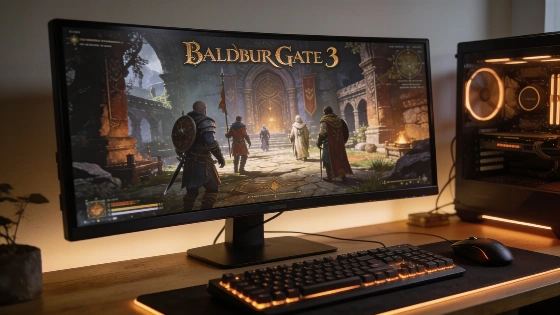
Mark Darrah, who worked on the original Baldur's Gate games, has highlighted why Baldur's Gate 3 stands out as a sequel, crediting its willingness to evolve beyond the series' classic formula and embrace new influences
Baldur's Gate 3 has drawn praise from Mark Darrah, a programmer on the original Baldur's Gate and its sequel, for its approach to continuing the series after more than two decades. Rather than attempting to replicate the exact style and mechanics of the late-1990s Infinity Engine games, Larian Studios has instead delivered a modern CRPG that acknowledges its heritage while embracing significant change.
Evolution over imitation
Darrah's comments, made in conversation with FRVR, focus on the importance of not treating sequels as strict recreations of their predecessors. He points out that while games like Pillars of Eternity have successfully channelled the spirit of classic Infinity Engine RPGs, the industry and player expectations have shifted considerably since the release of Baldur's Gate 2. According to Darrah, Larian's decision to blend elements from its own Divine Divinity series and other modern CRPGs has allowed Baldur's Gate 3 to feel both familiar and genuinely new.
He notes that while some spiritual successors have delivered faithful adaptations of the old formula, this approach can risk feeling dated or redundant. In contrast, Baldur's Gate 3's willingness to reinterpret the series' foundations has been key to its critical and commercial success, especially given the long gap between entries.
Influences and design choices
Darrah highlights that Larian's experience with games such as Divinity: Original Sin has shaped the design of Baldur's Gate 3, resulting in a game that is recognisably part of the Baldur's Gate lineage but also distinct in its systems and presentation. He suggests that the evolution of the CRPG genre, including titles like Neverwinter Nights and Dragon Age Origins, has informed the direction taken by Larian, leading to a sequel that reflects the broader arc of RPG development over the past two decades.
This approach is consistent with trends seen elsewhere in the industry, where long-running franchises often need to adapt to remain relevant. For example, the recent overhaul of Blood Bowl 3, as covered in our article on Warhammer Blood Bowl's free upgrade, demonstrates how developers are rethinking established series to meet modern expectations.
What remains unique about Baldur's Gate 3
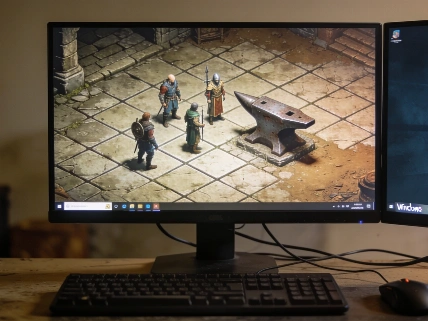
Despite its departures from the original formula, Baldur's Gate 3 retains key elements that connect it to its predecessors, including its Dungeons & Dragons roots and party-based structure. However, the game's turn-based combat, cinematic dialogue, and expanded narrative choices mark a clear shift from the real-time-with-pause mechanics and isometric presentation of the earlier titles.
Darrah's perspective suggests that the success of Baldur's Gate 3 lies in its ability to balance nostalgia with innovation, offering long-time fans a recognisable world while providing new players with a contemporary RPG experience. The game's critical reception and strong sales figures since launch indicate that this strategy has resonated with a broad audience.
When discussing sequels and franchise revivals, it is important to understand the distinction between remakes, remasters, and reinterpretations. A remake typically rebuilds a game from the ground up, often with new technology and design, while a remaster updates visuals and performance but keeps the core structure intact. Baldur's Gate 3 is neither; it is a sequel that reimagines what a Baldur's Gate game can be, reflecting both the evolution of the genre and the changing expectations of players over time.