
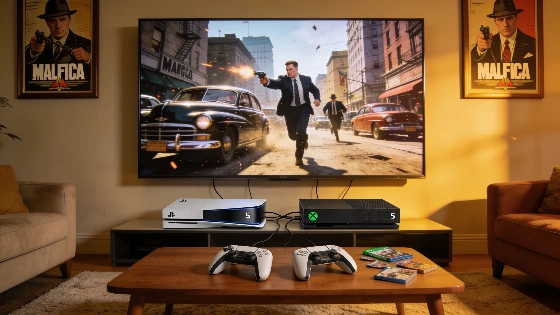
2K and Hangar 13 celebrate 25 years of Mafia with The Omertà Collection, bringing together remastered editions and a new update for PlayStation 5 and Xbox Series X|S, while reflecting on the series' evolution and future direction
The Mafia franchise has reached a significant milestone, with 2K and Hangar 13 marking 25 years since the original game's release by launching Mafia: The Omertà Collection. This new bundle brings together Mafia: The Old Country Definitive Edition, Mafia: Definitive Edition, Mafia II: Definitive Edition, and Mafia III: Definitive Edition, alongside a free update for Mafia: Definitive Edition on PlayStation 5 and Xbox Series X|S that introduces 60 frames-per-second gameplay. The collection aims to offer both long-time fans and newcomers a comprehensive way to experience the series' evolution across multiple generations of hardware.
Origins and Early Development
Mafia began life in 2002 as a project from Illusion Softworks, a Czech studio that set out to create a crime-focused game with a strong narrative. The original team, many of whom are still involved today, drew inspiration from classic gangster films and sought to blend cinematic storytelling with gameplay-a relatively uncommon approach at the time. The first Mafia was notable for its emphasis on story and its early use of cinematic techniques, despite the team's limited experience and resources. Development was challenging, taking over four years, but the result was a game that resonated with players and exceeded the team's expectations in terms of commercial success.
The unexpected popularity of the original Mafia established the foundation for a franchise. The game's reception, particularly in the Czech Republic, turned it into a cultural export and led to the acquisition of Illusion Softworks by Take-Two in 2008. This transition brought new resources and a broader international focus, setting the stage for future entries.
Ambition, Expansion and Technical Shifts
Mafia II entered development with heightened ambition, aiming to deliver a more authentic American city and a richer narrative. The project's scope grew significantly, with the team expanding from around 30 to nearly 200 people. Technical challenges, including a major engine change and the need to adapt to console platforms, contributed to a seven-year development cycle. While Mafia II was praised for its atmosphere and character chemistry, particularly between Vito and Joe, it faced criticism for not fully utilising its open world. Over time, however, appreciation for its story and setting has grown among players.
Mafia III marked another major shift, both creatively and structurally. Development moved to Hangar 13, with a new studio established in California and a more international team. The game adopted a fully open-world structure and tackled a civil rights-era narrative centred on Lincoln Clay. While the story and technical improvements were recognised, the open-world gameplay was seen as repetitive by some, and the game's critical reception was mixed. Nevertheless, Mafia III reached the largest audience in the series and provided the technical foundation for later remakes.
Remakes, The Old Country and The Omertà Collection
Following Mafia III, Hangar 13 revisited the franchise's roots with Mafia: Definitive Edition, a ground-up remake of the original game using the updated engine. This project re-established a strong working relationship between the UK and Czech teams and demonstrated continued demand for focused, narrative-driven experiences. The subsequent release of Mafia: The Old Country Definitive Edition built on this approach, offering a more linear, story-centric game while transitioning to Unreal Engine for future development. The Old Country was well received for its cast of characters and concentrated storytelling, with additional content such as free ride and DLC catering to players seeking more open-ended play.
The launch of Mafia: The Omertà Collection consolidates these efforts, providing access to all major entries and their definitive editions. The collection also introduces a long-requested 60fps mode for Mafia: Definitive Edition on current-generation consoles, addressing a persistent player demand. For those who discovered the series through The Old Country, the collection offers a straightforward way to explore the franchise's history.
Franchise Legacy and Future Direction
With 25 years behind it, the Mafia series stands as a rare example of a European-originated franchise achieving global recognition and longevity. The development team credits the enduring appeal to strong characters, compelling stories, and the ability to adapt to changing player expectations. While there is ongoing speculation about future remakes or sequels-particularly regarding Mafia II-Hangar 13 has not confirmed any specific projects beyond The Omertà Collection. The studio has indicated that positive reception to recent releases has given them the opportunity to continue developing narrative-driven Mafia games, but no further details have been announced.
The evolution of Mafia reflects broader trends in the industry, from the rise of open-world design to the increasing importance of technical performance and cross-platform support. As Take-Two's CEO recently discussed the future of streaming and console parity in a recent interview, the Mafia franchise's journey highlights how established series must continually adapt to new technologies and player expectations while retaining their core identity.
Understanding the difference between a remaster and a remake is essential when considering collections like Mafia: The Omertà Collection. A remaster typically updates visuals and performance for modern hardware while retaining the original game's structure and assets. In contrast, a remake involves rebuilding the game from the ground up, often with new technology, assets, and sometimes reimagined gameplay or narrative elements. Mafia: Definitive Edition is an example of a full remake, whereas Mafia II: Definitive Edition is a remaster. This distinction affects not only the player experience but also the technical challenges and development resources required for each approach.