
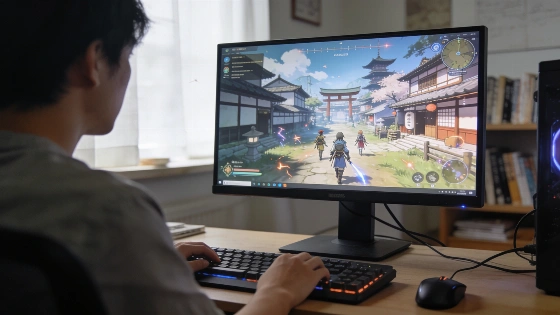
KonaGames has released Lexicon Odyssey on Steam for Windows. The RPG covers Japanese study from hiragana and katakana to JLPT N1, with thousands of vocabulary entries, grammar points and example sentences.
Japanese revision has been turned into a full role-playing game. KonaGames has released Lexicon Odyssey on Steam for Windows. Its learning path starts with hiragana and katakana and reaches JLPT N1.
Learning meets progression
The idea is simple, though demanding. The game puts study material inside its combat and progression systems instead of keeping it in a separate quiz mode. Auto-battles provide the action. Equipment and spell builds give players a reason to keep working through new language content.
Lexicon Odyssey combines explanations with active recall, mistake correction and spaced review. Recognising a word once is not the same as retrieving it later. The game also includes camp companions and a 30-second Word Sprint based on material the player has already studied.
The amount of content is large on paper. The game lists more than 9,230 vocabulary entries, over 590 grammar points and more than 21,500 Japanese example sentences. That gives its learning system a much wider base than a small phrasebook-style game.
Those figures show the size of the database, not a guaranteed learning result. The practical value will depend on how clearly the explanations are presented and whether the review systems lead to real recall instead of routine clicking.
From beginner to N1
Lexicon Odyssey is built for players with different starting points. Someone new to Japanese can begin with the two kana systems. More experienced learners can select a level through JLPT N1, the highest level named in the game's progression.
That range gives the release a clearer identity than a conventional RPG with Japanese vocabulary added on top. Lexicon Odyssey is trying to work as a structured study tool while keeping familiar genre rewards. The game includes 290 or more equipment pieces, over 140 spells and build choices that link learning progress to combat preparation.
The design also faces a clear test. Auto-battles may make revision easier to fit into a play session. They may also pull attention away from the language if the RPG layer becomes the main reason to continue. The correction and review cycles need to stay meaningful, not decorative.
The wider learning-game space has shown that a compact loop can support a focused concept. An earlier release used repeatable progression in that way. Lexicon Odyssey is taking a more structured educational route by tying its loop to a defined proficiency scale.
Steam launch details
The Windows release is available now on Steam. A 15% introductory discount is listed through 2 October. The game supports English, Japanese, Simplified Chinese and Traditional Chinese interface languages. That broadens access to the menus and explanations without changing the Japanese study material at the centre of the product.
The launch description gives the scope in concrete terms: 9,230-plus vocabulary entries, 590-plus grammar points, 21,500-plus example sentences, 290-plus equipment pieces and 140-plus spells. It also lists the 30-second Word Sprint and the route from beginner kana to JLPT N1.
Independent verification of those launch claims is limited. The available search results contain no confirmed reporting from major media, regulators, Valve or Japanese educational organisations about the release, its sales, its post-launch updates or the claimed learning features. The figures should therefore be treated as statements from the supplied launch description, not independently audited measurements.
A related SteamDB record, app ID 5282920, was first observed on 16 September 2026. SteamDB identifies it as an unknown app without a disclosed title, publisher or content. The record also says that no access token is available. It cannot establish that the app is Lexicon Odyssey or verify its genre, developer or release date.
The search results also provide no independently confirmed company profile, portfolio or official Steam page for KonaGames. That does not change the supplied report of the launch. It does mean that the developer's background and the relationship between KonaGames and the unidentified SteamDB record remain unverified. SteamDB is useful here for showing what is and is not visible in the platform data. It does not confirm the game's educational claims.
The release information does not establish a review status, an independent learning assessment or technical performance results. It also does not explain how much content is unlocked immediately, how level selection affects progression or whether the JLPT stages map directly to an external examination syllabus beyond the labels used by the game.
That distinction matters to prospective buyers. A large vocabulary and grammar database can make a game useful. It cannot by itself prove teaching quality, retention or exam readiness.
What the store discloses
The Steam listing says that some art, audio and promotional imagery contain AI-generated content. The notice does not describe every asset or explain how the material was produced. It should therefore be read as a disclosure about parts of the presentation, not as a claim about the game's entire visual or audio identity.
No multiplayer feature is described in the supplied release information. The game is presented as a single-player RPG. Its companions, battles, equipment and spells support an individual study loop rather than a competitive language-learning system.
Lexicon Odyssey is best understood as an educational RPG with a notably broad stated syllabus. It is not proof that game mechanics automatically improve language acquisition. The launch gives players a way to test whether active recall and spaced review can hold up alongside loot, builds and auto-battles.
Based on the available evidence, the concept is more credible than a vocabulary quiz dressed up as an adventure. The database figures are only the starting point. The learning loop will decide whether this becomes a useful study companion or an attractive catalogue of Japanese content.
Spaced review brings previously studied material back at intervals instead of presenting it once and moving on. Active recall goes further by asking learners to retrieve an answer rather than simply recognise it on a page. Lexicon Odyssey connects both methods to progression, which gives the release a sensible educational foundation even though the supplied information offers no independent evidence of results. That makes the Steam launch worth watching as a practical experiment in game-based study, rather than as a substitute for verified JLPT preparation.