
Naoki Hamaguchi says Final Fantasy VII Revelation will change quests and endings based on the character chosen for each experience, giving players a reason to return after finishing the game.
Final Fantasy VII Revelation is being built around an idea most role-playing games avoid: one complete run will not show everything. Director Naoki Hamaguchi said side quests can change in perspective, gameplay and conclusion depending on which character the player puts at the center of the experience.
Different routes
Hamaguchi discussed the final chapter of the remake trilogy during an IGN Japan special Tokyo Game Show livestream. His comments suggest that character selection will affect more than which party member handles a quest. The surrounding story may change. So may the way the task plays out and its ending.
That gives players a clear reason to return after finishing the main story. A second playthrough would not simply repeat the same campaign with a different lead. It could reveal another version of individual side stories and change the emotional context carried into the final battle.
Hamaguchi expects one playthrough to offer roughly the same amount of content as Final Fantasy VII Rebirth. The total experience across several runs is meant to go beyond what Rebirth can show in one campaign because some content is deliberately conditional.
The focus on replay also comes with a more flexible approach to progression. Naoki Hamaguchi confirmed that Revelation will include an auto-level option for players who skip side quests. The feature will let them stay around the recommended level for the main story. Nintendo Life reported that it was added after feedback on Rebirth, where some players found themselves underlevelled after skipping optional content.
From linear to vertical
The opening will take a more controlled approach. Hamaguchi said the first five or six hours of the main story will be relatively linear. After that, the game will open into a much larger world.
That world is also being built around vertical exploration. Rebirth focused more heavily on horizontal space. Final Fantasy VII Revelation is meant to add height to its environments. The available information does not explain every traversal system behind that change, but the design priority is clear: the final chapter will expand the series' sense of scale upward as well as outward.
This matters for players expecting a direct continuation of Rebirth's structure. The early hours are planned as a guided introduction. The wider game will reveal its full geography after that opening period instead of offering all of its freedom at once.
Previews and Tokyo Game Show 2026 coverage also describe more on-screen guidance for players who are less familiar with open-world games. The development team is considering ways to customize those prompts, although the available information does not specify the final range of settings. Revelation's larger world will likely come with more direct navigation help rather than leaving every player to work out its systems alone.
A changed return
Areas from Final Fantasy VII Remake and Rebirth will return, including Midgar. They will not be reproduced unchanged. Hamaguchi said the appearance of Meteor and other developments will be used to alter layouts while adding quests and new content.
Midgar will also connect directly to the Grasslands. The explorable space will be more than the city itself, with the surrounding area forming part of a continuous route into the wider world. That gives a familiar location a new practical role instead of treating it as a sealed-off revisit.
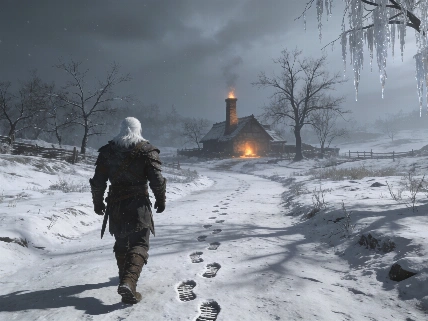
The Great Glacier will bring back a mechanic from the original Final Fantasy VII. As Shacknews reported in its coverage of the TGS interview, players will have to manage endurance and hypothermia in the cold region. Hamaguchi confirmed that the element is returning, though the available details do not show how much it has been redesigned for the remake.
One run is expected to be about the size of Rebirth. The branching quest design means a completionist's workload cannot be judged by the first campaign alone. As with any planned feature, the final value will depend on how much those alternate perspectives and conclusions add to the finished release.
Release and evidence
Final Fantasy VII Revelation is scheduled to launch on 8 April 2027 for PC, PlayStation 5, Xbox Series S|X and Nintendo Switch 2. The source also says that the game is confirmed to run at 4K and 60 frames per second on PS5 Pro. That is a stated technical target or capability, not an independently measured performance result in the material available here.
Tokyo Game Show 2026 also established the final chapter's official title and confirmed the same release date and platform range. VGC reports that Hamaguchi expects the game to occupy approximately 200 GB. Physical editions will still require players to download part of the data. The stated size is an estimate rather than a final installation figure, but it gives a clearer sense of the production's technical scale.
That distinction matters. A developer's technical claim can describe the intended experience without proving frame pacing, resolution behavior in demanding scenes or performance across every platform. The supplied information does not include independent testing, a complete graphics breakdown, PC requirements or details on how the different console versions will compare.
The same caution applies to the wider technical discussion around the game. Readers weighing hardware claims can use our hardware breakdown for context, but it should not be treated as independent testing of Final Fantasy VII Revelation itself.
What is confirmed is more interesting on the design side. The remake trilogy's finale is being built to reward deliberate replay rather than simply offering a larger map. That makes better use of multiple playthroughs than filling a campaign with repeated tasks. If the character-led variations meaningfully change the story, mechanics and endings as described, Final Fantasy VII Revelation will make replay part of its core structure rather than an optional extra.
Vertical exploration means moving through spaces with meaningful height instead of covering only wider stretches of ground. It can include routes above and below the player, but the available information does not confirm the exact traversal mechanics. The practical point is that Final Fantasy VII Revelation's world is being planned around more than map area alone. Its quest design also gives players a concrete reason to revisit that world from another character's perspective.