
Menaphos will open in Old School RuneScape in 2027, bringing a master-tier quest, the game's first Skilling Dungeon and a Soul Altar. Jagex is also expanding the game's servers and planning more updates while keeping its long-running identity intact.
Jagex has more than one million Old School RuneScape members, and the game still runs on infrastructure that keeps changing beneath its familiar world. That work now sits alongside a much larger addition: Menaphos will open in 2027.
Menaphos breaks the pattern
Players have known the desert city existed for roughly two decades without being able to enter it. At RuneFest 2026, Jagex confirmed that Menaphos will arrive with the master-tier quest Fool's Gold, the game's first Skilling Dungeon and a Soul Altar deep inside the pharaoh's pyramid.
The city will continue the storyline around Amascut. It is also a rare kind of addition for Old School RuneScape: a place that has lived in the game's world and lore for years before becoming playable.
Old School RuneScape is based on the 2007 version of a game first released in 2001. Its current form is nearly 20 years old, while the wider RuneScape identity reaches back about 25 years. Menaphos is not simply an old area being brought back. It is a long-promised part of the world finally becoming accessible.
Tom Jackson, Jagex's Associate Product Director for Old School RuneScape, discussed the roadmap at RuneFest. The company plans a substantial update every month, although some future additions will stay secret and others will be shown only in part. Jackson said Menaphos interests him most because it turns years of expectation into a place players can actually explore.
The wait matters because Old School RuneScape does not treat its past as disposable. Quests such as Fairy Tale and Chosen Commander still leave threads for new stories to pick up. Menaphos follows that pattern instead of wiping the slate clean.
Players still guard the identity
Jagex has to add modern content without making Old School RuneScape feel like another game. Jackson pointed to the polling system, which gives the community a formal say in the project's direction. Polling does not settle every argument, but it gives players leverage over the game they are helping preserve.
Jackson started playing RuneScape in 2005 and now describes his role as custodianship. That background helps explain the team's approach. The goal is not only to bring back familiar areas and mechanics. It is to recreate the feeling of discovering something new in a world that already feels like home.
Varalamore shows how that can work. The area was new when it launched, but its name and lore had appeared in the game for almost a decade. Jackson said players felt nostalgic when they arrived somewhere they had never visited. The feeling came from discovering an unexpected part of the world, not from repeating an old activity. Menaphos will push that idea further.
Modern infrastructure behind an old world
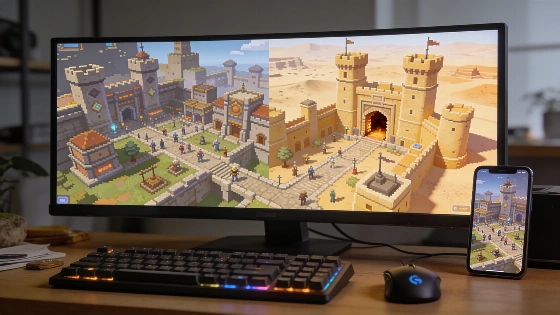
Old School RuneScape has moved well beyond its original desktop setting. Jagex brought the PC game to mobile largely as it was instead of rebuilding every system around touch controls. Later changes included the menu entry swapper, which turns some contextual actions into single taps. A sizeable group now plays only on mobile, although PC remains the majority platform.
Jackson said the game has more than one million members. Jagex did not provide an exact PC-to-mobile split, and cross-progression makes the comparison harder. Mobile is not a small experiment anymore. It is an established way to enter the same persistent world.
Server upgrades affect players more directly than many visual changes. Jagex has added servers in Japan, South Africa, Singapore and Brazil to cut latency for players in those regions. Jackson mentioned one player who had spent about 20 years playing with latency above 200 milliseconds before a closer server changed how the game felt.
Latency measures the delay between a player's input and the server receiving or answering it. More than 200 milliseconds can make timing-sensitive actions feel inconsistent even when the game is running correctly. Regional servers shorten the distance data must travel, but they cannot guarantee perfect performance for everyone. The infrastructure work changes how the existing game responds, rather than simply adding another destination.
Console support remains uncertain. Jagex has not ruled it out, but it has no immediate announcement planned. The hard part is not merely getting Old School RuneScape to run on a console. Its dense interface would also need to work with controller input. Community experiments have gone further than the official roadmap, with one player reportedly running the game on a PlayStation 2.
A live service with a memory
Old School RuneScape makes a stronger case for the live-service model than most modern games because new updates add to an existing journey instead of making older content irrelevant. Players can stop playing and return without finding that the world has been replaced. New areas extend the route through the game.
That structure lets Jagex discuss the future without treating the game's age as a problem to hide. Many players first encountered RuneScape when they were younger. Jackson suggested that retirement could eventually give some of them more free hours to play. That is speculation about audience behavior, not a forecast backed by figures, but it fits the unusually long relationship many players have with the game.
The wider franchise points in the same direction. In its official RS4 announcement, Jagex said the new Unreal Engine MMO would offer another way to experience Gielinor, not replace Old School RuneScape, RuneScape or RuneScape: Dragonwilds. The company also said the games have separate teams and roadmaps, so Old School RuneScape is set to receive continued investment alongside the other projects.
Jagex is developing four separate directions: RuneScape, Old School RuneScape, RuneScape: Dragonwilds and the forthcoming RS4 MMO. The official announcement calls RS4 an additional entry point into the universe and keeps the existing games' futures independent. Menaphos therefore matters beyond its own quests. It shows that Old School RuneScape still has a roadmap of its own while Jagex builds another large MMO.
The size of the franchise helps explain why Jagex can support several experiences at once. Official Jagex figures say the RuneScape franchise has generated more than 300 million created accounts over 25 years. The two main games have produced more than 3 billion dollars in combined revenue. Those figures cover the franchise as a whole, not Old School RuneScape alone, but they show the scale of the audience behind the strategy.
Old School RuneScape has kept its historic identity while adding Varalamore, new quests, new skill-related spaces, mobile support and servers closer to players in several regions. Menaphos will put that approach under its biggest test yet. Jagex must make the new city feel like a long-awaited discovery rather than a break from the world that made the game durable. GamesBeat's reporting on the RuneFest announcement names Fool's Gold, the first Skilling Dungeon and the Soul Altar in Jalanam as central parts of the expansion.
The polling system gives players a say, the accumulated lore leaves unfinished stories, and the infrastructure work removes some practical barriers to play. Jagex is betting that an old world can keep growing if new destinations fit the journey and the route to them keeps improving. Menaphos is scheduled to open in 2027.