
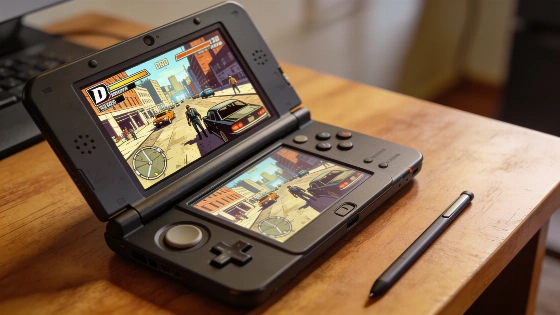
Rockstar's Grand Theft Auto: Chinatown Wars brought mature open-world gameplay to the Nintendo DS, introducing inventive mechanics and a distinct style that set it apart from other GTA entries
Grand Theft Auto: Chinatown Wars is a rare example of a major franchise taking a genuine risk on handheld hardware. Released in March 2009, it arrived at a time when the Grand Theft Auto series was focused on high-powered home consoles and PC, following the critical and commercial success of Grand Theft Auto 4. Instead of simply scaling down existing content, Rockstar created a new experience for the Nintendo DS, blending the series' signature open-world chaos with touch-screen controls and a bold, cel-shaded visual style.
Handheld Ambition and Platform Context
Chinatown Wars was initially exclusive to the Nintendo DS, a platform more closely associated with family-friendly titles than mature crime dramas. The DS's technical limitations-low-resolution screens, lack of an analogue stick, and a largely casual audience-meant that most major publishers approached it cautiously. Rockstar's decision to develop a new Grand Theft Auto entry for the DS was unexpected, especially given the franchise's recent push towards realism and graphical fidelity on more powerful hardware. The game's top-down perspective and stylised visuals paid homage to the series' origins while introducing new mechanics that took advantage of the DS's unique features, such as touch-screen car theft and mini-games.
Despite initial scepticism, Chinatown Wars demonstrated that the core elements of Grand Theft Auto-open-world exploration, sharp writing, and a wide array of missions-could be successfully adapted for handheld play. Enhanced ports later arrived on PSP and mobile devices, but the DS version remains notable for how it bridged the gap between the franchise's early design and its modern ambitions. The game's Liberty City setting, familiar to players of Grand Theft Auto 4, was reimagined to fit the DS's capabilities without sacrificing the series' trademark sense of scale and freedom.
Gameplay Innovations and Unique Systems
Chinatown Wars introduced several mechanics that set it apart from other entries in the series. One of the most significant was its approach to police chases: rather than simply escaping a search radius, players could actively reduce their wanted level by destroying police vehicles. This system encouraged more aggressive and dynamic encounters, adding tension and variety to pursuits. The game also featured a detailed drug-trading mini-game, allowing players to buy and sell substances across Liberty City's various gang territories. Each gang had preferred drugs and controlled specific areas, requiring players to monitor market conditions and plan routes to maximise profits while avoiding law enforcement.
Environmental elements, such as hidden cameras, played a role in the game's risk-reward structure. Disabling these cameras reduced the likelihood of police intervention during deals, further intertwining the game's systems. The combination of high-stakes trading, fast-paced chases, and the ever-present threat of vehicle destruction created a gameplay loop that was both challenging and rewarding. While some of these mechanics have since influenced later Grand Theft Auto titles, Chinatown Wars remains the only entry to fully integrate them into its core campaign.
Narrative and Characterisation
The story of Chinatown Wars follows Huang Lee, a new protagonist whose journey through Liberty City's criminal underworld is marked by personal loss and a drive for vengeance. Unlike the more earnest Niko Bellic from Grand Theft Auto 4, Huang's direct and uncompromising attitude grounds the narrative, making his actions feel consistent with the game's tone. The writing maintains Rockstar's established blend of dark humour and social commentary, while the stylised presentation allows for a distinct identity within the franchise.
Chinatown Wars also stands out for its integration of music and cultural references, with its opening cutscenes featuring hip hop beats and nods to both Eastern and Western influences. The game's radio stations, character interactions, and mission structure all contribute to a sense of place that feels both familiar and fresh. For players who had completed Grand Theft Auto 4 and were seeking new stories within Liberty City, Chinatown Wars offered a different perspective without feeling like a lesser experience.
Technical Limitations and Legacy
While Chinatown Wars was later ported to other platforms, its reliance on touch-screen mechanics has limited its availability on modern consoles. The DS version's use of the stylus for actions like hotwiring cars and interacting with the environment was central to its design, making straightforward ports challenging. Although the Nintendo Switch family could theoretically support these features in handheld mode, adapting them for PlayStation or Xbox would require significant reworking.
Despite not matching the sales figures of mainline Grand Theft Auto releases, Chinatown Wars has maintained a dedicated following among series fans. Its willingness to experiment with structure and mechanics stands in contrast to the current trend of folding new ideas directly into live-service modes, as seen in Grand Theft Auto 5's online component. The game's legacy is a reminder of a period when major franchises were more willing to explore side stories and alternative formats, a topic also explored in NGB's coverage of narrative-driven shooters such as The Defiant's campaign set on China's frontlines.
Chinatown Wars remains a distinctive entry in the Grand Theft Auto series, notable for its inventive mechanics, platform-specific design, and narrative ambition. For those who missed it at launch or are looking to revisit Liberty City from a new angle, it stands as a testament to what can be achieved when developers embrace the strengths and constraints of their chosen hardware.
Understanding the difference between a remaster and a port is key to appreciating Chinatown Wars' place in the franchise. A remaster typically updates visuals and performance for new hardware while retaining the original game's structure, whereas a port adapts the game to run on different platforms, sometimes with changes to controls or interface. Chinatown Wars' DS version was designed around touch input, making direct ports to traditional consoles less straightforward. This distinction helps explain why some classic games remain tied to their original platforms, even as technology advances.