
The Living Continent changes The Witcher 3 Remastered with region-specific seasons and accumulating snow. It also requires DirectX 12, ReShade add-on support and both story expansions.
In winter, snow piles around fires while villagers clear their doorsteps. Wildflowers arrive in their own weeks. Deezyyyy's The Living Continent gives The Witcher 3 Remastered a world that changes with the seasons rather than relying on a static weather cycle, with environmental simulation extending well beyond a visual filter.
Seasons by region
Trees leaf out and change colour on schedules set by species. Later, they stand bare. Across the year, 21 European meadow wildflower species bloom and fade at different points. Autumn brings gold birch and amber beech; oak leaves turn copper. Fallen leaves collect beneath the trees they came from, so the landscape changes across the calendar rather than simply shifting hue.
Climate depends on location. Toussaint gets only a light winter dusting, while Skellige and Kaer Morhen receive heavier snowfall. Daylight length changes with the date, too.
Players can adjust the season cycle if the game's calendar moves too quickly. According to ItsDeeezy's official update trailer, seasons change every 14 in-game days by default, and players can accelerate that interval. They can also lock the world to one season or have seasons follow real playtime. Each season then lasts from 30 minutes to four hours.
Winter leaves a mark
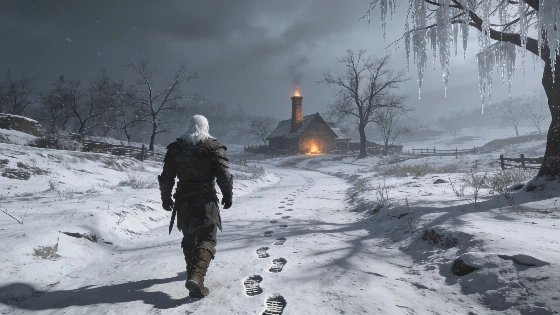
Snow builds up as it falls, then melts gradually. On cold, sunny days, icicles form along eaves. Puddles freeze, while nearby fires melt snow.
Geralt and NPCs leave boot prints carved into the depth buffer. The game's lighting and shadows affect those impressions, rather than leaving flat marks on the surface.
Villagers switch into existing winter clothing, with more than 3,100 combinations available. They shovel snow and chop firewood. Some warm their hands by fires, while children throw snowballs. Quest characters are excluded, limiting the changes in scripted scenes and keeping those characters' behaviour intact.
Version 1.4 adds seasonal everyday activities. NPCs can work in fields or clear snow and leaves. They can also gather firewood, while snow games are part of the update. These additions appear in ItsDeeezy's official update trailer.
Stars and atmospheric effects
At night, the mod places 9,096 stars according to their positions in the Yale Bright Star Catalog. The Milky Way appears alongside them, as do the northern lights. Meteor showers follow real-world dates; lunar eclipses and occasional comets also feature.
Version 1.4 adds daytime effects including halos and sundogs. Ice arcs and sun pillars are also included, along with crepuscular rays. Players can configure the northern lights. Visible breath appears in cold weather, and firelight illuminates falling snow. These are substantial additions, but the mod's description does not establish how they perform across different PCs.
The author says the effects are built into The Witcher 3's renderer, where the game lights and shadows them. The mod supports ray tracing and the recently implemented path tracing. Stars render after the upscaler, which keeps DLSS from blurring them. According to the mod's description, the update also cuts its GPU workload by about a fifth. NGB previously covered performance changes in path-tracing modifications, but the details supplied for this release do not establish a comparable test methodology.
Renderer integration matters here: effects inside the game's rendering pipeline respond to its lighting and shadows, unlike a filter laid over the finished image. Upscaling reconstructs a higher-resolution image from a lower-resolution render, so rendering stars afterwards can help keep them sharp. The approach gives the mod a stronger claim to environmental immersion than a simple screen filter.
Requirements and caveats
The Living Continent is available on Nexus Mods. The listing requires a DirectX 12-capable version of the game and ReShade with add-on support. Its stated requirements also specify game version 5.0 or newer and ReShade 6.8 or newer with full add-on support. ReShade presets are not required. Both story expansions, Hearts of Stone and Blood and Wine, are mandatory, and the mod is intended for PC.
Version 1.4 arrived less than a week after launch, pointing to active early updates. The source provides no independent compatibility testing. Older 1.32 and Next-Gen 4.04 mods are not automatically compatible with the 5.x branch, so players need to match their game and mod versions.
Deezyyyy credits the work as made with AI assistance. The author directed it and tested it in-game. That disclosure describes the production process; it does not establish that AI-generated content appears in the game.
There is a practical trade-off: the overhaul demands careful setup rather than offering a plug-and-play seasonal toggle. Its software requirements are specific, and the performance impact depends on the PC and settings.
In one user test discussed in an independent video review by The Hidden One, enabling the mod reduced performance by about 15 frames per second. That result came from a particular setup, not a universal estimate. It is separate from the author's stated reduction in GPU workload, and neither figure establishes what every player should expect.