
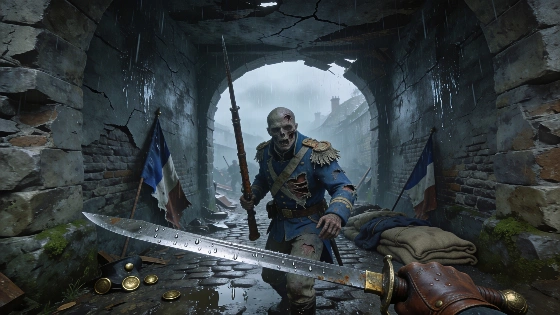
First-person parries and an undead Napoleonic setting give Valor Mortis a strong opening. Cramped encounters and a narrow enemy roster wear down much of its 20-hour PC campaign.
A well-timed parry gives Valor Mortis a sharp opening. One More Level's first-person soulslike pairs responsive combat with an arresting alternate history, then loses momentum as cramped routes and harder-hitting enemies leave too little room to fight. The final stretch recovers some ground, but the uneven journey makes the game more frustrating than its strong foundations deserve.
A war with a secret
In this alternate early 19th century, Napoleon Bonaparte won at Waterloo and still rules in 1820. Imperial propaganda claims his soldiers loved him so fiercely they would return from death to serve again. William Dowsett, an amnesiac British soldier in the Foreign Legion of the Imperial Guard, discovers the grim truth as he crosses war-torn landscapes and confronts the undead.
The story is one of the game's clearest strengths. Its mystery is easier to follow than those in many soulslikes, yet the game still relies on environmental storytelling. The revelations fit the setting's brutal themes. Haunting sequences give the journey a horror edge, while William's missing memories offer a natural way into a world he cannot recall.
The resolution is less satisfying. Some threads never get a proper payoff, leaving the already confirmed story DLC to potentially address what the main game leaves open. The ending feels incomplete.
Combat runs out of room
For roughly the first five hours, Valor Mortis makes a persuasive case for its unusual viewpoint. Enemies telegraph attacks that can be parried or avoided with a well-timed dodge. Successful counters build a Posture Bar for a Critical Hit. The Saber handles close combat, the Pistol targets certain weak points, and William's first Transmutation power sets enemies alight. Responsive movement and clear visual cues help the first-person combat feel controlled.
That control weakens in the mines. Wider spaces give way to narrow paths as enemy damage rises. In first person, it is harder to judge the space around William. A dodge into a wall or corner can turn a manageable fight into a quick defeat.
Chapter 6 puts a greatsword-wielding soldier at the entrance to a tight cave. His broad attacks leave little room to manoeuvre, and hard-to-see ground hazards make the encounter harder to read.
The encounter design also asks a lot from a limited toolkit. The Saber and Rapier feel similar, while shooting is not especially satisfying. Stasis and Shield powers arrive late. Embers and weapon skill trees offer passive build choices, but there is no proper armour system or gear system. Enemy variety is thin too: after four to five hours, most of the roster has appeared. A small number of bosses later return as regular enemies.
Some fights steer players toward one intended solution. Ranged-heavy sequences reward quick movement and traversal abilities in a way that recalls Ghostrunner, but a failure can mean another run from the nearest Lantern checkpoint. In a late chapter, accurate ranged attackers made the Musket the practical answer, shifting combat toward slow, long-range shooting. There is another needless snag: crouching and interacting share a button, so William can crouch instead of grappling.
Traversal powers open routes back into earlier locations, giving exploration a Metroidvania-like structure. Several bosses are inventive, including a haunted windmill. The final melee weapon, obtained after the flooded village, makes combat more dynamic. It arrives after a punishing middle stretch. NGB's earlier Soulslike preview considered a different approach to the genre; Valor Mortis shows how much first-person positioning depends on encounter design.
PC performance and verdict
The PC review took 20 hours and received a 7.5/10. Testing used a system with an i7-13700F and an RTX 4080. It had 32GB RAM. Performance sat around 80-90 FPS on the High preset, with DLSS in Quality mode. Frame Generation was enabled. Some traversal stutter occurred, while precompilation limited shader pauses at startup and when the game first reached new areas.
Ray tracing brought frequent stutter in nearly every location, with the worst problems in late-game areas. Disabling it made little visual difference. The game also crashed several times during the playthrough. Shortcuts limited lost progress, but the stutter and crashes still made for a rough technical showing. Performance on other systems may differ.
One More Level has built a solid foundation with a distinctive setting and responsive core combat. Clever route progression helps, but narrow encounters, limited enemy variety and the late arrival of meaningful combat options repeatedly undermine the game. Valor Mortis deserves credit for trying a first-person soulslike, though its 7.5/10 result is uneven and the exhausting middle keeps it short of greatness.
Positioning matters in a soulslike because players need room to read threats and evade them. A first-person camera narrows awareness of what is happening around the character, putting extra pressure on level design. Valor Mortis's strongest fights account for that constraint. Its worst encounters make the camera feel like an obstacle.
Lyrical Games' release announcement, distributed through GamesPress, sets Valor Mortis' global launch for October 13, 2026, at 17:00 UTC. The Polish studio One More Level, known for Ghostrunner, is developing the game. It is coming to PC through Steam and PlayStation 5. Xbox Series X|S will also get the game, with a day-one Xbox Game Pass release, according to IGN. The recommended launch price is $39.99 in the United States and €39.99 in Europe. In Poland, it is 149.99 złoty.
Polygon reports that PlayStation Plus subscribers can try the game, with trial progress carrying over to the full version after purchase. On October 9, 2026, Lyrical Games released the official launch trailer and additional interviews with voice actors Jennifer English and Vincent Cassel, according to GamesPress. The Los Angeles-based publisher describes itself as an independent company focused on supporting ambitious indie and AA projects as the market becomes less willing to fund riskier games.