
NO LAW from Neon Giant stunned at Gamescom 2026 with a live demo showing a seamless open world, persistent NPCs and multiple approaches to every objective in a city with no laws and no AI-generated assets
When a developer claims there is no wrong way to play, most players expect a marketing line. NO LAW, however, has put that promise to the test in public, demonstrating at Gamescom 2026 that its cyberpunk world is not just a backdrop but a system built for consequence and choice. The Swedish studio Neon Giant, previously known for The Ascent, brought a raw, unpolished build to the show floor-no bespoke demo, no handholding, just the game as it stood days before the event. The result was a rare glimpse of a project that refuses to dictate player behaviour, even as it delivers a handcrafted city where every address, every NPC, and every decision matters. According to IGN and PC Games Hardware, the project is being developed by a small team of around 24 people, who have deliberately chosen to focus on a "compact but dense" city rather than a sprawling open world.
Gameplay structure and player agency
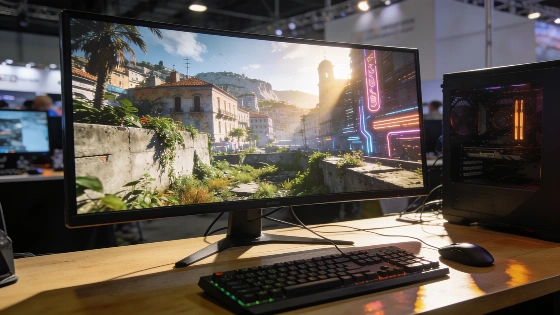
NO LAW's core design principle is simple: the player decides how to approach every objective, and the game refuses to reward or punish based on method. Whether you sneak, talk, improvise, or go in guns blazing, the only XP awarded is for achieving the goal, not the route taken. In the Gamescom demo, the same mission was completed twice-once as a near-pacifist, once as a combat specialist-each time with the world reacting differently. The city of Port Desire, a Mediterranean-inspired open world with aggressive vegetation and no loading screens, is mapped down to individual street names and building numbers. Players can strip away all UI guidance and navigate by reading signs and consulting a physical map, or enable full markers for a more guided experience. As reported by PC Games Hardware, Port Desire is designed for pedestrian exploration only, with no drivable vehicles, and features up to 3,000 simultaneously simulated NPCs, making the city feel densely populated and reactive.
Every significant NPC in NO LAW has a persistent presence. If a character is killed at home, they do not appear at work; if killed at work, they never return home. The story adapts to these absences, and routines are simple but meaningful-most have two or three locations depending on the time of day. According to PC Games Hardware, the daily routines of Port Desire's population are intentionally simplified compared to initial plans: the day is divided into four major time blocks, and shops open or close depending on the current period. The city's day-night cycle and weather are not just visual flourishes: crowds shift, certain locations open or close, and access to areas changes dynamically. Even shopping is physical, with players picking up items from shelves and facing real consequences for theft. The gun shop, for example, is protected by ceiling turrets, making a smash-and-grab a high-risk proposition.
Technical ambition and development scale
Neon Giant has confirmed that NO LAW is entirely handcrafted, with no generative AI used for assets or world-building. The team has grown from 12 to 24 developers since The Ascent, but remains small by genre standards. The city's verticality is a deliberate design choice, with no drivable vehicles-movement abilities are essential, and traversal can involve ladders, fire escapes, or special implants. The skill system is split between traditional RPG trees and ability canisters, which force players to choose between mutually exclusive upgrades. Inventory space is limited, requiring conscious trade-offs between armour, weapons, and consumables. PC Games Hardware reports that the Gamescom demo ran on Unreal Engine 5.8.2, utilizing Virtual Texturing and custom geometry extensions, and was publicly shown on a GeForce RTX 5080 with settings ranging from medium to high, highlighting the technical ambition of the project.
NO LAW is targeting a 2027 release on PC, PlayStation 5, and Xbox Series S|X, as confirmed by several recent previews and Gamescom 2026 coverage, including IGN. The game is now playable from start to finish internally, with the current focus on quality, playtesting, and polish. Neon Giant has not yet provided a final estimate for main story completion time, but the team insists this is a full-scale premium experience, not a short campaign. The studio's approach to consequence is uncompromising: some content will be missed in a single playthrough, and replaying with different skills or choices is encouraged. For comparison, the first demo run took 30 minutes, while a direct combat approach finished the same objective in five.
World systems and narrative design
Port Desire is a city-state in a permanent legal grey zone, surrounded by three rival nations that prevent annexation. This setting allows for research and activity that would be illegal elsewhere, but the city is kept in check by the Peacekeepers-a force that tracks player bounties and escalates responses from fines to shoot-on-sight orders. Bounties persist until paid off or cleared by a data broker, and killing Peacekeepers only increases the penalty. The narrative is non-linear, with leads branching and overlapping; players can pursue multiple threads at once, and the story adapts to missing characters or failed objectives.
Shopping, theft, and even the design of food packaging are all handled with a level of detail that avoids placeholders and AI shortcuts. Every product has a unique logo, slogan, and nutritional information, visible even in photo mode. The city's climate and vegetation are as much a part of the world as its neon-lit nights, with the environment actively fighting back against human control. The main character, Gray Harker, is a military veteran with a physical presence-his implants justify both gameplay abilities and narrative context. Luke Roberts voices Harker, joining a cast of five main characters and the Peacekeeping director, Gamble.
Comparisons and genre context
NO LAW's cyberpunk setting inevitably draws comparisons to CD Projekt RED's Cyberpunk 2077, but Neon Giant is clear that their focus is different. There are no vehicles, no number-heavy RPG systems, and the city's design is chunkier, more tactile, and more vertical. The team's background includes work on Wolfenstein, Bulletstorm, Far Cry, and Doom, and their confidence in first-person action is evident. According to IGN, the game is described as a first-person cyberpunk immersive sim, rather than a traditional RPG. The studio is not chasing genre giants but building the game they want to play, with a handcrafted approach that stands apart from procedural or AI-driven worlds. The city's seamless structure, persistent NPCs, and refusal to dictate player behaviour mark a deliberate break from genre convention.
Technical features include full hardware ray tracing and high object density, with path tracing not currently planned. The studio's resource-conscious approach means some features-like drivable vehicles-were cut early to focus on verticality and world density. The result is a city that feels alive, reactive, and genuinely explorable, with systems that reward curiosity and experimentation. For those tracking the rise of ambitious, player-driven worlds, NO LAW's approach is a notable contrast to the multiplayer focus seen in projects like Cinder City.
NO LAW's refusal to use generative AI, its commitment to handcrafted detail, and its uncompromising player agency set a new bar for immersive sims from small teams. Neon Giant's willingness to show a raw, live build at Gamescom-rather than a curated demo-signals a rare confidence in their systems and design. If the final release delivers on this promise, NO LAW could become a reference point for how consequence and freedom can coexist in a modern open world, without sacrificing narrative or technical ambition. As reported by PC Games Hardware, the technical foundation and design philosophy are closely tied to the team's decision to prioritize density and reactivity over sheer map size.
Ray tracing is a rendering technique that simulates the way light interacts with surfaces, producing more realistic reflections, shadows, and lighting effects in real time. In NO LAW, hardware ray tracing is used to enhance the city's visual fidelity, especially during night and rain sequences. Unlike traditional rasterisation, ray tracing calculates the path of individual light rays, which can be demanding on hardware but results in more convincing environments. While path tracing is a more advanced form of this technology, it is not currently planned for NO LAW, as the studio is prioritising consistent performance and high object density across platforms.