
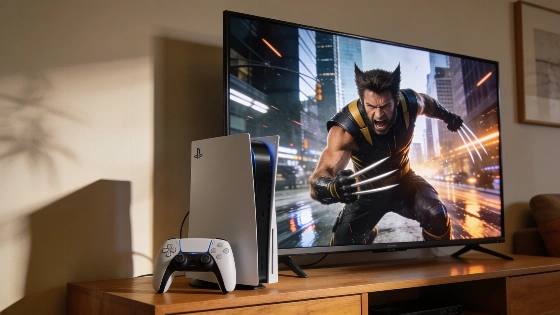
A new technical comparison reveals how Marvel's Wolverine leverages the PlayStation 5 Pro's advanced ray tracing, with the upgraded console sustaining high frame rates and sharper visuals while losing only a few frames per second
PlayStation 5 Pro's hardware has delivered a clear technical advantage in Marvel's Wolverine, handling the game's most demanding ray tracing effects with only a minor drop in frame rate. The latest side-by-side analysis demonstrates that the Pro model's enhanced GPU and upscaling technology allow it to maintain high performance even with advanced visual features enabled-an outcome that will matter for players seeking both fidelity and smoothness in upcoming releases.
Technical comparison and performance data
In a recent video breakdown, ElAnalistaDeBits compared Marvel's Wolverine running on both the base PlayStation 5 and the PlayStation 5 Pro. The analysis focused on two main display modes: Fidelity and Performance. Fidelity mode dynamically scales the internal resolution between 2160p and 1440p, while Performance mode drops this range to between 1440p and 1080p. The Pro's PSSR upscaler further sharpens the image, especially in scenes with complex reflections and global illumination enabled by Advanced RT mode.
Measured performance shows that enabling Advanced RT mode on PlayStation 5 Pro results in a frame-rate reduction of only 3 to 4 frames per second compared to running with ray tracing disabled. In Performance mode, the Pro can reach up to 100 frames per second with Unlimited VRR, making the performance penalty for advanced effects negligible for most players. This is a marked improvement over the base PlayStation 5, which cannot sustain the same level of visual fidelity without a more significant performance cost.
Visual quality and player experience
The PlayStation 5 Pro's advantage is most visible in scenes featuring ray-traced reflections and complex lighting. Thanks to the PSSR upscaler, image clarity remains high even as the internal resolution drops in Performance mode. Shadows and reflections appear more detailed and stable, with fewer artefacts and less shimmering than on the standard console. For players prioritising image quality, the Pro's ability to run Advanced RT mode with minimal compromise is a tangible benefit.
Players who prefer maximum frame rates can still disable Advanced RT mode to push performance even higher, but the marginal difference means most will not need to sacrifice visual effects for smooth gameplay. The Pro's hardware is clearly designed to bridge the gap between high-fidelity visuals and responsive play, a balance that will become increasingly important as more technically ambitious games arrive.
Implications for future releases
The PlayStation 5 Pro's handling of Marvel's Wolverine's ray tracing is a strong indicator of what players can expect from other major releases that push technical boundaries. Grand Theft Auto 6, for example, is expected to make extensive use of ray tracing to create a visually rich open world. While early indications suggest that GTA 6 may prioritise 4K resolution over a locked 60 frames per second, the Pro's hardware should ensure the most visually impressive console experience ahead of any eventual PC release.
For those tracking the evolution of console hardware, the Pro's performance in Marvel's Wolverine sets a new standard for what mid-generation upgrades can deliver. As previously reported earlier, PlayStation's hardware refreshes have consistently aimed to extend the lifespan and capabilities of the platform, and the Pro's technical showing here reinforces that strategy.
Remaining questions and technical context
Despite the strong results, some questions remain about how consistently the PlayStation 5 Pro will deliver these benefits across a wider range of games. Not every title will be optimised to the same degree, and the effectiveness of upscaling and ray tracing will depend on developer implementation. Players should also be aware that while the Pro's hardware enables higher performance ceilings, actual results will vary based on game engine, optimisation, and post-launch support.
As more games target advanced rendering techniques, the gap between base and upgraded consoles is likely to widen. For now, Marvel's Wolverine provides a clear example of how the PlayStation 5 Pro can justify its existence for players who value both technical ambition and practical performance.
Ray tracing is a rendering technique that simulates the way light interacts with surfaces, producing more realistic reflections, shadows, and global illumination. While it can dramatically improve visual fidelity, ray tracing is computationally intensive and often reduces frame rates on less powerful hardware. Upscaling technologies like PSSR help mitigate this by reconstructing higher-resolution images from lower-resolution renders, allowing consoles like the PlayStation 5 Pro to deliver sharper visuals without a proportional increase in processing demand. The balance between ray tracing, upscaling, and raw performance is now central to how modern games are optimised for current-generation hardware.