
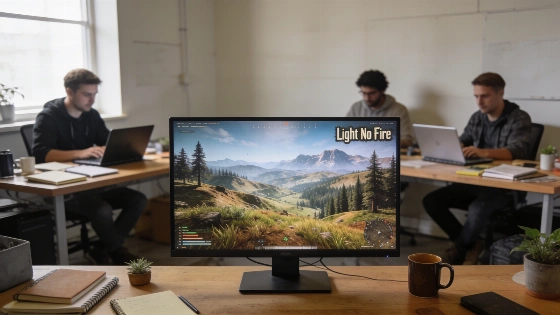
Hello Games has revealed that Light No Fire is being developed by a compact team of 12 to 20 people, mirroring the studio's approach with No Man's Sky at launch and raising questions about the scale and pace of the new survival project
Hello Games has confirmed that Light No Fire, its ambitious open-world survival game, is being developed by a team of just 12 to 20 people. This figure, revealed by studio founder Sean Murray, places the project on a similar scale to the original No Man's Sky launch team, despite the game's planet-sized ambitions and the studio's growth since its early days.
Development Scale and Studio Growth
According to Hello Games, the day-to-day team working on Light No Fire fluctuates between 12 and 20 developers. This is roughly the same number that supported No Man's Sky at launch, which Murray estimates averaged around 15 people. The studio now supports both Light No Fire and ongoing No Man's Sky updates, with a combined headcount of approximately 30 developers across both projects. For context, Hello Games operated with just six staff before No Man's Sky's release, so the current structure represents significant growth, even if the teams remain small by industry standards.
Murray has previously acknowledged that Light No Fire's scope is "crazy ambitious" for a studio of this size. The game aims to deliver a fully explorable, planet-scale open world, a technical and creative challenge that would typically demand a much larger workforce. However, Hello Games credits its proprietary tools and technology for enabling a small team to remain productive and focused on core development goals.
Comparisons with No Man's Sky
The decision to keep Light No Fire's team compact echoes the studio's approach with No Man's Sky, which launched in 2016 with a similarly lean development group. Despite initial criticism over the game's launch state and feature set, Hello Games has since delivered a decade of substantial updates, including the recently announced Cosmos update. The studio's experience with iterative development and live-service support appears to inform its strategy for Light No Fire, prioritising steady progress over rapid expansion.
While some players may recall the challenges faced by No Man's Sky at launch, Hello Games' track record of post-release improvement has shifted perceptions of what a small team can achieve over time. The studio's willingness to maintain a modest headcount suggests a continued focus on long-term support and incremental growth, rather than scaling up for a single release window.
Ambition, Tools and Remaining Uncertainty
Light No Fire remains in active development, with few major updates or gameplay reveals since its initial announcement over two years ago. The lack of regular news has led to speculation about the project's progress and whether the current team size is sufficient to deliver on its promises. Hello Games maintains that its internal technology stack allows for efficient world-building and content creation, but has not provided a detailed roadmap or release window for Light No Fire.
For players tracking major upcoming releases, the situation is reminiscent of other highly anticipated projects that have opted for extended development cycles and limited public updates. In a similar vein, Nintendo's recent decision to dedicate a full Direct broadcast to Fire Emblem: Fortune's Weave ahead of its Switch 2 launch demonstrates how studios are managing expectations and communication for large-scale titles (Nintendo's Fire Emblem: Fortune's Weave Direct).
What Remains Unknown
At present, Hello Games has not confirmed a release date, target platforms, or detailed gameplay footage for Light No Fire. The studio's communication strategy appears cautious, likely informed by the lessons of No Man's Sky's pre-launch cycle. While the team's size and productivity tools are cited as strengths, the scale of the project means that significant milestones may still be some way off. Players interested in Light No Fire should expect further updates only when the studio is ready to show substantial progress.
Understanding the relationship between team size and game ambition is crucial in modern development. Smaller teams can deliver large-scale projects by leveraging proprietary tools, procedural generation, and focused design, but this often results in longer development cycles and a need for clear communication about what will be available at launch. For players, this means that patience and realistic expectations are essential when following the progress of games like Light No Fire.