
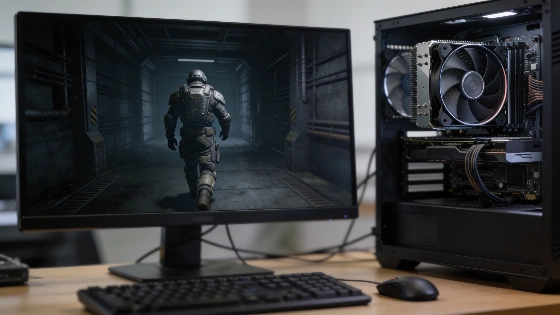
The Coalition's final PC requirements list 4K at 60 FPS for an RTX 5070 Ti and 1440p at 60 FPS for an RTX 3060 Ti. With upscaling enabled, Gears of War: E-Day looks more accessible than many recent Unreal Engine 5 releases.
The Coalition has placed an RTX 5070 Ti, rather than a flagship graphics card, behind Gears of War: E-Day's 4K 60 FPS PC target. Upscaling is enabled for that requirement, so it does not prove native 4K performance. Still, it gives the October 6 release a more approachable technical profile than many recent Unreal Engine 5 games.
PC requirements
The final specification list sets out three performance targets. The minimum tier aims for 1080p at 60 FPS on Medium settings with DLSS, FSR, TSR or XeSS. The Recommended tier targets 1440p at 60 FPS or higher on High settings. Ultra moves to 4K at 60 FPS or higher and lists the RTX 5070 Ti or Radeon RX 7900 XT.
TechSpot's summary of the published requirements lists an RTX 5050, RTX 2060, Radeon RX 6600 or RX 9060 for 1080p at 60 FPS. For 1440p at 60 FPS, it names an RTX 5060, RTX 3060 Ti, Radeon RX 6700 XT or RX 9060 XT.
The middle tier says the most about the game's demands. An RTX 3060 Ti or Radeon RX 6700 XT is listed for 1440p at 60 FPS, alongside an RTX 5060 or Radeon RX 9060 XT. That does not show how steadily the game will hold its target in every scene. It is still a relatively modest recommendation for a title built on Unreal Engine 5.
The processor requirements rise with each tier. Minimum lists a Ryzen 5 2600X, i7-6850K or i5-10400. Recommended calls for a Ryzen 5 5600 or i5-11600K. Ultra lists a Ryzen 7 7800X3D or i7-14700K.
Memory rises from 12 GB to 16 GB, while VRAM rises from 6 GB to 12 GB. Every tier requires 115 GB of SSD storage. The 12 GB RAM requirement applies to the minimum profile. Recommended and Ultra require 16 GB, while the 115 GB SSD requirement stays the same across all three tiers.
Microsoft and Xbox's official specification list also makes an SSD and a graphics card with hardware ray-tracing support mandatory for every PC profile. Some older systems without suitable DX12 Ultimate and ray-tracing support will therefore miss the stated requirements, even if their standard rasterization performance appears adequate.
Upscaling and ray tracing
Gears of War: E-Day will support NVIDIA DLSS 4.5, AMD FSR 4 and Intel XeSS 3.0t. The game also lists hardware ray-traced reflections, shadows and global illumination, along with HDR and ultrawide monitor support.
A built-in benchmark mode with advanced PC settings should give players a practical way to test their systems. They will not have to rely only on the preset labels.
These features make the 4K claim more useful, but they also come with limits. The target depends on upscaling, and the published requirements do not state the internal rendering resolution, whether frame generation is used or how stable the frame rate will be in demanding scenes. These are official targets, not independent measurements from a retail build.
GamingBolt noted that the Unreal Engine 5 game's combination of ray tracing and current upscaling technologies makes its hardware demands look relatively moderate compared with many other UE5 releases. That comparison needs care. The published 4K target is tied to upscaling, not native 4K rendering.
Console ambitions
The Coalition also wants to bring substantial lighting complexity to Xbox Series X|S. The game is described as running hundreds of shadow-casting lights at 60 FPS on consoles. The source does not provide a resolution-mode breakdown or independent testing of that claim.
Technical Director Kate Rayner has indicated that building the visuals around this lighting approach was difficult. The team reportedly iterated faster with hardware ray-traced Lumen. That suggests ray tracing was used not only for image quality but also during development.
That distinction matters. A method that speeds up development does not guarantee identical performance across Xbox Series X|S and PC hardware. The available information confirms an ambitious visual target and a stated 60 FPS goal. It does not yet provide platform-specific resolution, frame-pacing or stability data.
What players know
Gears of War: E-Day is scheduled to return the series to PC and Xbox Series X|S on October 6. Microsoft and Xbox announced through Xbox Wire on September 17 that the game had gone gold.
The same announcement set the start of preloading for Xbox Series X|S, PC through Xbox and Steam at September 29, 15:00 UTC.
The published requirements show the hardware classes The Coalition expects players to need. The supported upscalers and benchmark mode point to a PC version built for adjustment rather than one fixed preset.
The inclusion of DLSS 4.5, FSR 4, XeSS 3.0t, HDR and ultrawide support also shows that the PC release is built around adjustable image reconstruction and display options.
The main caveat is simple: a system requirement is not a benchmark. It tells players what the developer connects with a performance target. It does not show whether that target will hold in every firefight or whether image reconstruction will bring visible compromises.
Until independent testing is available, the RTX 5070 Ti recommendation should be treated as an encouraging specification, not a measured guarantee.
Upscaling renders the game internally at a lower resolution and reconstructs the image for a higher output. This reduces the GPU workload compared with native rendering. It can make a 4K output target possible on less expensive hardware, but it is not the same as native 4K clarity.
Based on the information available, The Coalition has put forward one of the more credible Unreal Engine 5 performance plans on paper. The requirements are restrained, the targets are clearly labeled, and the remaining question is whether the final build delivers stable results instead of only impressive numbers.