
A new showcase of Ganaboy's Dark Souls 3 path tracing mod transforms the Crucifixion Woods with NVIDIA DLSS 5. More than 80% of the game is reportedly integrated into the BVH, while the current release target remains the end of 2026.
Dark Souls 3 now looks much closer to a modern remake thanks to a path tracing mod that combines major geometry upgrades with NVIDIA DLSS 5. A new showcase of the Crucifixion Woods offers the clearest look yet at Ganaboy's project. The 2016 game appears far more contemporary, but its original identity remains intact.
Lighting rebuilt
The change goes well beyond brighter shadows or a sharper image. The mod's Lighting Engine uses path tracing to recalculate how light interacts with the environment. Its denoising pipeline relies mainly on NRD-SH.
The creator says the result is comparable in quality to Ray Reconstruction. NRD-SH is the preferred option because Ray Reconstruction has a heavier performance cost on RTX 20 and 30 series graphics cards. Fanáticos del Hardware also describes separate routing for path tracing and NVIDIA Neural Rendering.
In the showcased setup, NVIDIA DLSS 5 runs before Super Resolution. This reduces the computational load from path-traced lighting before the final upscaling stage. It is not simply another image-quality layer added afterward.
DLSS 5 remains exclusive to NVIDIA. The broader path tracing mod should work with AMD graphics cards that support ray tracing. The footage is therefore a technical demonstration of how the systems work together. It is not an official FromSoftware remaster or a confirmed commercial project.
Crucifixion Woods
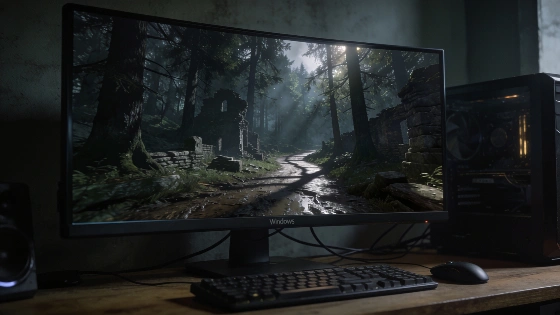
The Crucifixion Woods puts the mod through a useful test. Its open spaces and dense environmental detail give the lighting system plenty of room to show what it can do. Refined illumination and more convincing shadows make the area feel much richer than in the original game.
The visual jump invites comparisons with Bluepoint Games' Demon's Souls remake, although the asset work and rendering pipeline are different.
That comparison describes the footage. It does not prove that the projects have equal production values. The video comes from a modder, and the final experience will depend on the finished build, the user's hardware and the selected settings.
The showcase still explains why PC modifications remain the most practical option for players who want a more ambitious visual presentation. FromSoftware has not announced a remake or remaster of Dark Souls 3.
Build details
The creator's FAQ says that more than 80% of the full game's geometry has been placed inside the BVH used for path-traced scene data. The installation should occupy around 3 to 4 GB. That is roughly 10 times the geometry volume of the Dark Souls 2 project.
The current release window is the end of 2026, but that remains a target rather than a fixed date. Fanáticos del Hardware reports the same more-than-80% BVH integration figure in its recent coverage of the DS3 Lighting Engine.
Performance should be similar to DS2LE. Players who used DLSS Quality mode in Dark Souls 2 may need Balanced mode in Dark Souls 3 because of the heavier geometry load.
The mod is intended to work with UXM, Mod Engine 2 and Mod Engine 3. Published descriptions also mention support for AMD graphics cards with ray tracing. DLSS 5 processing will remain limited to NVIDIA hardware, and the creator stresses that a decent GPU is still required.
Lighting will receive more post-processing and further adjustments during testing. Fake lights may be used in the worst-case scenarios. Torch mechanics will not receive the same priority in the default setup as they did in Dark Souls 2.
The stated goal is simple: players should not need a torch to progress when using DS3LE-PT.
What remains unknown
Online play and Seamless compatibility have not been tested. The project's multiplayer status is therefore still unclear. TweakTown reports that the creator has made no final compatibility guarantees for online play or Seamless Co-op.
That limitation matters for Dark Souls 3. A visual overhaul that works only offline offers a different proposition from a drop-in upgrade for the original PC experience. The FAQ also does not provide measured frame-rate figures, tested resolutions or a complete hardware specification.
The path tracing effort follows an earlier project for Dark Souls 2. The creator's technical notes make clear that Dark Souls 3 is the more demanding undertaking.
Readers interested in how engine technology can reshape a game's visual identity can also consult our engine analysis for another example of technology changing development priorities.
Dark Souls 3 still looks capable for a game released in 2016. This mod shows how far targeted rendering changes can push it toward a modern presentation.
The planned release is not a substitute for an official remaster. Performance has not been independently measured here. The available evidence is still strong enough to make the PC version especially interesting for players who want advanced lighting.
The project's achievement is not that it pretends to be a new game. It shows how a rebuilt rendering layer can give an established game a credible second life.
Path tracing simulates many more interactions between light and the scene than conventional lighting. That can improve shadows, reflections and indirect illumination, but it also sharply increases rendering cost.
DLSS can reduce that load by reconstructing a higher-resolution image from a lower-resolution workload. The selected mode still affects the balance between clarity and performance.
Here, the mod is a compelling technical upgrade rather than a measured performance guarantee. Its eventual release and real-world testing will matter more than the showcase alone.