
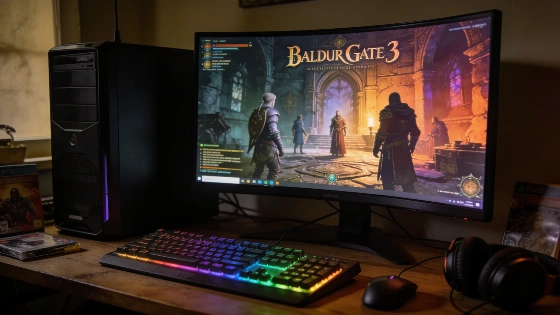
Larian Studios has published a new video highlighting ten of the rarest scenes and character outcomes in Baldur's Gate 3, including obscure endings and narrative twists that most players will never encounter
Larian Studios has released a new official video showcasing ten of the most elusive scenes and endings in Baldur's Gate 3. The compilation, presented by senior communications developer Aoife Wilson, draws attention to narrative outcomes and character fates that only a small fraction of players have witnessed. The video, available on Larian's YouTube channel, focuses on moments that are not only difficult to trigger but also reveal unexpected narrative branches and consequences for key companions.
Obscure Endings and Character Fates
The video highlights a range of rare outcomes, such as Lae'zel's self-inflicted demise, which reportedly has been seen by only around 50 players. Other examples include Wulbren Bongle, a gnome character from Act 2, who may choose to remain imprisoned if the player fails a critical roll. These scenes are described as statistical outliers, requiring specific choices or failures that most players are unlikely to encounter during a standard playthrough.
Additional rare moments involve major companions like Minthara and Astarion. In one sequence, Minthara offers an unusual gesture of support, while in another, she interacts with the player's transformed form in a way that diverges sharply from her typical narrative arc. Astarion's possible outcomes range from a rare romantic scene with Gale after the latter's ascension, to a grim fate as a cursed vampire dreg in Cazador's lair-an outcome that even the game's antagonists acknowledge as particularly cruel.
Narrative Complexity and Player Choice
The video underlines the depth of Baldur's Gate 3's branching narrative, where obscure combinations of decisions, dice rolls, and companion relationships can unlock scenes that most players will never see. For example, the Githyanki hero Orpheus may propose an alliance with the player's Mind Flayer form, a scenario that requires a highly specific set of circumstances and companion involvement. These outcomes demonstrate the game's commitment to reactive storytelling, with even minor characters receiving unique narrative resolutions based on player action or inaction.
While the video does not provide a ranked list or comprehensive statistics for each scene, it makes clear that these moments are among the least commonly experienced in the game. The rarity of these outcomes is attributed to the complex interplay of narrative variables, many of which depend on player failure or unconventional choices rather than optimal play.
Player Data and Community Insights
Alongside the video, Larian Studios has shared additional player data to mark Baldur's Gate 3's third anniversary. This data offers insight into how players typically approach the game, highlighting the contrast between the most common choices and the rare narrative branches featured in the video. The studio's willingness to spotlight these hidden moments reflects both the scale of the game's narrative design and the unpredictability of player behaviour in a system driven by dice rolls and branching paths.
For players interested in exploring every narrative possibility, the video serves as both a guide and a reminder of just how much content can remain hidden even after multiple playthroughs. It also reinforces the value of experimentation and replayability in uncovering the full scope of Baldur's Gate 3's story.
Branching narrative design allows games like Baldur's Gate 3 to deliver a wide range of outcomes based on player decisions, random chance, and character relationships. Unlike linear campaigns, these systems require developers to account for countless permutations, resulting in scenes and endings that may be seen by only a handful of players. This approach increases replay value but also means that some of the most interesting content can remain hidden without deliberate exploration or unusual playstyles.