
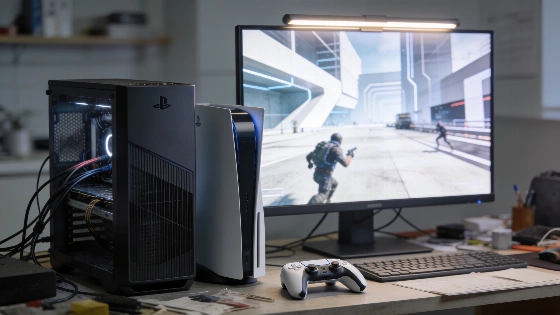
Sony's focus on selected multiplayer and live-service PC releases could leave room for AnyPS5, an experimental project that aims to convert PS5 executables for Windows and Linux without traditional emulation.
PlayStation may be pulling back from some single-player PC ports. An unexpected technical challenge is taking shape in response. AnyPS5 is being developed to convert PlayStation 5 executables into native Windows and Linux formats.
The project is nowhere near a playable release. It has reportedly reached the first boot stage for games, which points to an unofficial route for titles Sony may keep on its console. No independently verified AnyPS5 release or commercial game running through the project has been documented by major media or an official project platform. The available references are still discussions and reposted claims.
PlayStation changes course
During the current generation, PlayStation brought several major single-player releases to PC. They included God of War, its sequel, Ghost of Tsushima and The Last of Us series.
Recent industry coverage points to a stronger focus on live-service and multiplayer projects. That includes Bungie releases, Marathon and MARVEL Tōkon: Fighting Souls. It does not point to a commitment to bring the entire single-player catalogue to PC.
That strategy could leave games such as the Demon's Souls remake, developed by Bluepoint Games, without a stated PC path. It could also affect future projects such as God of War Laufey. The source presents that game as an example of a title that may remain a console exclusive for the foreseeable future.
Reports that Sony has formally ended single-player PC ports have not been confirmed by an official Sony policy statement in the available authoritative coverage. TechTimes describes the situation as a market direction and an expectation, not a published ban or a definitive end to the programme.
PlayStation's planned end to disc production in 2028 has added pressure to its platform strategy. The source says that decision could still be reversed, based on recent rumours. That leaves a clear gap between the games PlayStation has ported and what PC players may receive next. The size and permanence of that gap are still unsettled.
What AnyPS5 attempts
AnyPS5 is not a conventional emulator. Its design uses a relinker to convert an original PlayStation 5 executable into the target system's native format. It also implements the console's system PRX libraries for dynamic linking.
The project recompiles console shaders through Vulkan. That could let games operate on Windows or Linux without a separate emulation runtime.
The approach is possible because the PlayStation 5 and modern PCs use the x86-64 architecture. In theory, avoiding the need to reproduce the console's CPU through emulation could remove the processor bottlenecks that often limit emulated games.
That does not make performance or compatibility automatic. Hardware architecture is only one part of a console platform. The software around the executable still has to be recreated or replaced.
AnyPS5 already shows how large that task is. The tool can reach the initial boot sequence, but it cannot run games because required PlayStation 5 operating-system hooks are missing.
There is no independently verified evidence that a complete commercial game is playable through the project. For now, AnyPS5 should be treated as an early development effort, not as an available PC port.
What players could gain
If the missing hooks are eventually implemented, the compatibility layer could offer a technical route to PlayStation 5 games that Sony has not announced for PC. Native execution might let games run at or near full speed without the CPU limits tied to emulation.
The source also identifies possible DualSense support over Bluetooth through an unofficial application. That remains a potential benefit, not a demonstrated feature of a finished AnyPS5 release.
The most obvious question is Grand Theft Auto VI. AnyPS5 would not realistically bring Rockstar Games' highly anticipated game to PC before an official port. The project's current state and the amount of work still required make that clear.
That assessment concerns timing, not capability. A tool that only reaches an initial boot screen cannot be treated as a shortcut to a complete game before an official platform release.
Recent progress in PlayStation 5 emulation provides useful context. An earlier technical report on Silent Hill 2 showed that efforts to run PS5 software outside Sony's hardware have moved beyond purely theoretical discussion.
AnyPS5 follows a different path by targeting native execution. Both projects are still works in progress. Neither is a replacement for a supported PC release.
The technical barrier
AnyPS5's appeal is also its biggest warning. Converting executable code and recompiling shaders may address part of the platform gap. Games still depend on operating-system services, graphics functions, storage behaviour, input handling and other console-specific systems.
The missing PS5 OS hooks are not a minor launch problem. They are the reason the current build stops before gameplay begins.
The broader PS5-on-Linux scene shows another limitation. Unofficial projects can depend on vulnerabilities in particular firmware versions. Later Sony updates can close the methods they use.
Kaspersky reported firmware ranges of 3.00 to 7.61 for the PS5 and PS5 Slim in connection with Linux exploits discussed in 2026. That does not directly establish AnyPS5's requirements. It does show why unofficial PS5 software projects can be limited by system version and hardware configuration, not only by the quality of their code.
That distinction matters for the games named in this discussion. God of War Laufey, the Demon's Souls remake and other PlayStation 5 single-player titles are possibilities raised by the project's potential, not confirmed unofficial ports.
The source provides no completion date, compatibility list or playable release. The current evidence supports only initial booting.
PlayStation's decision to emphasize live-service and multiplayer games in its future PC strategy creates the opening AnyPS5 is trying to use. It does not guarantee that the opening will become a usable doorway.
The project matters because native compatibility could bypass some emulation limits. It is not yet a player-ready alternative. Sony still controls the official route to these games, while AnyPS5 remains a technical possibility with its hardest work still ahead.
There are also signs that the official PC pipeline remains an active, if sometimes unstable, business rather than a formally closed one. In September 2026, two PlayStation editions temporarily disappeared from Steam in the United Kingdom.
PCGuide reported that Sony called the incident an error and said it was working with Valve on a fix. The episode does not prove a change in single-player strategy. It does show why platform availability problems should be kept separate from an announced policy decision.
A compatibility layer translates or adapts software so it can run on another operating system. Emulation reproduces the behaviour of the original hardware and software environment.
Native execution can reduce the overhead of recreating a console's processor. It still needs accurate replacements for the system services that games expect. Shader recompilation can prepare graphics code for Vulkan, but it does not prove that every rendering feature will work correctly.
That is why reaching a boot screen is a useful milestone, but still far short of delivering a stable PC version.