
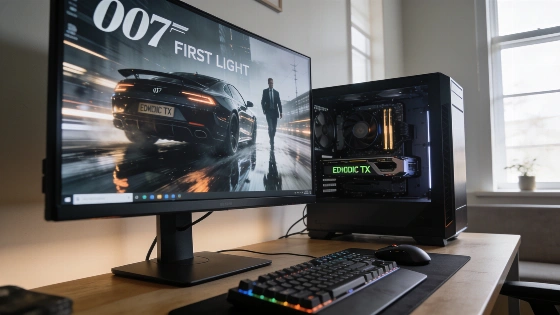
IO Interactive and Amazon MGM Studios have released a major PC update for 007 First Light, introducing full path tracing and DLSS 4.5 Ray Reconstruction to deliver more realistic lighting and reflections for GeForce RTX players
007 First Light has just received its most significant technical update since launch, with IO Interactive and Amazon MGM Studios rolling out full path tracing and DLSS 4.5 Ray Reconstruction support for PC players. According to NVIDIA GeForce News, this update officially launched on September 15, 2026, and brings a substantial leap in visual fidelity for GeForce RTX users. The update, available now, transforms the game's lighting, shadows and reflections, pushing the visual presentation closer to a cinematic standard-provided you have the hardware to match.
What the Update Delivers
Path tracing is now fully implemented across all levels of 007 First Light, replacing the previous hybrid ray-tracing approach. As confirmed by NVIDIA, this means every light source, shadow and reflection is calculated in real time, resulting in more natural illumination and complex environmental effects. DLSS 4.5 Ray Reconstruction, exclusive to NVIDIA's latest RTX graphics cards, further refines image quality by reconstructing ray-traced effects with greater detail and fewer artefacts. The update also retains DLSS 4.5 Super Resolution and Dynamic Multi Frame Generation, which were present at launch, ensuring frame rates remain playable even as visual fidelity increases. NVIDIA states that these enhancements are designed specifically for the GeForce RTX platform, and path tracing will deliver more detailed lighting, shadows, and reflections, while Ray Reconstruction aims to improve the quality of traced effects and reduce artefacts.
IO Interactive has advanced its proprietary Glacier engine to support these features, aiming to match the game's reimagined Bond origin story with equally ambitious visuals. The studio claims that character performances and environmental detail have also benefited from these engine upgrades, though independent testing will be needed to verify the full extent of these improvements. According to 4Gamer, this update marks a complete transition to path tracing for the PC version, moving away from the previous hybrid ray tracing implementation.
Platform Availability and Editions
007 First Light is currently available on PlayStation 5, Xbox Series X|S, and PC via Steam and Epic Games Store, with a 20% discount on PC at the time of writing. A Nintendo Switch 2 version is scheduled for release in summer 2026, but no specific date has been confirmed. The game is offered in Standard, Deluxe, Collector's and Legacy Editions, though the technical enhancements discussed here are specific to the PC version running on compatible NVIDIA RTX hardware. As highlighted by The Verge, the visual update is exclusive to the PC edition and does not extend to console versions.
Players on PlayStation 5 and Xbox Series X|S do not receive the new path tracing or DLSS features, and there is no word yet on whether future console updates might introduce similar visual upgrades. The PC update is available as a free patch for existing owners, but the demanding nature of path tracing means only high-end systems will see the full benefit. NVIDIA also notes that if players do not have an RTX-capable system, they can stream the game with all enhancements via GeForce NOW Ultimate on virtually any device.
Technical Requirements and Performance
To access the new path tracing and DLSS 4.5 Ray Reconstruction features, players will need a GeForce RTX graphics card that supports DLSS 4.5, with NVIDIA's latest drivers installed. Specifically, the update is tied to the GeForce Game Ready Driver 616.92, which NVIDIA released on September 9, 2026, and which is optimized in advance for the 007 First Light update. IO Interactive has not published revised minimum or recommended specifications for the update, but path tracing is known to be resource-intensive, often requiring an RTX 40-series GPU for smooth performance at higher resolutions. Frame rates and image quality will vary significantly depending on hardware, graphics settings and chosen DLSS mode.
Since launch, 007 First Light has sold several million copies and received critical praise for its narrative-driven approach to the Bond franchise. The addition of full path tracing and advanced DLSS features positions the PC version as the technical showcase for the game, echoing the kind of ambitious visual upgrades seen in other recent PC releases. For those interested in broader trends in technical innovation, a recent report on another PC launch highlights how studios are increasingly leveraging advanced rendering techniques to differentiate their titles.
What Remains Unclear
While IO Interactive has detailed the headline features of the update, there is no independent performance analysis yet to confirm how well path tracing runs across a range of supported hardware. It is also unclear whether the Switch 2 version will offer any form of ray tracing or upscaling, or if console editions might see further technical enhancements in future patches. The studio has not announced any plans for additional content or expansions, and the current focus appears to be on technical refinement rather than new gameplay features.
For players considering an upgrade or a first purchase, the main draw of this update is the promise of a more immersive and visually striking Bond experience on PC-assuming your system can handle the demands. The lack of parity with console versions is notable, and it remains to be seen whether this approach will become standard for major multiplatform releases or remain a high-end PC differentiator. IO Interactive's willingness to push technical boundaries is clear, but the real test will be whether these enhancements translate into a meaningfully better experience for players, rather than just a marketing bullet point.
Path tracing is a rendering technique that simulates the way light interacts with surfaces by tracing the paths of individual rays as they bounce through a scene. Unlike traditional rasterisation or even hybrid ray tracing, full path tracing calculates every light interaction, producing more realistic shadows, reflections and global illumination. However, this process is extremely demanding on hardware, often requiring powerful GPUs and advanced upscaling technologies like DLSS to maintain playable frame rates. As a result, path tracing is typically reserved for high-end PC releases and is rarely implemented on consoles or lower-spec systems.