
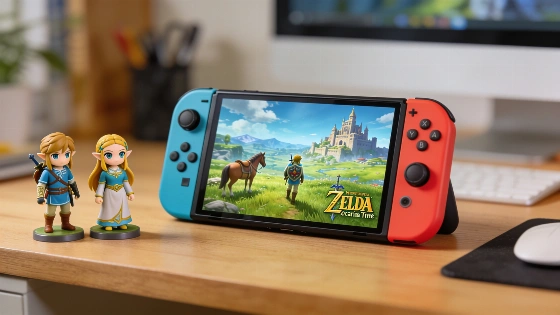
Nintendo fans believe The Legend of Zelda: Ocarina of Time remake for Switch 2 could launch in November, potentially going head-to-head with GTA 6, after new amiibo release dates fuel speculation
Nintendo has yet to officially confirm a release date for The Legend of Zelda: Ocarina of Time remake on Switch 2, but a growing number of fans are convinced the game will arrive in November. This speculation follows the appearance of new amiibo listings, which have historically coincided with major Nintendo game launches.
Amiibo Listings Spark Release Date Theory
The latest round of speculation began when Nintendo listed several new amiibo figures, including Sword Kirby, Dragoon, Noir Dedede and Hydra, all scheduled for release on 11 November. Observant fans noted that Nintendo often aligns amiibo launches with new game releases, even when the figures are not directly related to the game in question. This pattern has previously helped predict unannounced release dates for Nintendo titles.
Examples cited by the community include the Mineru's Construct amiibo launching alongside Fortune's Weave, and Meta Knight and Shadow Star amiibo arriving with Pokopia. While the connection is not officially acknowledged by Nintendo, the consistency of these pairings has led many to believe that the 11 November date could mark the arrival of The Legend of Zelda: Ocarina of Time remake on Switch 2.
Potential Head-to-Head with GTA 6
If the theory holds, Nintendo's flagship remake would launch in the same month as Grand Theft Auto VI, which is currently the only major title with a confirmed November release. Rockstar's blockbuster is expected to dominate the gaming calendar, with rival publishers largely avoiding the window. However, Nintendo's audience and platform focus may allow The Legend of Zelda: Ocarina of Time to attract significant attention despite the competition.
It is worth noting that GTA 6 is not planned for Nintendo platforms, reducing direct overlap. Nintendo's recent release cadence for Switch 2 exclusives has seen Fire Emblem: Fortune's Weave set for 17 September, Nintendo Switch Sports Resort for 22 October, and Xenoblade Chronicles 3: Nintendo Switch 2 Edition for 3 December. November remains conspicuously empty, further fuelling speculation.
What Remains Unconfirmed
At present, Nintendo has not officially announced a November release for The Legend of Zelda: Ocarina of Time remake, nor has it confirmed the game for Switch 2. The only concrete evidence is the amiibo release date, which has proven a reliable-though not infallible-indicator in the past. Fans are also hoping for a trailer and further details during the franchise's 40th anniversary celebrations later this year.
For context, the pattern of using related product launches to infer game release dates is not unique to Nintendo. In a similar vein, Rockstar's approach to physical editions of Grand Theft Auto VI in Japan, which includes a digital code with a strict redemption window, was recently discussed in our coverage of GTA 6's Japanese physical release policy.
Implications for Players
Should The Legend of Zelda: Ocarina of Time remake launch in November, it would represent one of the most significant Switch 2 releases to date, potentially drawing in both long-time fans and new players. The timing would also test Nintendo's ability to command attention during a month dominated by one of the most anticipated games in recent memory. Until Nintendo provides official confirmation, however, the release date remains speculative.
Remakes differ from remasters in that they involve rebuilding a game from the ground up, often with new assets, updated mechanics and modernised visuals, while preserving the core experience. For players, this means the potential for a classic title to feel fresh and relevant on new hardware, but also introduces uncertainty about how faithfully the original will be recreated and what new features might be added or changed.