
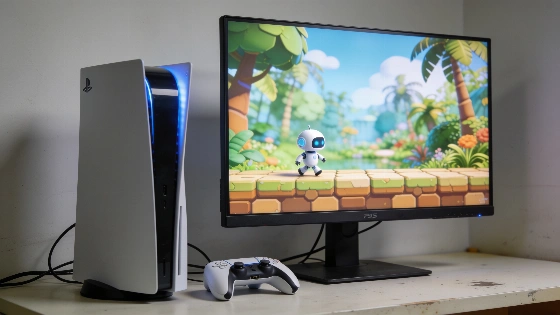
A custom KyTyPS5 fork lifts Astro Bot from severe slowdowns to 30 to 60 frames per second in its opening scenes. Marvel's Wolverine now reaches an in-game scene too, but remains unplayable.
Astro Bot is doing more than booting in the PlayStation 5 emulator KyTyPS5. A custom fork reaches 30 to 60 frames per second in the opening sequence. It also removes several major rendering faults and long freezes. Independent reporting by VideoCardz puts the experimental fork in the same 30 to 60 FPS range during early scenes, while the upstream build remains much slower. Marvel's Wolverine has also reached at least a menu or in-game scene in KyTyPS5 soon after release. Its current performance is still closer to a slideshow than a playable build.
Astro Bot speeds up sharply
Bryan Adams developed the custom KyTyPS5 fork. He uses BryanKAdams on GitHub. A side-by-side test on the same system compared the fork with the upstream emulator across Astro Bot's opening sections. This is more than a small optimization pass. The game moves from a slow technical demonstration to something that can briefly feel usable.
At the start of a new game, the upstream version stays below 20 frames per second. It then freezes for roughly 20 seconds. Bryan's fork reaches 60 frames per second without that freeze. The first steps at the crash site run at 18 frames per second upstream, but hold a steady 60 frames per second in the custom build. During the fly-in to Sky Garden, the upstream version freezes for around 40 seconds. It then falls to 5 frames per second. The fork reaches 25 frames per second.
That last comparison explains the five-times-faster claim attached to the demonstration. Elsewhere, the gain is closer to three times. The practical difference is still clear. The upstream build behaves like slow motion, while the fork reaches frame rates that make interaction possible. The broader 30 to 60 FPS figure covers early scenes only. It is not a performance guarantee for the whole game.
Visual faults are falling away
Frame rate is only part of the change. The fork restores the cloud layer over Sky Garden. It removes blotchy artifacts from the planets and reportedly displays the full level after Astro Bot lands. Those fixes matter because emulator progress is not measured by speed alone. A game can run quickly and still be far from a reliable replacement for native hardware if it loses major environmental elements.
The evidence remains limited. Testing covers the opening, not the complete campaign. The experimental fork is available on GitHub for anyone who wants to examine it. The reported 30 to 60 frames per second range therefore describes a small part of Astro Bot, not the performance of the full campaign.
Wolverine reaches the emulator
KyTyPS5 is moving beyond one showcase game. PSXTech has demonstrated Marvel's Wolverine launching into an in-game scene. That is a meaningful compatibility milestone, even though the result currently runs as an extremely slow slideshow. VideoCardz reports a test with a Ryzen 7 7800X3D and GeForce RTX 5090 that reached roughly 2 frames per second in the menu. Reaching a menu or early in-game scene is not the same as delivering playable gameplay. The available evidence does not establish a stable 10 to 20 frames per second result for the game.
Android Authority describes Wolverine's current state as a proof of concept rather than a working PC version. The game can move farther through the emulator than a simple boot screen, but it has not reached a practical performance level. The reports show compatibility progress, not a finished way to play Wolverine on Windows or Linux.
The emulator's recent record gives that launch more context. Independent coverage has identified KyTyPS5 reaching in-game states in Astro's Playroom, Crash Bandicoot 4, Hitman 3 / World of Assassination, Uncharted 4, Spider-Man: Miles Morales, Silent Hill f and Tekken 8. Grand Theft Auto V's PlayStation 5 build has also been shown running through KyTyPS5. Demon's Souls Remake climbed from 2 frames per second to between 10 and 18 frames per second in one day, then later reached 30 frames per second. Astro Bot itself first entered gameplay at around 11 frames per second with serious rendering problems. That progression explains why Wolverine's slideshow still matters. Compatibility is arriving before performance is solved.
Another experiment used NVIDIA's DLSS Multi Frame Generation with Demon's Souls Remake. PSXTech reported 120 frames per second from a base result of 30 frames per second through a four-times multiplier. Frame generation can create extra displayed frames. It does not mean the emulator is producing equivalent new game simulation frames or matching native input response. The figure is an experimental output, not proof that the underlying 30 frames per second performance has been transformed.
The PC access problem
The timing is awkward for Sony. The source argues that the company has stepped back from bringing its single-player games to PC. It identifies Astro Bot and Wolverine as the kind of first-party exclusives PC players might once have expected on Steam. If those games do not receive official PC versions, KyTyPS5 becomes the only route described here for playing them on PC.
Grand Theft Auto VI adds pressure. Rockstar's game is scheduled for PlayStation 5 and Xbox Series S|X on November 19. No PC version has been announced. An earlier GTA analysis already discussed that possibility, but KyTyPS5's progress makes the wider platform question less abstract. It still does not establish that Grand Theft Auto VI will run through emulation or that it will do so before an official PC release.
KyTyPS5 is not a practical PlayStation 5 replacement yet. It is an open-source PS5 emulator for Windows and Linux. Android Authority says its developers warn about graphical errors, crashes, low performance and limited compatibility. Astro Bot's strongest results cover only its opening. Marvel's Wolverine remains a slideshow. DLSS Multi Frame Generation changes the displayed output without automatically fixing emulation speed. The evidence still shows unusually rapid movement from booting and broken rendering toward recognizable gameplay. Sony's limited official PC path for games such as Astro Bot and Wolverine gives that work more weight. KyTyPS5 is becoming a technical counterpoint to the platform holder's release strategy, not just a curiosity.
Frame pacing matters as much as a headline frame-rate number because it shows how evenly frames arrive. A game displaying 30 frames per second with consistent delivery can feel steadier than one that jumps sharply between higher and lower results. Frame generation inserts predicted images between rendered frames. Motion can look smoother while the original rendering workload and much of the input response remain unchanged. That distinction matters when judging emulator footage that reports both a base result and a generated output.