

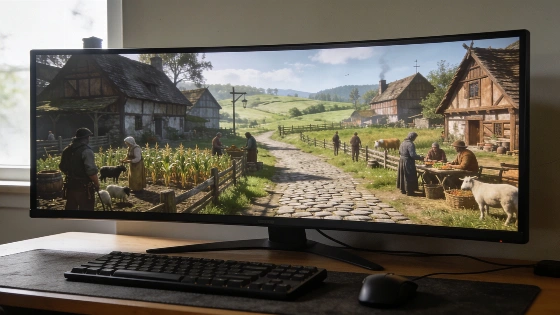
CD Projekt Red has revealed that early in The Witcher 3: Wild Hunt's development, the team's focus on realistic NPC schedules resulted in unexpected in-game behaviours, highlighting the challenges of simulating convincing open-world populations
CD Projekt Red has shared new insight into the early development of The Witcher 3: Wild Hunt, revealing that the studio's initial approach to non-player character (NPC) behaviour nearly caused significant design complications. During the game's pre-release phase, the development team prioritised creating believable daily routines for villagers and townsfolk, aiming to make the world feel genuinely inhabited. However, this emphasis on routine over player interaction led to some surprising and unintended consequences within the game's open world.
NPC Schedules and Player Interaction
According to quest designer Philipp Weber, the team's early focus was on simulating authentic day and night cycles for NPCs, particularly in rural villages. This meant that villagers would move between various points of interest, such as woodcutting areas or carpentry spots, based on their programmed schedules. While this approach enhanced the sense of realism, it left gaps in how NPCs responded to player actions, especially during moments of danger or disruption.
One notable example involved the game's fear response system. When players engaged in threatening behaviour-such as drawing a weapon in a peaceful village-NPCs were programmed to abandon their current tasks and flee. However, because the system did not account for specific roles or relationships, mothers in the game would sometimes drop their babies and run, resulting in immersion-breaking moments that highlighted the limitations of the early AI framework.
Technical Challenges and Solutions
Weber explained that, at the time, the studio lacked the tools and experience to efficiently balance NPC routines with responsive behaviour. In 2012, creating a small village with dynamic inhabitants was a time-consuming process, and the team's systems for pathfinding and interaction were still evolving. The developers eventually recognised the need to refine their approach, ensuring that NPCs could both follow believable schedules and react appropriately to player-driven events.
To address these issues, CD Projekt Red introduced more nuanced AI logic, allowing for context-sensitive reactions and preventing scenarios where NPCs would act in ways that undermined the game's credibility. By the time The Witcher 3 launched in 2015, the studio had implemented a more robust framework, enabling villagers to respond to threats without abandoning dependents or behaving unrealistically.
Open-World Design and Player Expectations
The Witcher 3's open-world structure placed unique demands on its AI systems. With villages often containing only a handful of houses, players were more likely to scrutinise the authenticity of each NPC's behaviour. The development team created hundreds of potential points of interest for groups such as the sailors in Novigrad harbour, ensuring that even with dozens of active NPCs, the world would not feel static or artificial.
This focus on detail reflects a broader trend in open-world game design, where players increasingly expect dynamic, believable environments. The challenges faced by CD Projekt Red echo those encountered by other studios experimenting with emergent systems and complex AI. For example, early prototypes of major games have sometimes revealed scrapped features or unexpected outcomes, as seen in unreleased footage from Demon's Souls that showcased abandoned mechanics.
Lessons for Future Development
CD Projekt Red's experience with The Witcher 3's NPCs has informed its approach to subsequent projects. The studio now has more efficient tools for building convincing settlements and balancing routine with reactivity. While the early AI missteps were quickly corrected, they serve as a reminder of the complexity involved in creating open worlds that feel both alive and responsive to player agency.
As open-world games continue to evolve, the interplay between scripted behaviour and emergent response remains a central technical and creative challenge. Developers must weigh the benefits of realism against the risk of unintended consequences, ensuring that player actions are met with credible, context-aware reactions from the game world.
Simulating convincing NPC behaviour in open-world games requires a careful blend of scripting and dynamic systems. While daily routines can make environments feel authentic, they must be balanced with responsive AI that adapts to player actions. Achieving this balance is a technical challenge that has shaped the evolution of open-world design, influencing how studios approach both immersion and interactivity in modern games.