
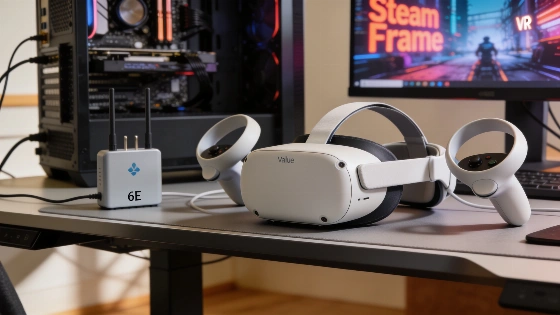
Valve has released the Steam Frame as its first standalone VR headset with early reviews highlighting exceptional comfort and strong PC streaming but raising concerns over its steep price and limited battery life
Valve's Steam Frame has arrived, and the first reviews are unanimous on one point: this is the most comfortable VR headset on the market, but its battery life and price tag are already drawing fire. The device's modular design and wireless PC streaming have impressed, yet the launch is overshadowed by practical and financial barriers that will keep most players on the sidelines. According to Game Informer and PC Gamer, the Steam Frame is available in two configurations-256GB for $1,059 and 1TB for $1,299-with both packages including the Steam Frame Controllers, a dedicated wireless adapter for PC streaming, and a copy of Half-Life: Alyx.
Comfort and Streaming Performance
Reviewers have singled out the Steam Frame's comfort as its defining feature. By placing the 21.6Wh battery at the rear of the headstrap, Valve has achieved a balanced fit that avoids the front-heavy drag common to other VR headsets. This design choice, highlighted by PC Gamer, IGN, and Tom's Hardware, results in a headset that sits securely without sliding down the nose, with foam padding and a nose cutout receiving specific praise. Several reviewers noted they were able to wear the device for extended periods without discomfort, a rarity in the current VR landscape.
Wireless PC streaming is another clear strength. The included wireless adapter establishes a dedicated link for streaming, and official specifications confirm support for Wi-Fi 7, which, along with SteamOS 3, makes launching games and working with a PC less dependent on the home network's quality. According to Road to VR and Thurrott, this dedicated adapter ensures minimal latency and reduces network interference. The dual-radio setup means the Steam Frame can handle both standard Wi-Fi and VR streaming simultaneously, and the integration with SteamOS makes launching games straightforward. Controller tracking has also been highlighted as accurate and reliable, with the same controllers supporting both VR and traditional flat games.
Hardware Details and Pricing
The Steam Frame is available in two configurations: a 256GB kit for $1,059 and a 1TB kit for $1,299, both including the Steam Frame Controllers, a dedicated wireless adapter for PC streaming, and a copy of Half-Life: Alyx. Notably, a power supply is not included; Valve sells a compatible 45W USB-C charger separately for $29, as confirmed by Game Informer and The Sixth Axis. Optional accessories include an Ergonomic Accessories Kit, an Accessory Replacement Kit, prescription lens inserts, and the Arcturus Vision camera for colour passthrough, which costs $149 and attaches via the front expansion port.
Technical specifications, as confirmed by Game Informer, PC Gamer, and Club386, include a 4nm Snapdragon 8 Gen 3 processor, 16GB unified LPDDR5X memory, and a 2160 × 2160 LCD per eye with refresh rates from 72Hz to 144Hz (the highest setting is experimental). The headset uses custom pancake lenses for up to 110° field of view, inside-out camera-based tracking, and supports foveated streaming-rendering only the area the user is looking at in full detail to maximise wireless bandwidth. The controllers use a dedicated 2.4GHz link, run on a single AA battery each, and offer up to 40 hours of use per battery.
Battery Life and Software Limitations
Battery life is the Steam Frame's most significant weakness. In standalone VR mode, the headset typically lasts around two hours, but demanding titles such as Half-Life: Alyx can drain the battery in under an hour at higher refresh rates. Streaming from a PC can extend playtime to roughly two hours, but this still falls short of what many players expect for longer sessions. Reviewers have suggested that anyone planning extended play will need to invest in a USB power bank or remain tethered to a charger. PC Gamer and Tom's Hardware note that the battery's placement in the rear of the strap is a key factor in the headset's comfort, but does not mitigate the limited runtime.
Software stability is another area where the Steam Frame falls short of expectations. While SteamOS 3 on ARM brings a KDE Plasma desktop and allows a portion of the Steam library to run natively, several reviewers encountered crashes and instability, particularly when using desktop and multi-window features. Some games flagged as compatible failed to launch, and the overall standalone experience was described as unfinished. The lack of colour passthrough in the base unit, which requires a $149 add-on, has also been criticised given the device's premium price.
Who Should Consider the Steam Frame
At $1,059 for the entry-level kit, the Steam Frame is not positioned as a mass-market device. According to Tom's Hardware, PC Gamer, and Club386, independent reviews published in mid-September 2026 were nearly unanimous: the main advantage of the Steam Frame is its comfort and the convenience of wireless streaming, while the high price makes it a niche product. Reviewers have been clear that first-time VR buyers are better served by more affordable options such as the Quest 3, which delivers a comparable display and a more accessible price. Existing Quest 3 owners are advised to weigh the benefits of improved comfort and streaming against the high cost and limited battery life. Despite these caveats, several reviewers still regard the Steam Frame as the best gaming VR headset currently available, citing its engineering and modularity as genuine advances. However, the absence of a new flagship VR title to drive adoption-unlike the Valve Index's launch alongside Half-Life: Alyx-means the Steam Frame enters a market still searching for its next killer app.
Foveated streaming is central to the Steam Frame's technical approach. By tracking the user's eye movements and rendering only the area in direct focus at full resolution, the headset can deliver higher apparent detail over a wireless connection without exceeding bandwidth limits. This technique reduces the load on both the headset and the network, but its effectiveness depends on precise eye tracking and robust software support. As more VR platforms adopt similar methods, understanding foveated rendering will become increasingly important for players comparing next-generation headsets.