
Star Wars: Galactic Racer pairs aggressive arcade driving with a roguelite campaign. Crashes and failed objectives can send a run back to the start, but upgrades and new equipment carry forward.
Star Wars: Galactic Racer succeeds where a licensed racer could easily have stalled. It makes speed feel dangerous. The PC version reviewed here delivers sharp arcade handling across Landspeeders, Speeder Bikes and Skim Speeders. Each campaign run also carries enough risk and reward to make another attempt worthwhile. StarWars.com identifies these three vehicle classes as the main choices for players adapting the racing experience to different play styles.
Speed with consequences
The driving feels immediate and forceful. The afterburner and Ramjet provide strong bursts of speed. Defensive and utility skills can shield the racer or take control of the vehicle through auto-pilot.
Turns are the real test. Understeer and oversteer can send a vehicle into a wall and trigger a deliberately comic slowdown. Taking another racer out produces a dramatic crash camera, giving collisions real weight.
This is not a simulation built to model every mechanical detail. It is an arcade racer about momentum, risk and split-second control. Its aggressive energy is closer to WipEout and Burnout than to a conventional circuit racer, though the Star Wars setting gives it a clear identity.
That identity also carries unusual historical weight. IGN describes the project as the first new Star Wars racing game in more than two decades. Fuse Games is the developer.
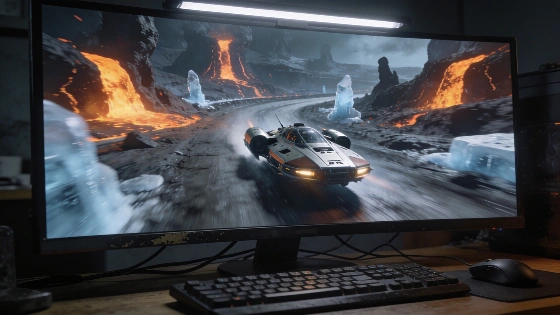
The six available worlds build that identity through hazards rather than simple scenery. Ando Prime can freeze a racer and cut speed until superheated vents restore momentum. Other courses introduce lava rivers, overheating Ramjets and acid that can damage several parts of a setup. These obstacles force players to read the track and choose equipment with more care than a basic boost system would demand.
The campaign loop
Galactic Racer's strongest idea is its campaign structure. A run begins with a league token. It can end when a specific objective is failed or the vehicle crashes too many times.
Additional league tokens can extend the campaign, but they remain limited. Every aggressive shortcut therefore carries a cost.
Persistent rewards ease that pressure. Completing a race earns upgrade points, new equipment and turning points even when the finishing position is not a victory. Most events favour a top-four finish for the best returns, but the game still gives progress for taking part. A failed run does not feel completely wasted, yet the current campaign can still be lost.
Six upgrade areas let players improve durability, Ramjet speed and battery capacity for skills. Equipment occupies different slots and can bring useful effects as well as drawbacks when something goes wrong. Repeated use of certain abilities also unlocks racer styles, beginning with Survivor. Each style adds its own perks.
The system has several layers without becoming hard to understand. The three vehicle classes give progression a practical purpose instead of turning it into a menu exercise.
The campaign follows Darius Pax, founder of the Galactic League, as he tries to defeat Kestar Bool and retain control of the competition. The story is functional rather than the main attraction. The real narrative comes from the changing build created during each run and the knowledge gained from a failed attempt.
Modes and missing variety
The campaign offers a changing selection of events. Straight races sit alongside elimination contests, vehicle field tests, head-to-head challenges, contracts and objectives that restrict how a course must be tackled. Random elements can change the value of equipment and skills. The in-game shop gives players more reasons to spend turning points.
Outside the main campaign, there is multiplayer, a set of special scenarios with defined win conditions and an arcade mode built around time trials. The campaign remains the larger offering because it links racing performance to longer-term upgrades. Multiplayer adds competition, but it does not replace the carefully tuned single-player loop.
The explorable hub areas have less purpose. They look attractive, but their function is narrow. Players speak to one or two characters, visit the shop and return to the racer. That movement adds little to the campaign. More tracks or deeper racing spaces would have served the game better.
The same restraint affects variety. The six worlds have distinct hazards, and the game introduces a new racer. More planets and a wider selection of track ideas would have made the package stronger. Podracers are available, but they are not the central focus. The main campaign is built around the three other vehicle types highlighted in StarWars.com's official vehicle guide.
A strong racing foundation
Galactic Racer is at its best when the track leaves little room for error. Boosting into a turn can produce a perfect line or a costly impact. Defensive abilities force players to decide whether survival or speed matters more in that moment.
The crash cameras sell the spectacle without hiding the cause of failure. The controls stay clear enough that repeated attempts feel like learning rather than grinding.
The presentation also handles the setting well. The game looks fantastic, and each hazardous world gives its races a recognisable mechanical character. The limited variety is easier to notice because the existing courses show how much more the design could do with additional locations and event types.
This PC review covers the version supplied by the publisher, not a measured comparison across platforms. The source provides no frame-rate figures, resolution targets or hardware specifications. Performance claims beyond the observed feel of the racing would therefore be unjustified. The available evidence points to handling, progression and replay structure as the game's main strengths, rather than a technical benchmark.
The game is scheduled to launch on October 6, 2026, for PlayStation 5, Xbox Series X|S and PC. The PC release includes Steam and Epic Games Store versions. The console editions are planned for the current PlayStation and Xbox platforms.
According to Intel Gaming Access, Fuse Games head Matt Webster said the project was created "in close collaboration with Lucasfilm Games". That places the licensed foundation within an official partnership rather than treating the setting as a superficial skin.
The small hubs are expendable, and the track roster could be broader. Those weaknesses do not derail the central design. Star Wars: Galactic Racer is a genuinely accomplished arcade racer that uses roguelite pressure to make failure useful and victory meaningful.
It is not a WipEout substitute, and it does not need to be one. Its best case is as a confident Star Wars racing game with enough mechanical bite to stand on its own.
The commercial positioning is direct. The Drive lists the base edition at $59.99 and the Deluxe Edition at $79.99, giving the launch a conventional premium-price structure. Those prices matter because the game's value rests less on sheer content volume than on how well its campaign loop turns the existing races, upgrades and vehicle choices into repeatable challenges.
A roguelite campaign changes how progression works. Each attempt can end while carrying some rewards into future runs. That differs from permanent failure because upgrade points, equipment and unlocked styles can make the next attempt more capable after a crash.
In Galactic Racer, limited league tokens keep the campaign tense. Persistent rewards stop setbacks from becoming empty repetition. That balance gives the game's arcade racing more staying power than its straightforward event list initially suggests.