
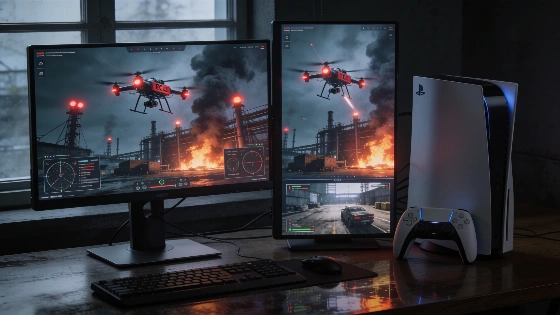
Anraga Studios and The Farm 51 have announced Rescue Drone Simulator Second Chance a narrative-driven rescue simulator set in a near-future crisis scenario with a focus on realistic drone operations and customisation for PC PlayStation 5 and Xbox Series X|S in 2027
When disaster strikes and human rescuers cannot reach the heart of the crisis, Rescue Drone Simulator: Second Chance aims to put players in the cockpit of the machines that step in. Anraga Studios and The Farm 51 have officially announced this story-driven rescue simulator, targeting a Q1 2027 release on PC, PlayStation 5, and Xbox Series X|S. The project promises a grounded take on near-future emergency response, where drones become the frontline tool for saving lives in environments too hazardous for people. According to Playfront, the announcement has been independently confirmed in German gaming media, which reiterated the same key release details, further validating the project's public reveal.
Confirmed features and campaign structure
Rescue Drone Simulator: Second Chance is built around a campaign of 20 missions, split across four acts and five maps, each with multiple weather variants. Players take on the role of an emergency drone operator, responding to fires, explosions, natural disasters, and missing-person cases. The game's structure is designed to test both technical skill and decision-making under pressure, with each mission requiring players to assess threats, select the right drone, and execute complex rescue operations in real time. As of September 16, 2026, the game is already listed as a new project on the Steam storefront, indicating active preparations for its release campaign and a public product page, as confirmed by SteamDB.
The title's "Second Chance" theme extends beyond the civilians being rescued. The in-game rescue unit is staffed by specialists who, due to injury, illness, or trauma, can no longer serve in traditional roles. Drone technology gives these characters a way to continue their life-saving work from a distance, leveraging their experience and instincts in a new form. This narrative thread is woven through the campaign, with the story penned by Artur Fojcik, known for his work on Chernobylite and Get Even. The Farm 51, as highlighted in prior coverage, has a track record of developing atmospheric, story-driven projects, reinforcing expectations for a strong narrative focus in this title.
Gameplay systems and technical detail
Unlike many drone games that offer only a floating camera, Rescue Drone Simulator: Second Chance simulates the physical realities of drone flight. Players must manage mass, inertia, thrust, aerodynamics, battery life, and environmental hazards such as wind and rain. Each drone's configuration-customised in the workshop between missions-directly affects its handling and durability. The game supports two control models: a Simulator mode for authentic drone physics and an Arcade mode with flight assistance for newcomers.
The player's fleet includes four distinct drones: a Rescue Drone for locating and aiding civilians, a Firefighting Drone for extinguishing blazes, a Police Drone for non-lethal crowd control, and an Interceptor Drone for neutralising hostile drones. Each machine offers a different playstyle and set of tools, from dropping medical kits to deploying smoke grenades or launching nets. Full customisation is available, with parts such as motors, propellers, batteries, and cooling systems affecting performance and flight time. According to CBS News New York, the operational use of drones in real-world emergency services is a growing trend, with drones already being deployed for rapid response in crisis situations, which aligns with the game's realistic approach to rescue scenarios.
Visual direction and audio identity
Rescue Drone Simulator: Second Chance deliberately avoids a sterile sci-fi look, instead drawing on the industrial and analogue aesthetics of the 1980s and 1990s. Art direction is led by Wojciech Pazdur, CEO and co-founder of The Farm 51, who also composes the game's music inspired by the era's soundscape. The visual and audio design aim to create a believable near-future world that feels tactile and human, rather than abstract or overly futuristic.
This approach sets the project apart from many contemporary simulation titles, grounding its technology in a world that feels both familiar and functional. The emphasis on physical control panels, analogue electronics, and industrial environments is intended to reinforce the sense of realism and operational tension throughout the campaign. The Farm 51's previous work on narrative-driven games such as Chernobylite further supports the expectation of a rich, immersive atmosphere.
Release timing and platform plan
Rescue Drone Simulator: Second Chance is scheduled for simultaneous release on PC (Steam), PlayStation 5, and Xbox Series X|S in the first quarter of 2027. Anraga Studios has confirmed that both controller and keyboard-and-mouse setups will be supported, with first- and third-person camera options and on-screen indicators for speed and wind. The game is being developed in Unreal Engine 5, and the studio's focus on drone-themed titles positions it within a growing niche of simulation experiences. The official announcement trailer has already been published on IGN's channel, which typically indicates the availability of press materials and confirms the project's public presentation beyond the initial press release.
The announcement follows a period of increased interest in realistic simulation games, as seen in recent coverage of other genre entries. However, Rescue Drone Simulator: Second Chance distinguishes itself through its narrative ambitions and its commitment to simulating the operational complexity of real-world drones. No pricing or edition details have been disclosed at this stage, and no public demo or beta has been announced. Playfront and other independent publications have also reported on the project, suggesting that the announcement has reached multiple media outlets and is not limited to a single PR channel.
In simulation games, the distinction between Arcade and Simulator modes is crucial for accessibility and authenticity. Arcade modes typically offer simplified controls and forgiving physics, allowing new players to engage without steep learning curves. Simulator modes, by contrast, aim to replicate the real-world behaviour of vehicles or equipment, demanding greater precision and understanding of technical systems. This dual approach enables a broader audience to experience the core gameplay while still providing depth for enthusiasts seeking a more challenging and realistic simulation.