
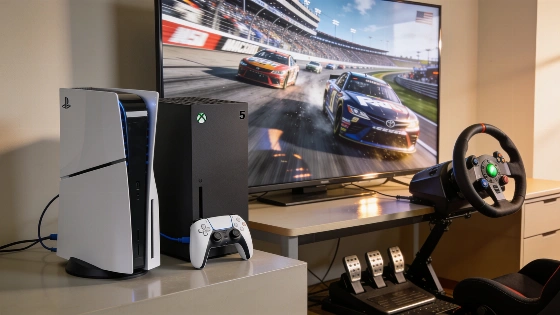
NASCAR 26, developed by iRacing Studios, has unveiled a new developer diary trailer detailing its revamped career mode, The Chase standalone mode, and technical upgrades ahead of its 18 September release on PlayStation 5, Xbox Series X|S and PC
Players eyeing the next big leap in console racing will find their expectations reset by the latest developer diary for NASCAR 26, which puts its overhauled career mode and the all-new The Chase mode front and centre. With a September 18 release date now locked for PlayStation 5, Xbox Series X|S and PC, iRacing Studios is making a direct play for authenticity and depth, promising a suite of features that go beyond the annual franchise churn.
Career Mode and The Chase
The headline change is a career mode that now demands weekly strategic planning, with decisions carrying forward across seasons and affecting both driver progression and team development. Facilities management and team upgrades are no longer background noise-they're core to how players shape their path through the four included NASCAR series. Meanwhile, The Chase arrives as a standalone, fully customisable mode, letting players fight for a championship over the final 10 races against a field of their choosing. This is not a simple ruleset toggle but a dedicated mode designed to replicate the high-stakes drama of the real-world playoff format.
For those who want to test their mettle, the new Peak Performance training mode offers structured challenges, while cross-platform multiplayer aims to break down the remaining barriers between console and PC racers. The developer diary, released on YouTube, showcases these systems in action but stops short of revealing every detail about progression or online matchmaking.
Technical and Gameplay Upgrades
Graphical improvements are visible in the trailer, with dynamic lighting, improved skies, and a revamped paint kit that should allow for more detailed customisation. The new dynamic track technology is pitched as a major step forward, with track conditions evolving over a race weekend and affecting grip, tyre wear, and strategy. Enhanced calibration tools and force feedback support are intended to give players more control fidelity, while the driving model itself has been reworked with new tyre and braking systems.
Driver AI is also being retooled, with side drafting and more realistic behaviour promised. The 750 HP package, improved particle effects for smoke and debris, and the addition of safety violations and DNFs (Did Not Finish) are all intended to bring the simulation closer to the real sport. Notably, the game adds new tracks such as the Qualcomm Circuit at Naval Base Coronado, Chicagoland, and St. Petersburg, expanding the series' circuit roster.
Release Details and Editions
NASCAR 26 will be available in two editions: Standard (£59.99/$59.99) and Gold (£79.99/$79.99), with Gold Edition buyers receiving three days of early access from 15 September, four monthly paint scheme DLC packs, 1,000 career mode rep points, and a $10,000 career bonus. The game features real drivers from the NASCAR Cup Series, O'Reilly Auto Parts Series, Craftsman Truck Series, and ARCA Menards Series, with Kyle Larson as the cover athlete. Cross-platform multiplayer is confirmed, but the extent of cross-progression and save transfer between platforms has not been detailed.
iRacing Studios, known for its simulation pedigree, is again collaborating directly with NASCAR to deliver what it claims is the most authentic console NASCAR experience to date. The developer's approach mirrors the kind of genre-specific innovation seen in other recent racing releases, as reported earlier in the context of real-time strategy hybrids. However, the real test will be whether these features deliver meaningful depth and replayability beyond the initial launch window.
What Remains Unclear
While the developer diary provides a broad overview, several key questions remain. The trailer does not confirm final performance targets for each platform, nor does it specify resolution modes or frame-rate caps. Details on online matchmaking, anti-cheat measures, and the robustness of cross-platform play are also absent. The impact of the new dynamic track system on actual gameplay balance and AI behaviour will only become clear once independent testing is possible.
Players considering a pre-order should note that, as with most annual sports releases, the real value of these features will depend on their implementation at launch and the quality of post-release support. The inclusion of safety violations and DNFs is a welcome nod to realism, but how these systems interact with progression and online competition is not yet fully explained.
NASCAR 26's developer diary signals a clear intent to move the franchise beyond incremental updates, but the absence of hands-on evidence means players should remain cautious. The promise of a more strategic, authentic, and technically advanced NASCAR experience is compelling, but only a full release and independent analysis will determine whether the game delivers on its ambitions. For now, the franchise's willingness to embrace deeper simulation and cross-platform play is a positive step, but the proof will be in the racing, not the marketing.
Dynamic track technology, as highlighted for NASCAR 26, refers to systems where the racing surface evolves during a session-rubber builds up, grip levels change, and weather or debris can alter the optimal racing line. This approach aims to replicate the unpredictability and tactical demands of real-world motorsport, requiring players to adapt their driving and strategy as conditions shift. While such systems have appeared in high-end PC simulations, their effectiveness on consoles depends on both technical implementation and how well AI and physics respond to changing track states. For players, this means that no two races should feel identical, provided the feature is robustly delivered.