

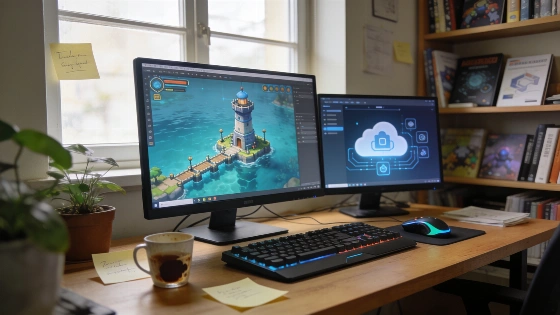
A solo developer behind Operation Octo has reported that Google's Gemini AI surfaced a confidential character name from their unreleased content, prompting new questions about how AI systems access and process private game development data
Concerns over artificial intelligence and digital privacy have intensified after an indie developer reported that Google's Gemini AI chatbot disclosed a highly specific, unreleased character name from their upcoming game. The incident, which surfaced through a Discord exchange, has highlighted the potential for AI systems to access information stored in private documents, even when such details have never been made public.
The Incident and Developer Response
Klub Kofta Studio, the solo developer behind the aquatic tower defence title Operation Octo, described how a player used Google's Gemini AI to ask about future content for the game. The AI responded with information that, according to the developer, should not have been accessible-most notably, the exact name of a new creature, 'Vantage Tripod'. Klub Kofta stated that this name had only ever existed within a private Google Doc and had not been shared on Discord, in-game, or through any public channel.
The developer provided screenshots of the Discord conversation, showing that even when the player used incognito mode, Gemini was able to surface the confidential name. Klub Kofta emphasised that the only digital record of 'Vantage Tripod' was in their own Google Drive, raising immediate questions about how the AI accessed such specific information.
Possible Explanations and Privacy Concerns
While the account remains unverified beyond the developer's own documentation, the situation has prompted speculation about the extent to which AI systems like Gemini may scan user files stored on Google Drive. Some Reddit users suggested that default settings might allow AI models to index Drive content for training or response generation, though this has not been independently confirmed. Klub Kofta maintained that the name was never mentioned in Discord chat history or any other public forum, and that a search of the server confirmed its absence prior to the AI's response.
This episode has reignited debate about the boundaries of AI data access, especially for developers working on unreleased projects. The risk of confidential material being surfaced by AI tools is particularly acute for smaller studios and solo creators, who may rely on mainstream cloud services for documentation and asset storage.
Implications for Game Development
The potential for AI chatbots to reveal private development details could have significant consequences for the industry. While large publishers often operate with strict internal controls and dedicated infrastructure, indie developers frequently use consumer cloud platforms for convenience and cost reasons. If AI systems can access and disclose information from these sources, the risk of unintentional leaks increases substantially.
With major releases such as Grand Theft Auto VI on the horizon, the incident serves as a timely reminder for studios of all sizes to review their data privacy settings and consider the implications of integrating AI-powered tools into their workflows. The situation also echoes broader concerns about how AI is reshaping the boundaries between public and private information in gaming and beyond. For those interested in how narrative integration can affect major franchises, a recent discussion on Final Fantasy VII's evolving storylines can be found in this analysis of Final Fantasy VII Revelation's approach to spin-off content.
What Remains Unclear
At present, there is no definitive evidence that Google's Gemini AI routinely scans private Google Drive files for use in chatbot responses, nor has Google issued a statement addressing this specific case. The incident remains based on a single developer's report, and alternative explanations-such as accidental exposure or coincidental naming-cannot be entirely ruled out. However, the specificity of the leak and the developer's insistence on the name's secrecy have made this a focal point for ongoing discussion about AI and digital privacy in game development.
Understanding how AI systems interact with user data is increasingly important for developers and players alike. Many AI-powered tools rely on large-scale data ingestion to improve their responses, but the mechanisms for data access, consent, and privacy protection are not always transparent. For game creators, especially those using cloud-based services, it is essential to review platform settings and stay informed about how their information might be processed or surfaced by emerging AI technologies.