
Epic is shifting developers toward AI as Sweeney predicts most game-development work could reach at least three times its January 2026 efficiency by next year. The forecast is ambitious, and current gains vary sharply by task.
Epic is moving developers into new roles to speed the adoption of artificial intelligence. CEO Tim Sweeney says the goal is to help staff make more content and improve its quality, rather than produce the same games with fewer employees. The Straits Times reported that teams using Unreal Engine are also meant to benefit from the tools.
AI as a production tool
Sweeney described the reshuffle on X as a way to accelerate AI adoption across Epic. The company also wants developers outside its studios who use Unreal Engine to gain access to the tools. That puts AI on the engine's future production roadmap, not just inside Epic's own workflow.
The productivity figures so far vary sharply. Sweeney cited gains of about 20 per cent in some technically demanding Unreal Engine work, compared with five times the efficiency in areas such as web development. He expects very little game-development work to fall short of three times January 2026 efficiency by this time next year. That is a forecast, not evidence that every discipline or project will improve at the same rate.
Separate reporting concerns an unnamed shooter based on Marvel and Star Wars properties owned by Disney. Bloomberg reported that Epic had shifted the project to an AI-first workflow, with generative tools including Claude intended for code and graphics. The game has reportedly faced delays and staffing shortages. Bloomberg also reviewed internal instructions that reportedly called for no further manually written code. The instructions said art assets should be made through an AI-oriented process.
Those reported directions apply to that project. They are not a public company-wide policy. Epic has not disclosed the game's official title or release date. It has also not released a full public design document.
Epic's spokesperson said the company is adopting accelerated AI development while employees remain the authors and set the project's creative direction, Ars Technica reported. That position sits alongside Bloomberg's account of the project instructions. It does not show that AI-assisted production has improved the game or cleared its reported delays.
Earlier playtesting
Sweeney's creative case for AI centers on the time between an idea and a playable prototype. He argues that some recent AAA failures spent too much of development building game systems before teams could test them. Earlier playtests could expose weak mechanics sooner, giving developers more time to change or abandon those ideas.
That is a more concrete claim than simply speeding up asset production. But there are no project-level results showing that AI has already improved Epic's own games. Faster prototyping can create more chances to test ideas; it cannot establish that the ideas work or that the finished game will be better.
Unreal Engine's next steps
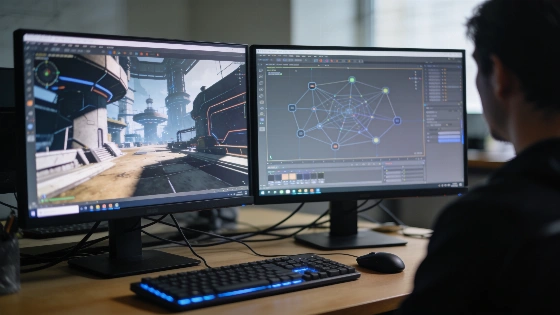
Epic has begun connecting AI systems to its engine. Unreal Engine 5.8 is planned to include an experimental Model Context Protocol plugin, which can link large language models with engine systems. It can connect to Blueprints and assets. It can also work with levels and materials. Meshes are included too.
The plugin will not be enabled by default. Its inclusion does not mean Epic has finished building an AI workflow or made one mandatory.
Epic has described this integration as important to Unreal Engine 6, where language-model tools are intended to play a central role. The company has said UE6 is expected to integrate models including Claude and Gemini, with the aim of cutting routine work and improving team productivity. Those are plans for a future engine, not confirmed results from commercial games. Early access is targeted for the end of 2027. Epic expects the full release 12 to 18 months later, though both dates remain part of its current plan.
This is a production strategy, not a player-facing launch such as No Man's Sky on iPhone. Epic has not announced a new game or feature for players to use today.
Ambition and resistance
Sweeney rejected a follower's suggestion that the reshuffle was preparation for an IPO. He said Epic's stated aim was to get through the AI transition and help other developers do the same. A solo developer criticized his reading of community sentiment, reflecting objections to AI among some players and creators. Sweeney responded that the industry must build for current and coming conditions, and argued that AI can empower creators.
He also predicted that games made with AI assistance will account for at least 90 per cent of total playtime in about a year. That is his expectation, not a verified industry measurement. The source does not define how much AI involvement would qualify a game for that category.