
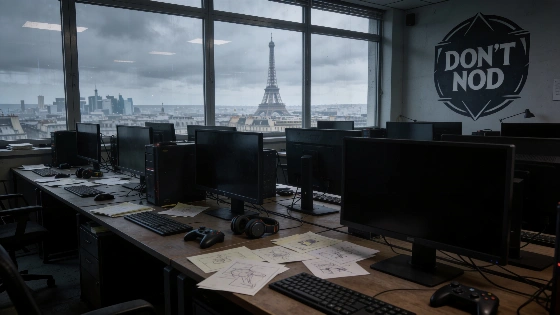
DON'T NOD has issued a stark warning about its future, revealing plans to cut up to 90 jobs and admitting it may not survive beyond January 2027 after the commercial failure of Aphelion and a sharp drop in revenue
DON'T NOD, the French studio behind Life is Strange, has openly acknowledged that it may not remain operational beyond January 2027 unless it secures new funding. The company's latest financial update leaves little room for optimism, with management confirming plans to cut up to 90 jobs and warning of "material uncertainty" over its ability to continue trading.
Financial Collapse and Job Losses
The studio's financial position has deteriorated rapidly. For the first half of 2026, DON'T NOD reported revenue of €6.1 million, down 14% from the previous year's already modest €7 million. However, the real damage is visible when capitalised production costs are excluded: total operating revenue plummeted by 56%, from €13.9 million to €6.1 million, as the studio recognised no capitalised costs for the period. This collapse is directly linked to the disastrous launch of Aphelion, which reportedly sold only a few thousand units on Steam, and the failure of an unannounced project codenamed P14 to meet internal funding criteria.
Cash reserves have been draining at an alarming rate. At the end of June 2026, DON'T NOD held €9.8 million in gross cash, which fell to €8 million by the end of July. This is a stark contrast to the €15.4 million reported at the close of 2025. The company has now confirmed that up to 90 jobs in France are at risk as part of a restructuring effort aimed at reducing costs and consolidating operations.
Strategic Shift and Project Pipeline
In response to its worsening outlook, DON'T NOD is abandoning its previous approach of running multiple parallel projects. The studio will now focus its French operations on a single production line, aiming to concentrate expertise and maintain a more sustainable project pipeline. Between 2023 and 2026, DON'T NOD released five games, but none achieved the commercial breakthrough needed to stabilise the business. Recent titles such as Vampyr, Tell Me Why, Twin Mirror, and Banishers: Ghosts of New Eden received positive critical attention but failed to deliver significant sales. Lost Records: Bloom & Rage, released last year, contributed only partial revenue from PS Plus and Game Pass deals, with little impact from retail sales.
Previous rounds of cost-cutting and restructuring have not been enough to restore competitiveness. The company's latest filing makes clear that further changes are inevitable if it is to survive. Management is now exploring all available legal and operational options, including further restructuring, asset sales, or external financing arrangements.
Dependence on External Funding
The most immediate threat to DON'T NOD's future is its reliance on securing new external funding. The company has stated that its ability to continue operations and develop new projects depends on attracting outside investment in the coming months. Without this, the studio's future beyond January 2027 is in serious doubt. The warning is explicit: unless new capital is found, DON'T NOD may not be able to meet its obligations or maintain its development pipeline.
For players, this means that the fate of one of France's most recognisable narrative-driven studios now hangs on the outcome of urgent financial negotiations. The possibility that Aphelion could be the last game released by DON'T NOD is no longer theoretical-it is a scenario the company itself has raised in official documentation.
What This Means for Players and the Industry
DON'T NOD's predicament is a direct result of repeated commercial underperformance, not a sudden market shift or external shock. The studio's reputation for narrative-driven experiences remains strong among critics, but critical acclaim has not translated into the sales needed to sustain a mid-sized independent developer. The decision to consolidate around a single production line is a belated but necessary correction after years of overextension. The reality is that, in today's market, even established studios with a history of creative success are not insulated from financial collapse if their games fail to find a large enough audience. DON'T NOD's future now depends on whether it can convince investors that its next project will break the cycle of disappointment. If it cannot, the studio risks joining the growing list of respected developers forced out of the industry by commercial realities.
To understand the significance of DON'T NOD's warning, it helps to know how capitalised production costs work in game development. Studios often record the costs of developing a game as an asset on their balance sheet, spreading the expense over the expected life of the project. When a studio stops capitalising these costs-either because a project fails to meet funding criteria or because it is cancelled-reported revenue can drop sharply, exposing the true scale of financial strain. This accounting shift is not just a technicality; it is a visible sign that a studio's development pipeline is in trouble and that future releases are at risk.